Eurostar Travel Guide: Everything You Need to Know
I’ve taken Eurostar more times than I can count — a solo weekend in Paris, a work trip to Brussels, a longer run up to Amsterdam with a friend. Each time I’m reminded how good this train actually is: you leave central London and arrive in the middle of Paris or Brussels without a single airport involved. No security theatre with liquids, no bus to a remote terminal, no circling above Charles de Gaulle. Just a train.
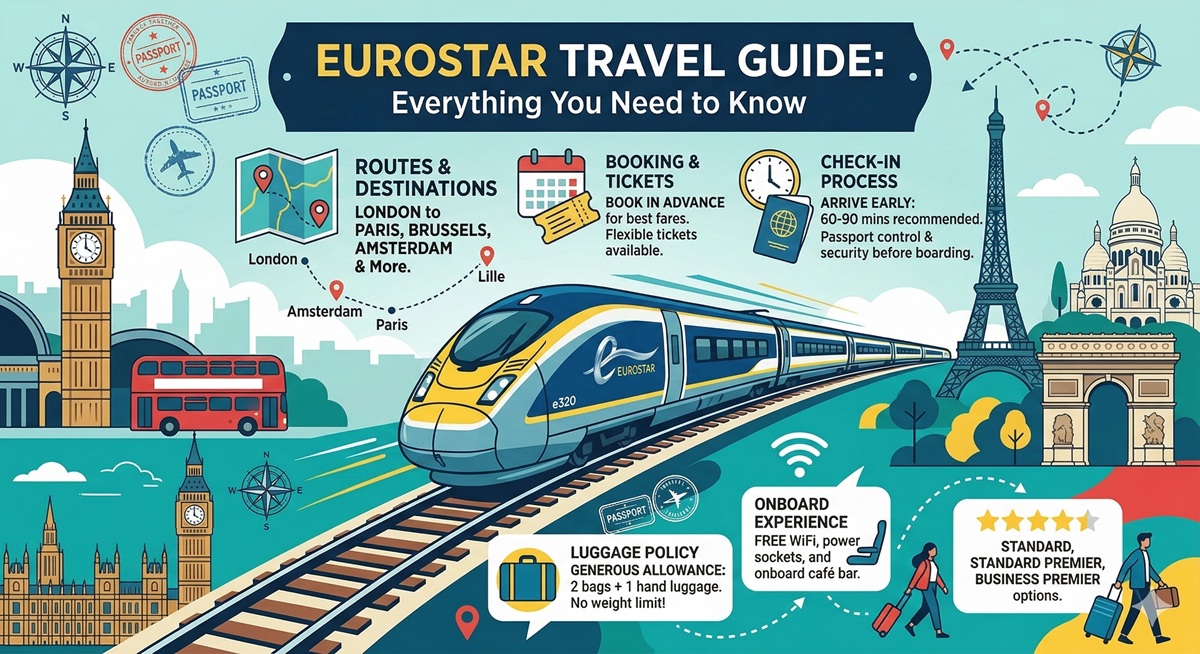
This guide covers everything you need before you book: the routes and journey times, how to find a cheap ticket, what the seat classes are actually like, what happens at St Pancras on the day, and what to expect on board.
Quick facts:
| Route | Journey time | Frequency | Cheapest advance fare |
|---|---|---|---|
| London St Pancras → Paris Gare du Nord | 2h 16m | Up to 18 trains/day | From £39 one way (return booking) |
| London St Pancras → Brussels-Midi | 1h 51m | Up to 10 trains/day | From £39 one way (return booking) |
| London St Pancras → Amsterdam Centraal | 3h 41m | Up to 3 trains/day | From £39 one way (return booking) |
| London St Pancras → Lille Europe | 1h 20m | Several per day | From ~£29 one way |
The Routes
London to Paris
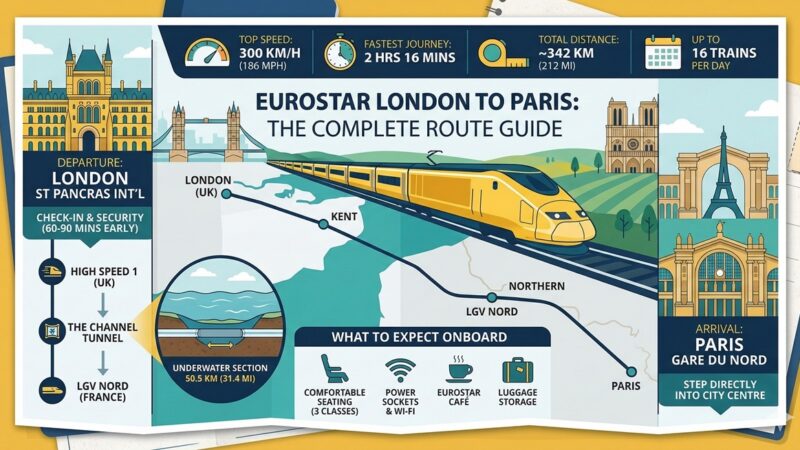
The flagship route. London St Pancras to Paris Gare du Nord in 2 hours 16 minutes, with up to 18 departures a day. The tunnel crossing takes about 20 minutes and happens in the middle portion of the journey — you won’t even notice it unless you’re watching the window, where the light simply drops away.
Gare du Nord is central Paris, a short Metro ride from anywhere you’d want to be. Compare that to flying into Charles de Gaulle — 45 minutes on the RER B on a good day, longer if you’re heading to the Left Bank or central arrondissements. City centre to city centre, Eurostar wins the time comparison decisively on the Paris route.
For more on what to do when you get there, see our Paris sights and travel tips guide.
A full breakdown of the route, tips on seats, and what to expect at each end is in the Eurostar London to Paris guide.
London to Brussels
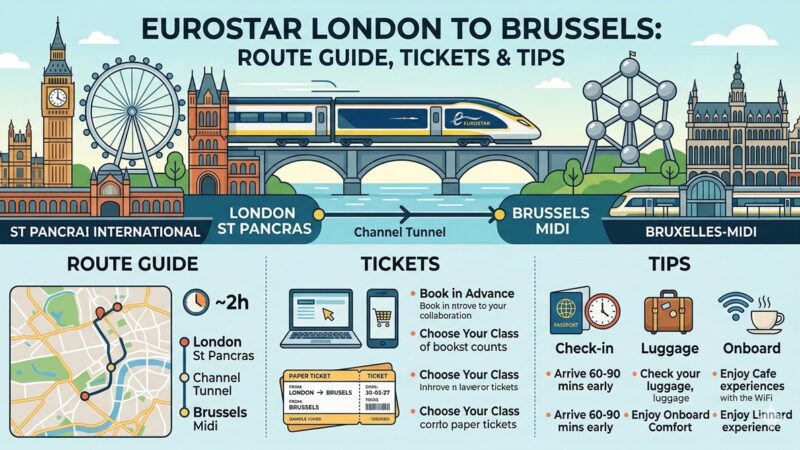
Brussels-Midi in 1 hour 51 minutes — the shortest of the main international routes. Brussels is often overlooked by travellers who go straight to Paris, which is a shame. The food is exceptional, the beer list is staggering, and the city has a genuine character that’s hard to place anywhere else.
From Brussels-Midi, the central districts are easily walkable or a short Metro ride. Belgium’s own high-speed rail network fans out from here to Bruges, Ghent, and Antwerp, which makes Brussels a useful base for exploring the country by train.
Full details in the Eurostar London to Brussels guide.
London to Amsterdam
The direct London to Amsterdam service launched in 2023 and changed the equation for that route entirely. The journey takes 3 hours 41 minutes, and you travel without a change. Before the direct service existed, you had to change at Brussels — useful to know if you find a cheap indirect routing.
Amsterdam Centraal is, naturally, right in the centre of the city. Trams and the metro fan out directly from the station. The outward check-in at St Pancras includes Dutch passport control before you board, which adds a little time but means you clear immigration before you depart rather than on arrival.
The Eurostar London to Amsterdam guide covers the full picture including the passport control process and onward connections.
Other Routes
Eurostar also serves Lille (1h 20m from London), which is useful if you want a cheap city break in northern France or a jumping-off point for the wider region. Seasonal services have included direct trains to the South of France (Avignon, Marseille) in summer months — worth checking when you book if that’s your destination.
Tickets: What to Know Before You Book
Eurostar tickets are cheapest when booked well in advance and expensive when bought last-minute. The pricing logic is similar to airline dynamic pricing: the cheapest fares go on sale months ahead and sell through quickly, with prices rising as the train fills.
As a rough guide:
- Advance fares: from £39 one way (Eurostar’s advertised fare, return booking only) to Paris or Brussels, often £60–80 for a realistic outward date with flexibility on timing
- Semi-flexible / anytime: £100–200+ one way
- Premier: around £325 one way (about £490 return)
The single biggest lever on price is how far ahead you book. I’ve found that 6–10 weeks out hits a reasonable sweet spot between availability and price. Within two to three weeks of travel, you’re generally paying significantly more. Fridays and Sundays carry a premium over midweek departures.
Book direct at eurostar.com for the full seat selection and simplest cancellation process. Third-party booking sites sometimes show cheaper prices, but verify what you’re actually buying — some add booking fees or restrict changes.
Eurostar also has a loyalty programme, Club Eurostar, which is worth joining if you travel regularly.
Booking a hotel as well? It’s worth pricing a train + hotel package before you book the two separately. lastminute.com’s Eurostar city breaks bundle the train and a hotel in Paris, Brussels or Amsterdam, and on some dates the package comes in cheaper than buying each on its own. On others it doesn’t, so compare both. One catch: changes to a package follow lastminute.com’s terms, not Eurostar’s free exchange rules.
Seat Classes
Eurostar has three classes. They’re more meaningfully different from each other than airline equivalents at the same level.
Standard is the base class. It’s a proper, comfortable seat — comparable to a good domestic train rather than an economy airline seat. You get a table or an airline-style tray, a power socket, and two bags included with no weight limit and no liquids restriction. For a 2-hour journey, it’s genuinely fine.
Plus (formerly Standard Premier) adds a light meal and drinks served at your seat on London routes, and on the e320 trains a roomier 2+1 seat instead of Standard’s 2+2. On Paris trains, Plus is often worth paying for on a morning or evening departure when you’d otherwise be eating a sandwich.
Premier (formerly Business Premier) is the top tier: fine dining at your seat, lounge access in London, Paris and Brussels, priority gates, three bags instead of two, and fully flexible tickets you can exchange or refund free up to two days after departure. On the e320 the seat itself is the same as Plus. It’s expensive — typically £300–400 one way — but the lounges, the flexibility, and the boarding process genuinely justify it for regular business travellers.
A full comparison of all three classes, including photos, food, and what’s worth paying for, is in the Eurostar seat classes guide.
Check-In and Boarding at St Pancras
St Pancras International is the UK departure point for all Eurostar services. The international terminal is a distinct section of the station — follow signs from the main concourse.
Eurostar recommends arriving at least 30 minutes before departure, but in practice 45–60 minutes is more comfortable, especially if you have luggage or are travelling with children. The process:
- Check in at the automated gates or the staffed desks using your ticket or e-ticket QR code
- UK passport control — this is a real border crossing; non-EEA/non-UK passports may be checked more carefully
- Security — airport-style X-ray and metal detector. No liquids restriction (unlike airports), but bags go through
- French or Belgian border control — you clear EU immigration before you board in London, not on arrival
- Departure lounge — seating, shops, a bar, and the Eurostar lounges if you have Premier or a lounge pass
- Boarding — called by carriage number
The dual passport control (UK exit + EU entry) is the thing that catches first-time travellers out. Allow time for it. Queues at French and Belgian border control can be slow during school holidays and busy summer periods.
A full walkthrough of what to expect is in the Eurostar check-in guide.
Baggage
This is where Eurostar beats flying most clearly. You get two bags plus a small hand luggage item, with no weight limit and no liquids restriction on Standard and Plus. Premier gets three bags.
No 100 ml rule. No weighing your bag at check-in. A full case of wine, a large suitcase, a child’s car seat — all fine within the rules. The only condition: you must be able to lift and stow your bags yourself.
The full rules — including bikes, prams, oversized items, and customs — are in the Eurostar baggage allowance guide.
Food and Drink On Board
There’s a bar buffet car on all trains. On Standard tickets, that’s where you get food — sandwiches, snacks, hot drinks, beer and wine. It’s serviceable rather than exciting, but it does the job for a 2-hour journey.
Plus and Premier both include food at your seat on London routes. Plus gets a light meal (a choice of two dishes) with drinks; Premier gets a fuller fine-dining menu. It’s one of the clearest practical differences from Standard, where you buy from Eurostar Café.
The full guide to what’s on offer, including what to expect in each class, is in the food on Eurostar guide.
On Board: What the Journey Is Like
The trains are double-decked — you board on the lower level and can sit on either deck. Upper deck windows are better for views but the ride quality is the same. Seats run in standard airline-style rows on Standard, and in a more open, table-configuration on Premier.
Wi-fi is available but inconsistent. It tends to work reasonably well through northern France and Belgium, drops in the tunnel (obviously — you’re under the sea), and can be patchy near London. Don’t rely on it for anything time-critical.
Power sockets are at every seat. Bring a European adapter if you have a two-pin UK plug, though most modern USB-C cables plug directly into the socket type provided.
The journey through northern France is mostly flat agricultural land. It’s not the most visually exciting landscape, but the time passes quickly. By the time the pace slows and Paris’s outer suburbs appear, you’ve barely been on the train for two hours.
Staying Near St Pancras
If you have an early departure — the first trains leave London before 7am — staying near St Pancras the night before is worth considering. King’s Cross and St Pancras are surrounded by hotels at every price point, from budget chains to the St. Pancras London, Autograph Collection (formerly the St Pancras Renaissance) in the original station building.
A full rundown of options, including which are genuinely walking distance from the terminal and which hotels offer good value for the area, is in our hotels near St Pancras guide.
Eurostar vs Flying to Paris: The Real Comparison
On the London to Paris route, Eurostar is faster city centre to city centre — and that’s before factoring in airport check-in time. Flying to CDG means:
- Getting to Heathrow or Gatwick (45–90 min from central London)
- Arriving 2 hours before departure for international flights
- 1h 15m flight
- CDG arrivals, then 45–60 min on the RER B to central Paris (longer if you’re in Zone 1 traffic)
Total door-to-door time: 5–6 hours on a typical day.
On Eurostar: 45 minutes to St Pancras, 45–60 minutes before departure, 2h 16m train. Door-to-door: roughly 3h 30–4 hours. And you arrive at the centre of Paris, not in the suburbs.
The cost comparison is closer. A return flight to Paris can be found cheaply — £50–80 return on Ryanair or easyJet, before bags. Add a hold bag (both carriers charge for it), airport transfers, and the time cost, and Eurostar at £80–120 return in advance often competes favourably. At peak times, Eurostar is sometimes cheaper outright.
For a wider view of France beyond Paris, see our France travel guide.
Practical Tips
Book early for the best prices. The cheapest Eurostar fares go quickly, and prices rise steadily as the departure date approaches. If you know your dates, book as soon as they go on sale.
Choose your seats. When you book direct with Eurostar, seat selection is free. On the Paris route, seats on the right side of the train (from London) tend to get morning sun heading out. Window seats in upper deck give a slightly better view.
Build in 60 minutes at St Pancras. Especially during school holidays, the dual passport control queues can be long. 30 minutes is the official minimum; 60 minutes is realistic comfort.
Weekday departures are cheaper. Friday and Sunday trains carry a premium because everyone wants them. Tuesday and Wednesday departures are almost always cheaper.
Get the Eurostar app. Your ticket lives there, boarding pass is available offline, and real-time departure updates are useful.
You don’t need a European plug adapter for the journey. Power sockets on board vary — some trains have UK three-pin, some have European two-pin. A universal travel adapter is safest. Once you’re in France or Belgium, you’ll need one; our EU plug adapter guide covers what you need.
Frequently Asked Questions
Is Eurostar faster than flying to Paris?
City centre to city centre, yes. The Eurostar journey (including check-in time) typically takes under 4 hours door-to-door from central London to central Paris. Flying, including airport transfers, takes 5–6 hours.
How much does Eurostar cost?
Advance Standard fares start from £39 one way (Eurostar’s advertised fare, return booking only). A realistic advance return for Paris typically runs £80–150. Premier is around £325 one way. Prices depend heavily on how far ahead you book and which day you travel.
Do I need a passport for Eurostar?
Yes. Eurostar crosses an international border. You go through UK and EU passport control at St Pancras before boarding. Your passport (or, for EU citizens, national ID card) is required.
Can I take luggage on Eurostar?
Standard tickets include two bags plus hand luggage, with no weight limit and no liquids restriction. Premier includes three bags. See the Eurostar baggage allowance guide for full details.
Where do I board Eurostar in London?
St Pancras International, King’s Cross. The Eurostar international terminal is signposted from the main station entrance. There’s no Eurostar service from any other London station.
Does Eurostar go to Amsterdam direct?
Yes — direct London to Amsterdam trains run up to three times daily, with a journey time of 3 hours 41 minutes. You clear Dutch passport control at St Pancras before departure.