Eurostar London to Brussels: Route Guide, Tickets & Tips
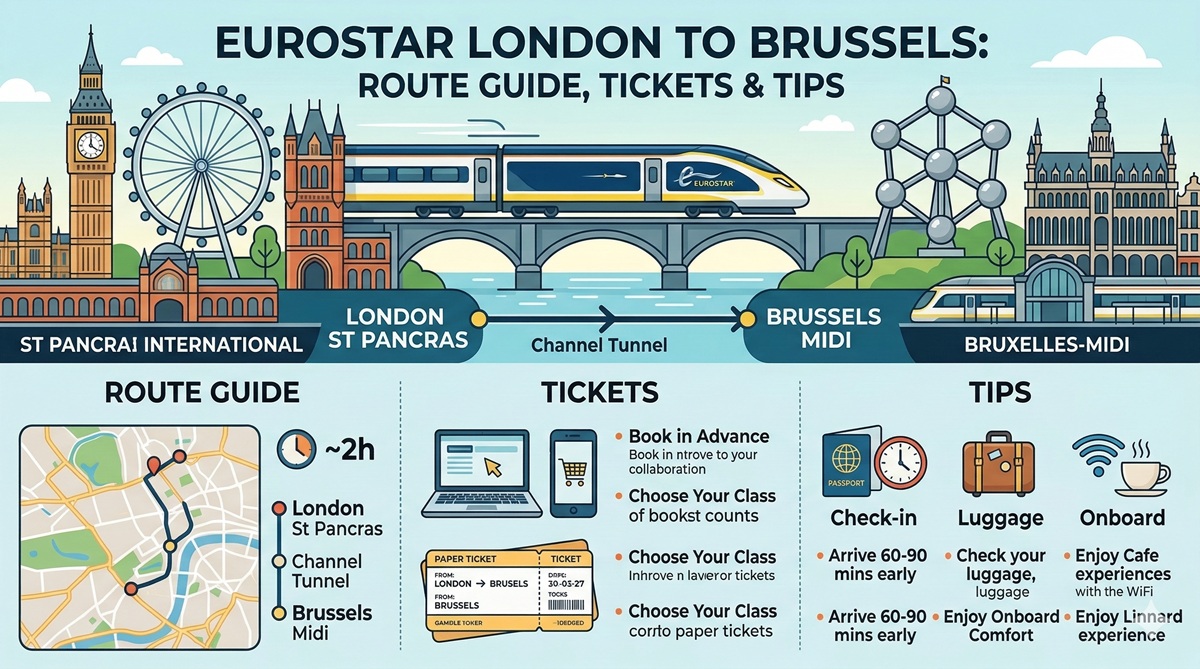
Brussels gets less attention than Paris, partly because it has no single landmark that sells it the way the Eiffel Tower sells Paris. It is still one of the best cities in Europe for eating and drinking, it has a medieval centre worth walking round, and the journey from London is the shortest of Eurostar’s three main routes: 1 hour 53 minutes, with no changes.
That makes it an easy long weekend. Leave London on a Friday morning and you can be in the city centre by lunchtime.
Quick facts:
| Departure station | London St Pancras International |
| Arrival station | Brussels-Midi (Bruxelles-Midi / Brussel-Zuid) |
| Journey time | 1 hour 53 minutes |
| Frequency | Up to 10 trains daily |
| Cheapest advance fare | From £39 one way (return booking) |
| Typical advance return | £80–140 |
The Journey
The train follows the same line as the Paris service through Kent and the Channel Tunnel. On the French side it heads northeast rather than south, calling at Lille (where some passengers get on or off) before running east across the flat Belgian countryside into Brussels.
The tunnel crossing takes about 20 minutes and comes roughly in the middle of the trip. Mobile signal drops out briefly and comes back once you’re in France. On a journey this short, a coffee from the Eurostar Café and something to read is usually all you need.
Brussels-Midi: Arriving and Getting Around
Brussels-Midi (Bruxelles-Midi in French, Brussel-Zuid in Dutch) is where international trains arrive in Brussels and is one of the busiest stations in Belgium.
The streets immediately around the station are not the Brussels you came for, so don’t judge the city by your first five minutes outside.
Getting from Brussels-Midi to the centre:
- Metro/Premetro: Brussels-Midi is served by metro lines 2 and 6 and by premetro (underground tram) lines 3 and 4. For the Grand Place, take the premetro north to Bourse, a few stops away; metro lines 2 and 6 run around the inner ring instead. A single Brupass ticket costs €2.70 (€2.40 if you tap a contactless bank card, capped at €8.50 a day); a 10-journey card is €18.90.
- Train: A local train from Brussels-Midi to Brussels-Central, the station nearest the old town, takes a few minutes. Useful if your hotel is in that direction.
- Taxi/Uber: A taxi from Brussels-Midi to the Grand Place or Ixelles typically costs €12–18. Uber also operates in Brussels. Use the official taxi rank outside the station rather than anyone touting for fares inside.
- Walking: The city centre is about 25 minutes on foot from Brussels-Midi via the Rue du Midi, which is easy if you’re travelling light.
What to Do in Brussels
Many visitors use Brussels as a base for Bruges and Ghent, both easy day trips by train, but the city itself is worth at least a couple of days.
The Grand Place is one of the finest town squares in Europe, lined with ornate guild houses and the Gothic town hall. It’s quieter early in the morning, and the buildings are lit up in the evening.
Belgian food is the main reason to go: mussels and frites at a proper brasserie rather than a tourist-trap imitation, waffles from a street stall, chocolate from the many artisan shops in the centre, and beer. Belgium brews well over a thousand different beers, and the specialist beer cafés in Brussels stock a large share of them.
The Comic Strip Museum (Musée Belge de la Bande Dessinée) is worth a visit even if you don’t read comics. It covers Tintin, the Smurfs and the wider Belgian tradition of bande dessinée, in a converted Art Nouveau department store.
Ixelles and Saint-Gilles are the neighbourhoods to wander for restaurants, independent shops and a sense of where people in Brussels actually live. Brussels was central to the Art Nouveau movement, and some of the best examples of it are in these two districts.
Tickets for London to Brussels
London–Brussels fares follow the same dynamic pricing as every Eurostar route: cheapest well in advance, more expensive as departure gets closer.
- Standard advance: from £39 one way (Eurostar’s advertised fare, return booking only); a typical advance return is £80–140
- Plus (formerly Standard Premier): from about £98 one way in advance; includes a light meal and drinks at your seat
- Premier (formerly Business Premier): around £325 one way (£490 return); fully flexible tickets and lounge access
The Brussels route tends to be less in demand than Paris, so cheaper seats can sometimes still be found closer to departure than on equivalent Paris trains. Friday evenings and Sunday afternoons still cost more.
Booking a hotel as well? Price a train and hotel package before booking the two separately. lastminute.com’s Eurostar city breaks bundle the train with a hotel in Brussels, and on some dates the package is cheaper than buying each on its own. On others it isn’t, so compare both. One catch: changes to a package follow lastminute.com’s terms, not Eurostar’s free exchange rules.
For more on fares, booking windows and finding the best prices, see the Eurostar tickets guide.
Seat Classes
All three Eurostar classes, Standard, Plus and Premier, run on the London–Brussels route. On a 1h 53m journey Standard is perfectly adequate; the Plus meal is pleasant, but there’s less time to enjoy it than on the Paris run.
For a full comparison of what each class includes, see the Eurostar seat classes guide.
Check-In at St Pancras
Check-in for Brussels works exactly as it does for Paris: ticket gates, security, a UK exit check and then the Schengen entry check, which French border police carry out at St Pancras on behalf of Belgium too. Eurostar recommends arriving 75 minutes before departure for Standard and Plus, and the gates close 30 minutes before. Coming back from Brussels-Midi, the recommendation is 45–60 minutes.
On a busy day the entry check is where queues build up, and how long it takes varies a lot from one period to the next.
Full walkthrough in the Eurostar check-in guide.
Baggage
Standard and Plus tickets include two bags plus a hand-luggage item, with no weight limit and no liquids restriction. Premier allows three bags. Details are in the Eurostar baggage allowance guide.
Brussels as a Rail Hub
Belgium’s rail network makes Brussels a practical base. From Brussels-Midi or Brussels-Central:
- Bruges: about an hour. The medieval canal city is one of Belgium’s most visited places and an easy day trip from Brussels, or a base in its own right if you prefer it.
- Ghent: around half an hour. A university city with well-preserved medieval architecture, less polished for tourists than Bruges.
- Antwerp: under an hour. Belgium’s second city, with a strong café culture and a fine historic centre.
- Liège: about an hour. Less visited, with Romanesque architecture and a good food scene.
- Onwards to France, Germany and the Netherlands: Paris Gare du Nord is about 1h 22m from Brussels-Midi on Eurostar (the former Thalys service), and Amsterdam is just under two hours on Eurostar, or a little over two hours on the slower direct trains. You can link up a longer European trip from here without flying.
Practical Tips
Don’t hang around Brussels-Midi. The area isn’t dangerous, but it isn’t pleasant either. Take the premetro a few stops into the centre.
You don’t need to book Belgian domestic trains early. Unlike Eurostar, Belgian domestic tickets aren’t dynamically priced, so a Bruges day trip costs the same whenever you buy it. Trains can be crowded on summer weekends. Check times on the SNCB/NMBS website (Belgium’s national rail operator).
Walk one street back from the Grand Place to eat. Brussels has restaurants at every price level, and those on the main tourist streets around the square are rarely the best value.
Beer cafés are not pubs. In a Brussels beer café you sit down, order from a long list (the staff will help you choose) and drink slowly. A 33cl Belgian strong ale is often 8–12% ABV, so pace yourself.
Day trips work well on a long weekend. Arrive on Friday, spend Saturday in Bruges and come home on Sunday.
Frequently Asked Questions
How long is the Eurostar from London to Brussels?
1 hour 53 minutes, the shortest of Eurostar’s three main international routes.
How much is the Eurostar to Brussels?
Standard advance fares start from £39 one way (Eurostar’s advertised fare, return booking only). A typical advance return is £80–140. Premier is around £325 one way.
Which station does Eurostar arrive at in Brussels?
Brussels-Midi (Bruxelles-Midi in French, Brussel-Zuid in Dutch). Local trains, the metro, premetro trams and taxis connect it with the city centre.
Do I need to go through passport control for Brussels on Eurostar?
Yes. You clear both UK exit and Schengen entry passport control at St Pancras before boarding. Belgium is in the Schengen Area, and UK passport holders can visit for up to 90 days without a visa.
Is Brussels worth visiting for a weekend?
Yes. The food and beer alone justify it, and the Grand Place, the Art Nouveau architecture and the easy day trips to Bruges and Ghent make it one of the better short breaks in Europe.
For the full picture on taking Eurostar, including routes, tickets, classes and baggage, see the Eurostar travel guide.