Eurostar Seat Classes: Standard vs Plus vs Premier
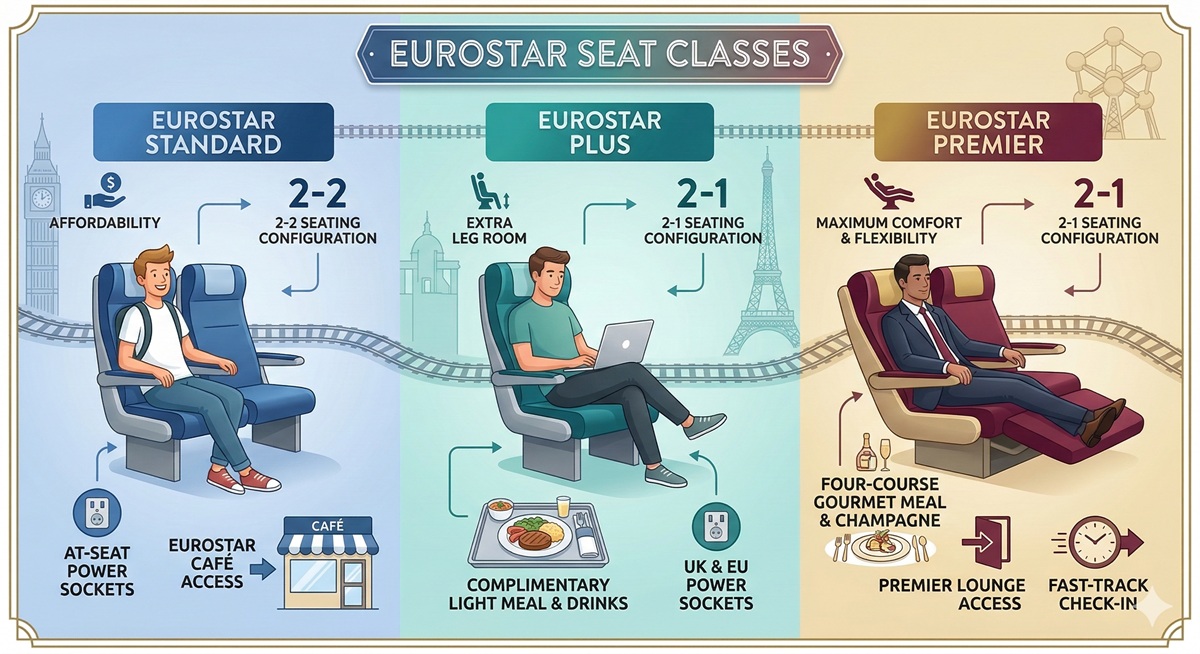
One of the questions I get asked most about Eurostar is whether it’s worth upgrading from Standard. The answer depends on what you’re paying and when you’re travelling — but unlike most airlines, where the gap between economy and business class is mostly space and a slightly wider seat, Eurostar’s class differences centre on the meal service. And on a 2-hour train, that actually matters.
Eurostar renamed its classes a couple of years ago: Standard Premier is now Eurostar Plus, and Business Premier is now Eurostar Premier. Plenty of sites still use the old names, so if you see them, that’s what they mean.
Here’s what each class includes, what it costs, and when upgrading makes sense.
The Three Classes at a Glance
| Standard | Plus (formerly Standard Premier) | Premier (formerly Business Premier) | |
|---|---|---|---|
| Seat | 2+2 seating | Roomier 2+1 seating | Same 2+1 seats as Plus |
| Food included | No — buy from Eurostar Café | Light meal and drinks at your seat | Fine dining and drinks at your seat |
| Bags | 2 bags + hand luggage | 2 bags + hand luggage | 3 bags + hand luggage |
| Lounge access | No | No | Yes (London, Paris, Brussels) |
| Exchanges | Free up to 1 hour before departure (pay any fare difference) | Free up to 1 hour before departure (pay any fare difference) | Free, up to 2 days after departure |
| Refunds | Up to 7 days before departure, £25 fee | Up to 7 days before departure, £25 fee | Free, up to 2 days after departure |
| Priority lane and same-day boarding guarantee | No | No | Yes |
| Typical advance price | From £39 one way (return booking) | From ~£98 one way | Around £325 one way |
Ticket terms are from Eurostar’s help centre. Prices move constantly, so treat them as a guide.
Standard Class
Standard is Eurostar’s base class. The seats are comfortable — wider and more upright than an economy airline seat, arranged 2+2 with a fold-down tray table or a fixed table on table-seat configurations. Every seat has a power socket. Legroom is reasonable for a two-hour journey.
What you don’t get: no included food and no lounge access. For food and drink, you use Eurostar Café, the bar car that runs on every train and sells sandwiches, snacks, hot drinks and alcohol.
Standard is more flexible than most people expect. You can exchange a Standard ticket with no fee up to an hour before departure, paying only the difference if the new train costs more, and you can get a refund up to 7 days before departure for a £25 fee.
The Standard baggage allowance is two bags plus a small hand luggage item (handbag, laptop bag, small daypack), with no weight limit and no 100 ml liquids rule. This is better than the baggage policy of any comparable budget airline. See the Eurostar baggage allowance guide for the full rules.
When Standard makes sense: Any trip where you’re content to sort your own food and want to pay the least. For a two-hour Paris trip on a budget, Standard is entirely adequate.
Typical Standard prices:
- Cheapest advance: from £39 one way (Eurostar’s advertised fare, return booking only)
- Realistic advance (6 weeks out): £55–90 one way
- Short notice: £100–180 one way
Eurostar Plus (formerly Standard Premier)
Plus is the middle class, and for most leisure trips it’s the one worth looking at.
The seat: On the e320 trains that run most London services, Plus coaches have 2+1 seating instead of Standard’s 2+2, so you get a wider seat and more elbow room. They’re the same seats Premier passengers sit in.
The food: A light meal and drinks served at your seat on journeys to and from London. You choose from two dishes — breakfast on morning trains, bowl food later in the day — with hot and cold drinks. It’s a proper meal rather than a snack, but it isn’t the fine-dining service Premier gets. On routes that don’t touch London, Plus passengers choose light bites from Eurostar Café instead.
The ticket terms: Identical to Standard — free exchanges up to an hour before departure, refunds up to 7 days before for £25.
For an early morning departure or a dinner-time return from Paris, Plus is arguably the best value of the three classes. You’d pay £10–20 for food and a drink at the station anyway; here it’s built in, and the seat is genuinely better.
When Plus makes sense: Morning and evening departures when you’re hungry. Weekend trips where a bigger seat and a meal add something. When the price premium over Standard is modest (check at booking time — sometimes it’s only £20–30 more).
Typical Plus prices:
- Cheapest advance: from ~£98 one way
- Realistic advance: £110–160 one way
- Short notice: £160–240 one way
Eurostar Premier (formerly Business Premier)
Premier is Eurostar’s top class. On board, you sit in the same 2+1 seats as Plus. What you’re really paying for is everything around the seat.
The food: At-seat fine dining with drinks, served by a dedicated onboard team. It’s a clear step up from the Plus meal.
The lounges: Premier includes lounge access in London, Paris and Brussels. The St Pancras lounge is a calm space with food and drinks, which beats the main departure hall on a busy Friday morning.
Flexible ticketing: This is the practical killer feature for business travellers. Premier tickets can be exchanged or refunded with no fee up to two days after departure. If your meeting runs over and you miss your train, you haven’t lost anything.
Priority lane and boarding guarantee: Premier gets dedicated priority gates at the station and a guarantee of travel on the same day.
Bags: Three bags plus hand luggage, versus two for Standard and Plus.
When Premier makes sense: Regular business travel, especially when plans change. Trips where the lounge has value — early departures, long waits. When the company is paying. For leisure it’s hard to justify on price alone, because the seat is the same one Plus passengers get.
Typical Premier prices:
- Typical fare: around £325 one way (about £490 return)
- Standard booking: £300–400 one way
- Peak Friday/Sunday departures: £400–500+ one way
The Rolling Stock Question
Most London services run on the e320, Eurostar’s main current fleet. On these trains, Standard is 2+2, and Plus and Premier share coaches with 2+1 seating. Older trains in the fleet have different layouts, so the exact seat you get can vary by service.
If you’re choosing between Plus and Premier purely for a better seat, save your money: on the e320 they’re the same. Pay for Premier when you need the flexibility or the lounge.
Upgrades and Promotions
Eurostar sometimes offers upgrade promotions, particularly into Plus, at a discount to the walk-up price. They’re worth watching if you’re flexible.
Eurostar’s loyalty scheme is Club Eurostar. You earn points on every booking, and points can be spent on rewards including upgrades. Premier bookings earn the most per journey because points are based on the fare.
Which Class Should You Choose?
Standard: If you’re on a budget, it’s a short trip, or you don’t care about food on the train. Fine for two hours, and more flexible than most people assume.
Plus: If you’re travelling on a morning or evening train and would otherwise buy food at the station. You get a better seat and a meal. Check the price premium at booking — sometimes it’s very small.
Premier: If your company pays, your plans might change, or you want the lounge. Hard to justify on cost alone for leisure unless the price is down to promotional levels.
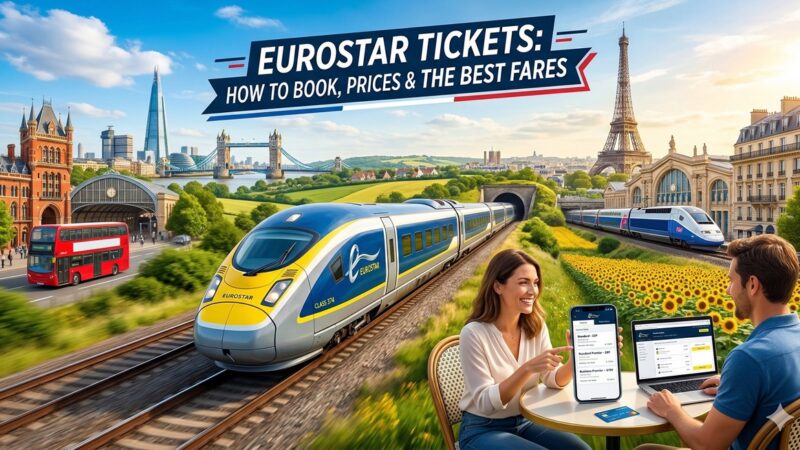
For booking details and how to find the best fares, see the Eurostar tickets guide. For the full overview of travelling on Eurostar, see the Eurostar travel guide.
Frequently Asked Questions
What are the Eurostar classes called now?
Eurostar Standard, Eurostar Plus and Eurostar Premier. Plus was previously called Standard Premier, and Premier was previously called Business Premier.
Is Eurostar Plus worth it?
On morning and evening trains when you’d otherwise pay for food, frequently yes. You get a wider 2+1 seat and a light meal with drinks, and the price premium over Standard is sometimes quite small. On a midday train when you’re not hungry, less so.
What is the difference between Eurostar Standard and Plus?
On the e320 trains, Plus has 2+1 seating instead of 2+2, so the seat is wider. Plus also includes a light meal and drinks at your seat on London routes. Ticket terms and bags are the same, and neither includes lounge access.
What is the difference between Eurostar Plus and Premier?
On the e320 the seats are the same. Premier adds fine dining, lounge access, priority gates, three bags instead of two, and free exchanges or refunds up to two days after departure.
Does Eurostar have first class?
Premier is the equivalent of first class. Eurostar doesn’t use the term “first class”.
Can I upgrade after booking?
Sometimes — Eurostar offers upgrades at the station or via the app, subject to availability. Prices for on-the-day upgrades vary.