Portable Travel Kettle: Best Picks & Guide
I started packing a travel kettle after one too many hotel rooms where the in-room kettle looked like it hadn’t been cleaned since the 90s. It sounds excessive until you’re in a budget hotel in Eastern Europe at 6am, wanting coffee, staring at a kettle with mysterious residue. A small travel kettle weighs less than a book and guarantees you’ll always have clean, boiling water wherever you stay.
Do you need one? If you regularly stay in hotels with kettles, probably not. If you stay in hostels, Airbnbs, or budget accommodation where kettles are hit-or-miss, a travel kettle is a small comfort that makes a real difference.
What to Look For
Dual Voltage
This is the most important feature for international travellers. The UK runs on 230V; the US and parts of Asia run on 110V. A dual-voltage kettle (110V-240V) automatically adjusts and works worldwide without a transformer.
Single-voltage kettles (230V only) work in the UK and most of Europe but will either blow a fuse or boil very slowly if you try to use them in the US or Japan.
Check the label: If it says “110V-240V” or “100V-240V”, it’s dual voltage. If it only says “220V-240V”, it’s single voltage.
Size and Capacity
Travel kettles typically hold 0.5L to 1L.
- 0.5L: Good for one person, fits in a day bag, heats quickly
- 0.8-1L: Better for two people or if you want multiple cups without refilling
Smaller kettles pack more easily but take longer if you need multiple cups. I find 0.5L is enough for solo travel; 0.8L is better when travelling with a partner.
Material
Stainless steel: More durable, easier to clean, better at maintaining water temperature. Slightly heavier. The better choice if you have room.
Plastic: Lighter, cheaper, more prone to absorbing odours over time. Fine for occasional use.
Silicone (foldable): Collapses flat for packing. Less durable than rigid kettles, and the silicone can retain smells. Good if space is your main concern.
Boil Time
Wattage determines how fast the kettle boils. Higher wattage = faster boiling.
- 300W: Slow (5-8 minutes for 0.5L) but works on most outlets, including lower-amperage circuits
- 600-800W: Reasonable speed (3-5 minutes for 0.5L)
- 1000W+: Fast but may trip breakers in older buildings
Lower-wattage kettles are safer for international travel where electrical systems vary. The trade-off is patience.
Safety Features
Auto shut-off: Essential. The kettle turns off when water boils.
Boil-dry protection: Turns off if the kettle is empty or runs out of water. Prevents damage and fire risk.
Cool-touch exterior: Double-wall construction keeps the outside cool when boiling. Nice to have but not essential.
Types of Travel Kettles
Standard Compact Kettles
Traditional kettle shape, just smaller. Usually 0.5-0.8L capacity. The most reliable option – they work like a regular kettle but pack into luggage.
Good for: Most travellers who want a dependable kettle
Foldable/Collapsible Kettles
Made from food-grade silicone that collapses flat. Typically reduce to about 1/3 of their full height.
Good for: Backpackers, carry-on only travellers, anyone where space is critical
Downsides: Less durable, silicone can develop odours, some models feel flimsy
Immersion Heaters
Not a kettle at all – a heating element you dip into a cup of water. The most compact option.
Good for: Extreme minimalists, backup option
Downsides: Slower, requires a suitable container, can’t leave unattended, looks suspicious in airport security
Kettle Sets
Some travel kettles come with cups, spoons, and a carry case. The Lakeland Travel Kettle Set is a popular example.
Good for: Those who want an all-in-one solution
Downsides: The included cups are usually small and flimsy
Recommendations
Best for Most Travellers
A standard compact kettle with dual voltage, 0.5-0.8L capacity, stainless steel interior, and auto shut-off. Look for models from established brands with good reviews.
Price range: £20-40
Best for Minimal Packing
A foldable silicone kettle. Accept the trade-offs (slower, less durable) in exchange for packability.
Price range: £15-30
Best for UK/Europe Only
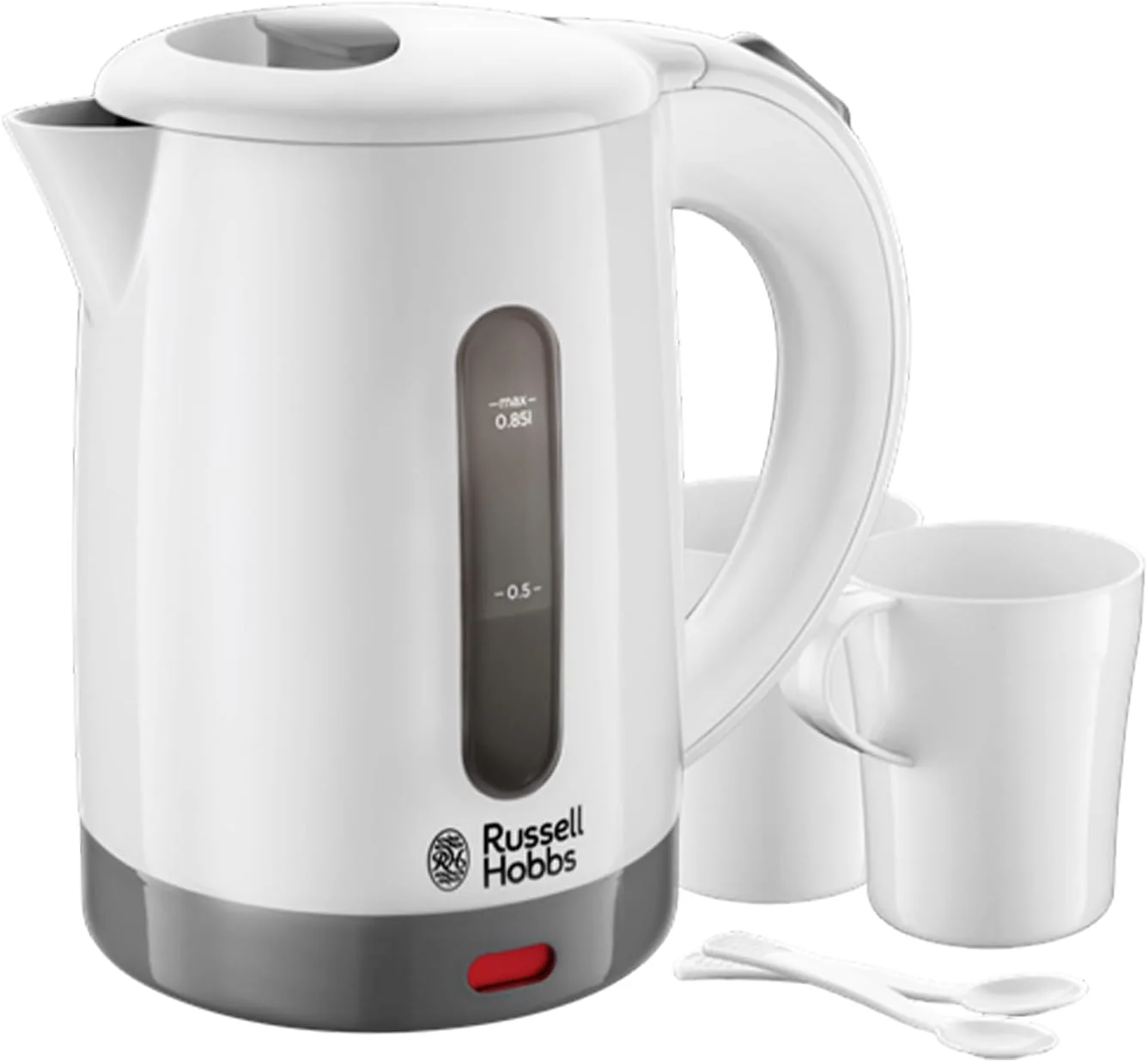
A standard compact kettle without dual voltage. Since you don’t need voltage flexibility, you can prioritise other features or save money. The Russell Hobbs 23840 is a solid choice at around £15 – small (0.85L), lightweight, includes two cups and spoons, and has automatic shut-off.
Price range: £15-30
International Voltage Reference
| Destination | Voltage |
|---|---|
| UK Kettle Works? | Europe |
| 220-240V | Yes |
| USA/Canada | 110-120V |
| No (need dual voltage) | Australia |
| 230V | Yes |
| Japan | 100V |
| No (need dual voltage) | Southeast Asia |
| 220-240V | Yes |
If travelling to 110V countries with a 220V-only kettle, it won’t work properly – it’ll heat very slowly if at all. Get a dual-voltage model or buy a cheap kettle on arrival.
Where to Buy
UK:
- Amazon (largest selection)
- Argos (Russell Hobbs travel kettle)
- Lakeland (kettle sets)
- Currys (limited selection)
In destination:
Travel kettles are available in most countries but selection is limited and prices are often higher. Buy before you go.
Tips for Use
- Let it cool before packing – even with a cool-touch exterior, give it a few minutes
- Empty and dry after use – prevents limescale and mould
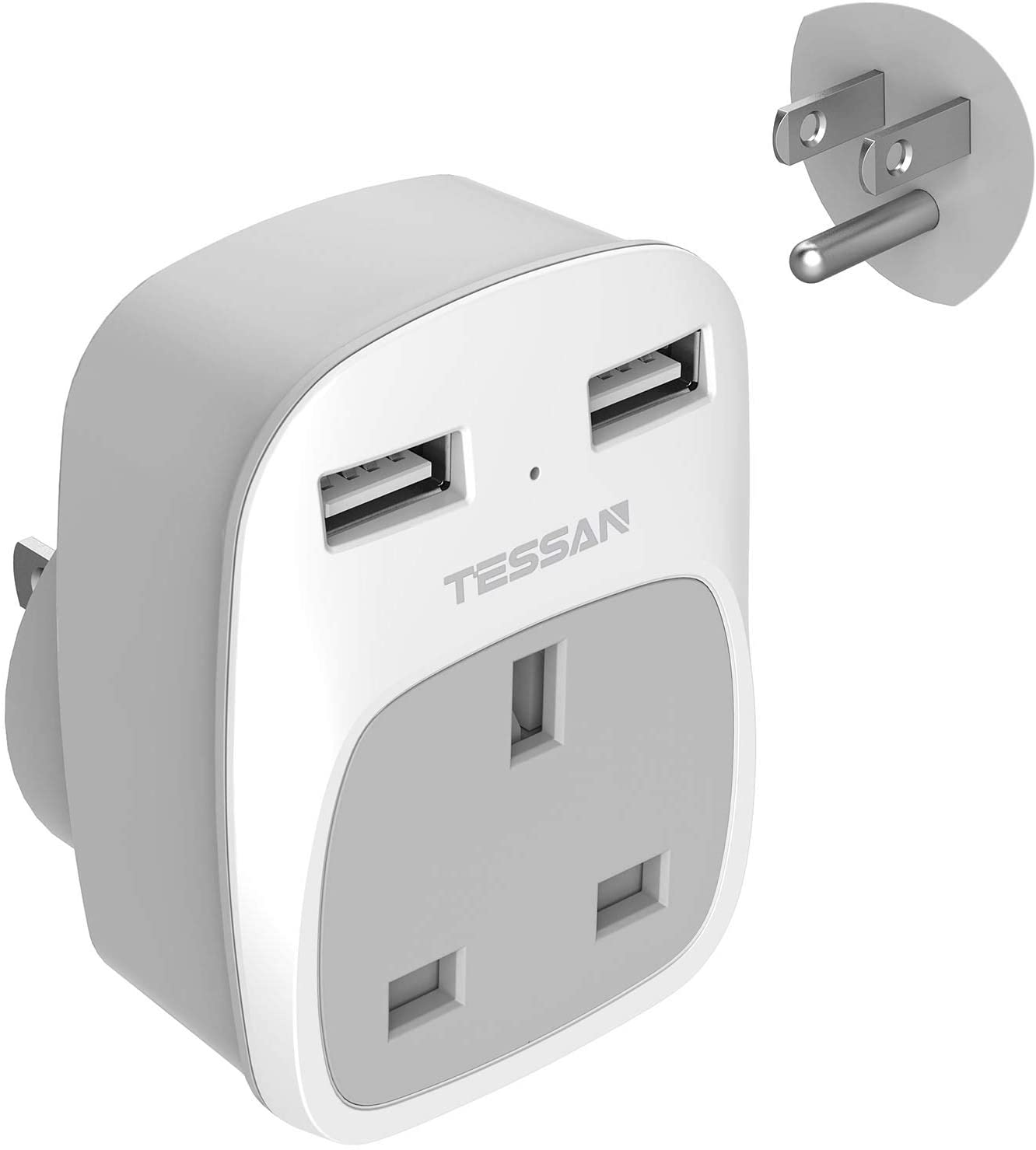
- Check the voltage before plugging in – if you have a dual-voltage kettle, it should handle this automatically, but verify you’re using the right adapter
- Don’t overfill – water expands when boiling and can overflow
- Descale occasionally – limescale builds up even with travel kettles. A quick rinse with diluted white vinegar helps.
Do You Actually Need One?
Yes, if:
- You stay in budget accommodation, hostels, or Airbnbs
- You’re particular about cleanliness
- You need hot water for baby formula, medication, or dietary needs
- You want tea/coffee without leaving your room at 6am
Probably not, if:
- You mostly stay in mid-range or better hotels (they’ll have kettles)
- You don’t drink hot beverages
- You’re only doing short city breaks
A travel kettle is one of those items that feels unnecessary until you need it. For the weight and cost involved, it’s worth packing if you travel regularly.