Central America Travel Guide
Central America is where North and South America squeeze together into a narrow strip of land packed with volcanoes, rainforests, Mayan ruins, and Caribbean coastline. I spent two months travelling from Guatemala to Panama and found a region that felt overlooked by the backpacker trail despite having everything travellers claim to want – ancient history, wildlife, beaches, adventure, and prices that make Southeast Asia look expensive.
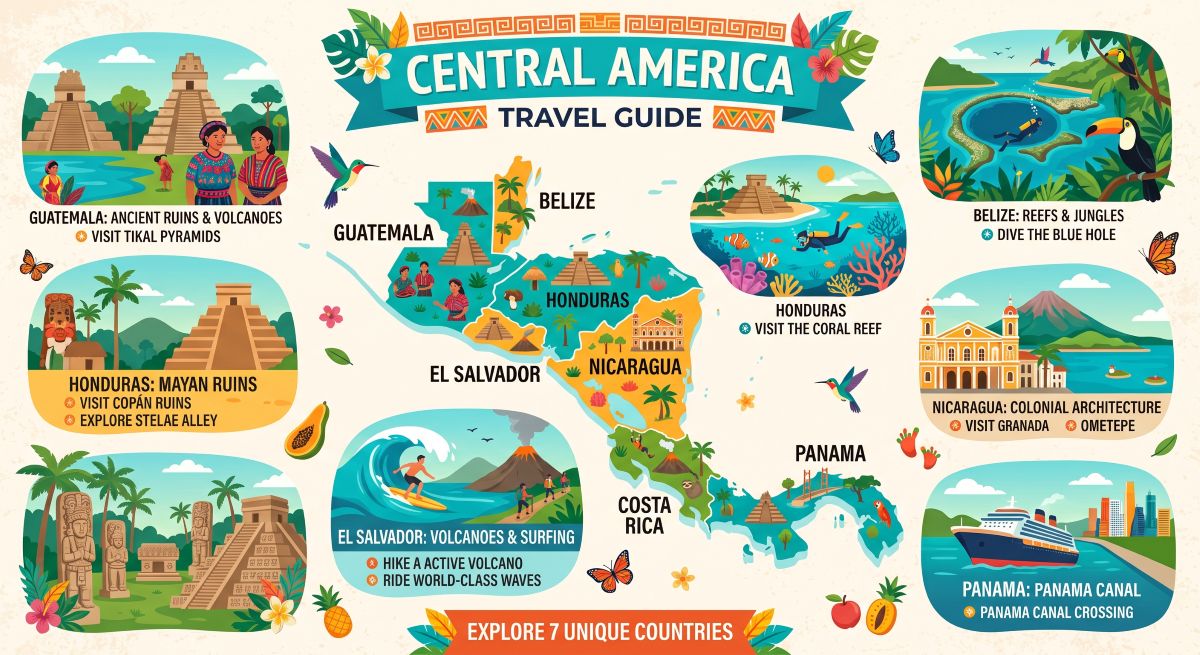
Seven countries connect Mexico to Colombia, each with its own character. Costa Rica has perfected eco-tourism. Guatemala has the best Mayan ruins outside Mexico. Belize combines Caribbean beaches with jungle adventures. Panama has the canal and surprisingly cosmopolitan cities. Honduras offers world-class diving at a fraction of Caribbean prices. Nicaragua and El Salvador are the road-less-travelled options for those wanting something grittier.
Choosing Your Country
Central America rewards focused trips. The countries are small but transport is slow – winding mountain roads, border crossings, and limited infrastructure. Pick two or three countries rather than trying to see everything.
| Country | Best For | Budget Level | Safety |
|---|---|---|---|
| Costa Rica | Wildlife, eco-lodges, families | £££ | Very safe |
| Belize | Diving, ruins, Caribbean | ££-£££ | Generally safe |
| Guatemala | Mayan ruins, culture, budget | £ | Caution needed |
| Panama | Canal, cities, beaches | ££-£££ | Generally safe |
| Honduras | Diving (Roatan), ruins | £-££ | Caution needed |
| Nicaragua | Volcanoes, budget, off-beat | £ | Generally safe |
| El Salvador | Surfing, emerging destination | £ | Caution needed |
Costa Rica
The most visited Central American country and the easiest for first-timers. Costa Rica abolished its army in 1948 and invested in education and conservation instead. The result is the region’s most stable democracy, best infrastructure, and most developed tourism industry.
The wildlife is extraordinary. Sloths hang from trees in Manuel Antonio. Turtles nest on Caribbean beaches. Cloud forests have quetzals and hummingbirds. The country has 5% of the world’s biodiversity in 0.03% of its land area.
What makes it different: Safety, infrastructure, eco-tourism focus, wildlife guaranteed
Best for: Families, first-time Central America visitors, wildlife enthusiasts, adventure sports
Highlights: Arenal Volcano, Monteverde cloud forest, Manuel Antonio National Park, Caribbean coast (Tortuguero, Puerto Viejo)
Time needed: 10-14 days
Daily costs:
- Budget (hostels, local food): £35-50
- Mid-range (hotels, tours): £80-150
- Luxury (eco-lodges, guided tours): £200+
Belize
The only English-speaking country in Central America, Belize combines Caribbean beach culture with Mayan ruins and jungle interior. The barrier reef – the second largest in the world – runs the length of the coast, with the famous Blue Hole a bucket-list dive site.
Belize is small. You can combine beaches (Caye Caulker, Ambergris Caye), ruins (Caracol, Xunantunich), and jungle (Cayo District) in a single trip without excessive travel.
What makes it different: English-speaking, Caribbean culture, reef diving/snorkelling, compact size
Best for: Divers, snorkellers, those combining beach and adventure, English-only speakers
Highlights: Blue Hole diving, Caye Caulker island, Caracol ruins, Actun Tunichil Muknal cave
Time needed: 7-10 days
Daily costs:
- Budget (hostels, local food): £40-60
- Mid-range (hotels, tours): £100-180
- Luxury (resorts, private tours): £250+
Guatemala
Guatemala has Central America’s best-preserved Mayan heritage and its most dramatic landscapes – volcanoes rising above colonial cities, jungle-covered pyramids, highland villages where traditional dress is daily wear rather than tourist costume.
Antigua, the former colonial capital, is one of the region’s most beautiful towns – cobblestone streets, ruined churches, volcano views. Lake Atitlán has indigenous villages around a crater lake. Tikal’s pyramids rise above jungle canopy. Semuc Champey has turquoise pools in the jungle interior.
Guatemala is cheap. It is also the region where safety requires most attention – petty crime is common, and some areas should be avoided. Stick to the tourist trail and exercise normal precautions.
What makes it different: Mayan culture (living and ancient), dramatic landscapes, budget prices, colonial architecture
Best for: History lovers, budget travellers, Spanish learners, photographers
Highlights: Antigua, Lake Atitlán, Tikal ruins, Semuc Champey, Chichicastenango market
Time needed: 2-3 weeks
Daily costs:
- Budget (hostels, street food): £20-35
- Mid-range (hotels, restaurants): £50-90
- Luxury (boutique hotels, guides): £150+
Panama
Panama is Central America’s most developed economy, built on the canal that connects Atlantic and Pacific. Panama City has a Miami-like skyline, good restaurants, and the canal itself – watching massive ships pass through the locks is genuinely impressive engineering.
Beyond the city, Bocas del Toro has Caribbean islands with backpacker-to-boutique accommodation. The San Blas Islands are controlled by the indigenous Guna people – palm-fringed islands with basic accommodation and no resort development. The highland town of Boquete has coffee farms and cooler weather.
What makes it different: The canal, modern infrastructure, indigenous territories (San Blas), dollar economy
Best for: City lovers, those wanting comfort, beach-and-city combinations, coffee enthusiasts
Highlights: Panama Canal, Casco Viejo (old town), Bocas del Toro islands, San Blas Islands, Boquete coffee region
Time needed: 10-14 days
Daily costs:
- Budget (hostels, local food): £35-50
- Mid-range (hotels, restaurants): £80-140
- Luxury (resorts, private tours): £200+
Honduras
Honduras gets a bad reputation. The mainland cities have real security problems. But the Bay Islands – Roatan, Utila, and Guanaja – are a different world entirely: Caribbean islands with some of the cheapest scuba diving certification in the world.
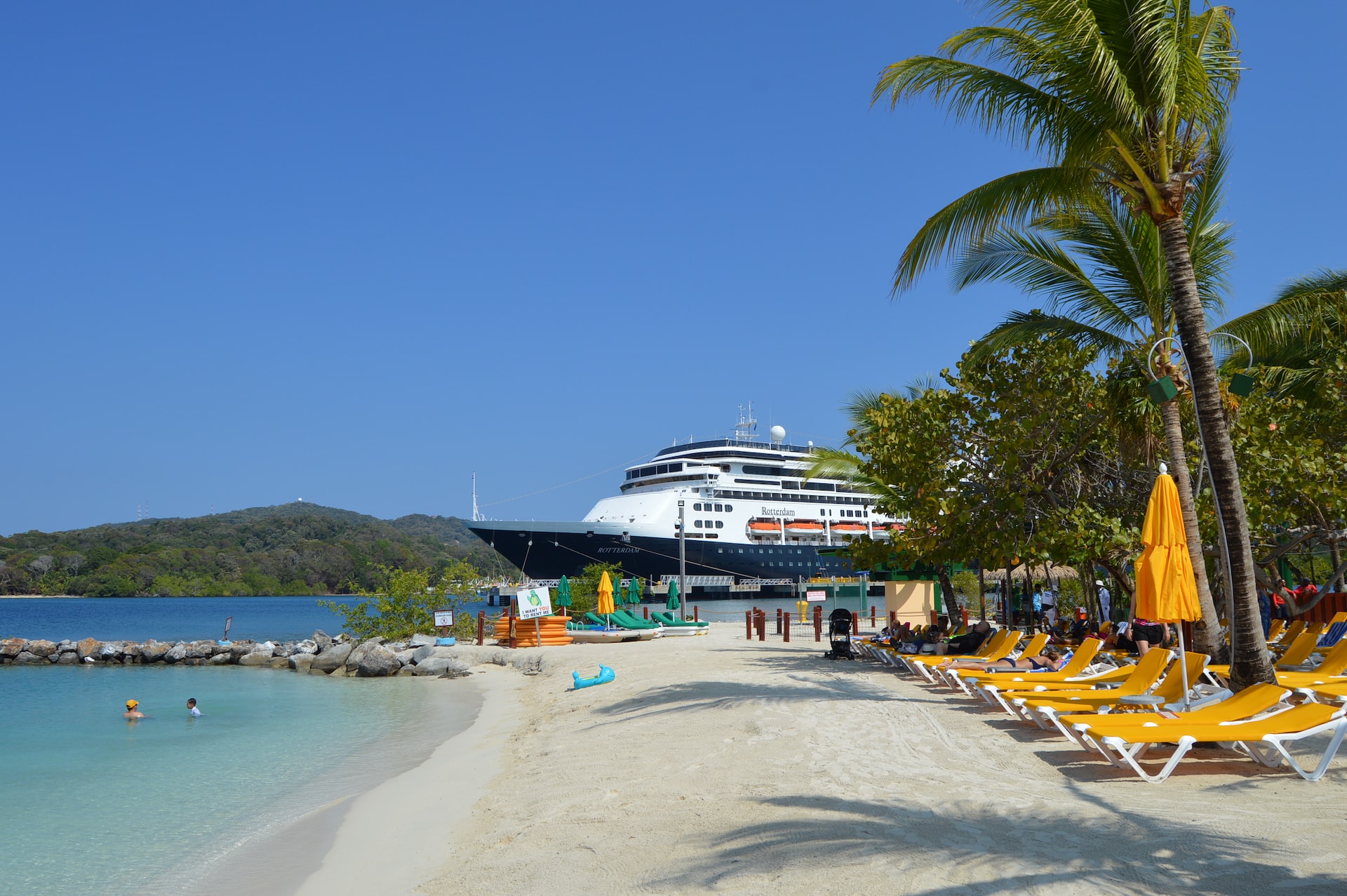
Roatan is the most developed island, with cruise ship visitors and proper resorts alongside dive shops. Utila is the backpacker choice – basic accommodation, party atmosphere, and dive courses that cost half what you would pay in Thailand. The Mesoamerican Barrier Reef runs past all three islands.
On the mainland, Copán has impressive Mayan ruins with intricate stone carvings – less crowded than Guatemala’s Tikal.
What makes it different: Cheapest diving certification in the Americas, Caribbean islands, Copán ruins
Best for: Budget divers, backpackers, those seeking value Caribbean
Highlights: Roatan diving, Utila dive courses, Copán ruins
Time needed: 7-14 days
Daily costs:
- Budget (Utila hostels, street food): £25-40
- Mid-range (Roatan hotels, diving): £60-120
- Luxury (Roatan resorts): £180+
Nicaragua
The largest Central American country and one of the least visited. Nicaragua has colonial cities (Granada, León), volcanic landscapes, surfing beaches, and the laid-back Caribbean coast of the Corn Islands.
León has backpacker energy and volcano boarding on Cerro Negro – sliding down an active volcano on a wooden board. Granada is more polished, with colourful colonial architecture on Lake Nicaragua. The Pacific coast has consistent surf breaks. Ometepe is a volcanic island in Lake Nicaragua with hiking and rural peace.
What makes it different: Volcanoes, colonial architecture, budget prices, uncrowded
Best for: Budget travellers, surfers, volcano enthusiasts, those avoiding tourist crowds
Highlights: Granada, León, volcano boarding, Corn Islands, Ometepe Island, San Juan del Sur surfing
Time needed: 2-3 weeks
Daily costs:
- Budget (hostels, local food): £20-35
- Mid-range (hotels, tours): £50-90
- Luxury (boutique hotels): £120+
El Salvador
Central America’s smallest and most densely populated country is emerging as a surf destination. The Pacific coast has consistent waves at destinations like El Tunco and El Zonte. The country adopted Bitcoin as legal tender in 2021, adding a curious tech-bro element to the surf town vibe.
Beyond surfing, El Salvador has colonial towns (Suchitoto), volcanic crater lakes (Coatepeque), and Mayan ruins (Joya de Cerén, buried by volcanic ash like a Central American Pompeii). It also has a difficult recent history – civil war ended only in 1992 – and ongoing gang-related security concerns in certain areas.
What makes it different: Surfing, Bitcoin economy, Mayan sites, compact size
Best for: Surfers, adventurous travellers, those wanting something different
Highlights: El Tunco surfing, Ruta de las Flores, Joya de Cerén ruins, Lake Coatepeque
Time needed: 7-10 days
Daily costs:
- Budget (hostels, local food): £25-40
- Mid-range (hotels, surf camps): £60-100
- Luxury (limited options): £150+
When to Visit
Central America has two seasons: dry and wet.
Dry Season (December to April): Best weather, higher prices, more tourists. This is “summer” locally despite being Northern Hemisphere winter. Christmas and Easter are peak periods.
Wet Season (May to November): Afternoon rain showers, lush green landscapes, lower prices. Rain rarely lasts all day. September-October is wettest. Caribbean coast is wetter year-round but has different patterns.
Hurricane Season (June to November): Caribbean coasts (Belize, Honduras Bay Islands, Nicaragua’s Corn Islands) have some risk. Pacific side and highland areas are not affected.
Getting There
From the UK: No direct flights. Connect through US hubs (Miami, Houston, Dallas) or Mexico City. Total travel time 14-20 hours depending on connections.
Main international airports:
- San José (Costa Rica) – most flight options
- Panama City – growing hub
- Guatemala City – for Guatemala/Honduras
- Cancun (Mexico) – for Belize overland
Overland from Mexico: Possible via Guatemala or Belize. Popular backpacker route.
Getting Around
Buses: The main transport for budget travellers. “Chicken buses” (repurposed US school buses) are cheap and chaotic. Tourist shuttles connect main destinations more comfortably at higher prices.
Domestic flights: Useful for reaching islands (Bay Islands, Corn Islands) or saving time on long routes.
Rental cars: Roads have improved but vary in quality. Useful for Costa Rica, Panama, and Belize. More challenging elsewhere.
Border crossings: Generally straightforward but time-consuming. Expect 1-3 hours for paperwork and waiting. Some borders have “helpers” who may or may not be official – fees should be posted.
Safety
Central America’s reputation for danger is partly deserved, partly outdated. Tourist areas in most countries are reasonably safe with normal precautions.
General advice:
- Don’t flash valuables, expensive phones, or jewellery
- Use ATMs inside banks during daylight
- Take taxis at night rather than walking
- Stick to tourist areas, especially after dark
- Check current travel advisories for specific areas
Country-specific:
- Costa Rica and Belize: Generally very safe
- Panama: Safe in tourist areas and Panama City
- Guatemala, Honduras, El Salvador: Exercise increased caution; avoid certain areas (consult advisories)
- Nicaragua: Currently safe for tourists, though political situation can change
Costs
Central America offers excellent value – cheaper than Mexico, much cheaper than the Caribbean.
Budget daily costs (hostels, street food, local transport):
- Guatemala, Nicaragua, Honduras: £20-35
- El Salvador: £25-40
- Panama, Belize: £35-50
- Costa Rica: £35-50
Mid-range daily costs (hotels, restaurants, tours):
- Guatemala, Nicaragua, Honduras: £50-90
- El Salvador: £60-100
- Panama, Belize: £80-150
- Costa Rica: £80-150
Visas
UK citizens can enter all Central American countries visa-free:
- Guatemala, El Salvador, Honduras, Nicaragua: 90 days (CA-4 agreement – 90 days total across all four)
- Costa Rica: 90 days
- Belize: 30 days (extendable)
- Panama: 180 days
The CA-4 agreement means Guatemala, El Salvador, Honduras, and Nicaragua share a single 90-day allowance. Leaving the CA-4 zone (to Belize, Costa Rica, or Panama) resets this.
Frequently Asked Questions
Do I need a visa to visit Central America?
UK citizens can visit all Central American countries visa-free. Costa Rica, Belize, and Panama have individual allowances (30-180 days). Guatemala, El Salvador, Honduras, and Nicaragua share a combined 90-day allowance under the CA-4 agreement. Leaving the CA-4 zone resets the clock.
What is the best time to visit Central America?
The dry season (December to April) offers the best weather with minimal rain. This is peak tourist season with higher prices. The wet season (May to November) has afternoon showers but lower prices and fewer crowds. Hurricane risk exists on the Caribbean coast June-November.
Is Central America safe for tourists?
Safety varies by country and area. Costa Rica and Belize are very safe. Panama is safe in tourist areas. Guatemala, Honduras, and El Salvador require more caution – stick to tourist routes, avoid certain areas, and check current advisories. Tourist areas are generally much safer than statistics for entire countries suggest.
How expensive is Central America?
Very affordable. Budget travellers can manage on £20-35/day in Guatemala, Nicaragua, and Honduras. Costa Rica is pricier at £35-50/day budget, £80-150 mid-range. Overall much cheaper than the Caribbean or Mexico’s resort areas.
Which Central American country is best for beginners?
Costa Rica is the easiest introduction – safe, good infrastructure, English widely spoken, wildlife guaranteed. Belize is also straightforward with English as the official language. Guatemala offers more adventure and better value but requires more travel experience.
What’s the best country for diving in Central America?
Honduras (Bay Islands) offers the best value – Utila has the cheapest dive certification in the Americas. Belize has the Blue Hole and excellent reef diving at higher prices. Both share the Mesoamerican Barrier Reef system.
Countries to Explore
Central America
Nearby Destinations
- Mexico
- Cancun, Mexico
- Cozumel Diving
- Colombia – onward travel to South America