Pacific Islands Travel Guide
The Pacific Islands exist in a different reality. I arrived in Fiji exhausted from months of travel and found myself doing nothing for days – swimming in water so clear it barely seemed real, eating fresh fish on the beach, watching sunsets that looked digitally enhanced. The South Pacific has a way of slowing everything down. Time works differently when you are surrounded by ocean and the nearest city is a long flight away.
These islands are scattered across an ocean larger than all the land on Earth combined. Polynesia, Melanesia, Micronesia – the names cover thousands of islands ranging from Fiji’s 300+ islands to tiny atolls with a single village. Most visitors focus on a handful of destinations: Fiji for accessibility and variety, French Polynesia for honeymoon luxury, or one of the smaller nations for something more remote.
Choosing Your Island
The Pacific Islands are not interchangeable. Each destination has its own character, price point, and experience.
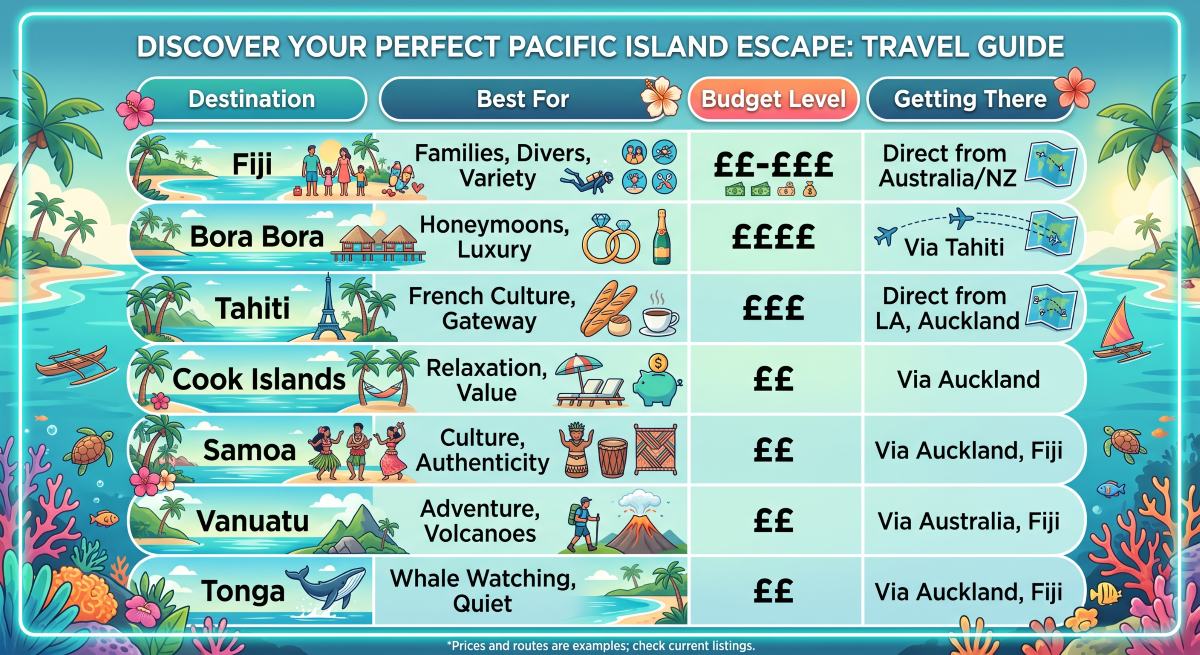
| Destination | Best For | Budget Level | Getting There |
|---|---|---|---|
| Fiji | Families, divers, variety | ££-£££ | Direct from Australia/NZ |
| Bora Bora | Honeymoons, luxury | ££££ | Via Tahiti |
| Tahiti | French culture, gateway | £££ | Direct from LA, Auckland |
| Cook Islands | Relaxation, value | ££ | Via Auckland |
| Samoa | Culture, authenticity | ££ | Via Auckland, Fiji |
| Vanuatu | Adventure, volcanoes | ££ | Via Australia, Fiji |
| Tonga | Whale watching, quiet | ££ | Via Auckland, Fiji |
Fiji
The most accessible South Pacific destination for most travellers. Fiji has direct flights from Australia, New Zealand, and the US West Coast, making it the natural first choice for Pacific exploration.
The country comprises over 300 islands, though most visitors see only a handful. The main island of Viti Levu has the international airport (Nadi) and the capital (Suva). The real Fiji is in the outer islands – the Mamanucas for easy resort access, the Yasawas for backpackers and boutique resorts, and the more remote islands for diving and seclusion.
What makes Fiji different: Accessibility, variety (from backpacker hostels to five-star resorts), excellent diving, and genuinely warm local culture. Fijians are famously friendly – “Bula!” greets you everywhere.
Best for: First-time Pacific visitors, families, divers, mixed-budget groups
Time needed: 7-14 days
Daily costs:
- Budget (dorms, local food): £40-60
- Mid-range (resort rooms, restaurants): £100-180
- Luxury (overwater/beachfront villas): £300+
French Polynesia
Bora Bora is the poster image of the South Pacific – a volcanic peak rising from a turquoise lagoon, overwater bungalows on stilts, honeymooners sipping champagne at sunset. It is beautiful, expensive, and unapologetically romantic.
But French Polynesia is more than Bora Bora. Tahiti is the main island and international gateway, with Papeete offering French-Polynesian culture, markets, and food trucks. Moorea is Bora Bora’s quieter, cheaper neighbour with similar scenery. The Tuamotu atolls have world-class diving. The Marquesas are remote and rugged.
What makes it different: French influence (baguettes, wine, language), overwater bungalow culture, extreme luxury, and prices to match.
Best for: Honeymoons, special occasions, diving (Tuamotus), anyone with a significant budget
Time needed: 7-14 days
Daily costs:
- Budget (guesthouses, local food): £80-120 (very difficult)
- Mid-range (hotels, restaurants): £200-350
- Luxury (overwater bungalows): £600-1,500+
Cook Islands
Fifteen islands scattered across 2 million square kilometres of ocean, with a total population smaller than a London suburb. Rarotonga is the main island – you can drive around it in 45 minutes. Aitutaki has one of the world’s most beautiful lagoons.
The Cook Islands offer a middle ground: more affordable than French Polynesia, more relaxed than Fiji, with strong Polynesian culture and an association with New Zealand (the currency is NZ dollars, many Cook Islanders live in Auckland).
What makes it different: Intimate scale, Polynesian culture, excellent value for the Pacific, stunning lagoon (Aitutaki)
Best for: Couples, relaxation, cultural experiences, value-conscious travellers
Time needed: 7-10 days
Daily costs:
- Budget (hostels, self-catering): £50-80
- Mid-range (resorts, restaurants): £120-200
- Luxury (beachfront villas): £300-500
Samoa
The Samoas (independent Samoa and American Samoa) offer something increasingly rare in tourism – genuine, unpolished cultural experiences. Traditional village life continues largely unchanged. Sunday is for church and family. The fales (open-sided beach huts) where many visitors stay have no walls.
Samoa is not a luxury destination. The beaches are beautiful but facilities are basic. The reward is authenticity – fire knife dancing that is not performed for tourists, village councils that have governed for centuries, landscapes without resort development.
What makes it different: Strong traditional culture, village stays, natural beauty without heavy tourism infrastructure
Best for: Cultural travellers, those seeking authenticity over luxury, budget backpackers
Time needed: 7-14 days
Daily costs:
- Budget (fales, local food): £30-50
- Mid-range (hotels, restaurants): £80-150
- Luxury (limited options): £200-350
Vanuatu
An archipelago of 80+ islands with active volcanoes, world-class diving, and intact traditional culture. Port Vila on Efate is the main hub, but the outer islands – Tanna with its accessible volcano, Espiritu Santo with its blue holes and shipwreck diving – are the real attractions.
Vanuatu feels less developed than Fiji, more adventurous than French Polynesia. The volcano on Tanna (Mount Yasur) lets you stand on the crater rim watching lava explode below. The diving at SS President Coolidge is a genuine world-class wreck dive.
What makes it different: Active volcanoes, adventure focus, tribal culture (land diving on Pentecost), excellent diving
Best for: Adventure travellers, divers, volcano enthusiasts, those wanting something different
Time needed: 10-14 days
Daily costs:
- Budget (guesthouses, local transport): £40-70
- Mid-range (resorts, tours): £100-180
- Luxury (boutique resorts): £250-450
Tonga
The only Pacific nation never colonised by Europeans, Tonga maintains a strong traditional monarchy and culture. The main attraction for visitors is whale watching – humpback whales migrate to Tongan waters from July to October, and Tonga is one of the few places where you can swim with them.
Outside whale season, Tonga is quiet – perhaps too quiet for some. The islands are beautiful but infrastructure is limited. This is not a resort destination; it is a place to slow down completely.
What makes it different: Whale swimming (seasonal), traditional monarchy, very quiet, limited tourism development
Best for: Whale enthusiasts (July-October), those seeking solitude, cultural travellers
Time needed: 7-10 days
Daily costs:
- Budget (guesthouses, local food): £40-60
- Mid-range (hotels, whale tours): £120-200
- Luxury (limited options): £250-400
When to Visit
The South Pacific has a tropical climate year-round, but timing matters.
May to October (Dry Season): The best time for most islands. Lower humidity, less rain, cooler temperatures. Peak season with higher prices. July-October is whale season in Tonga.
November to April (Wet Season): Hot and humid with more rain, though it rarely rains all day. Lower prices and fewer crowds. Cyclone risk exists, especially January-March.
Water temperature: Warm year-round (26-29°C). No wetsuit needed for snorkelling.
Getting There
The Pacific is remote. Most visitors connect through:
Australia: Fiji, Vanuatu, New Caledonia have direct flights from Sydney, Brisbane, Melbourne
New Zealand: Cook Islands, Fiji, Samoa, Tonga have direct flights from Auckland
United States: Fiji and Tahiti have direct flights from Los Angeles. Hawaii serves as a stepping stone for some destinations.
Inter-island: Fiji Airways connects many Pacific nations. Island hopping requires patience – flights are infrequent and expensive.
From the UK: No direct flights. Route via Los Angeles, Auckland, or Sydney. Expect 24+ hours total travel time.
Costs
The Pacific is not cheap. Everything is imported, and tourism is often the main industry. French Polynesia is one of the world’s most expensive destinations. Fiji and the Cook Islands offer better value. Samoa and Vanuatu are the budget options, but “budget” is relative.
What increases costs:
- Overwater bungalows (£500-1,500/night)
- Inter-island flights
- Diving and tours
- Imported food and alcohol
What saves money:
- Shoulder season travel
- Staying on main islands
- Self-catering accommodation
- Local food (markets, food trucks)
Practical Information
Visas: UK citizens can visit most Pacific nations visa-free for 30-90 days:
- Fiji: 4 months visa-free
- French Polynesia: 90 days (Schengen rules apply as French territory)
- Cook Islands: 31 days
- Samoa: 60 days
- Vanuatu: 30 days
- Tonga: 31 days
Currency: Varies by nation. Fiji dollars, French Pacific Francs (French Polynesia), NZ dollars (Cook Islands), Samoan Tala, Vanuatu Vatu, Tongan Pa’anga. Credit cards accepted at resorts; cash needed for villages and small islands.
Language: English is widely spoken in Fiji, Cook Islands, Samoa, Tonga, Vanuatu. French and Tahitian in French Polynesia.
Health: No major health risks for most islands. Dengue fever exists; use mosquito repellent. Medical facilities are limited outside main islands – travel insurance with evacuation cover is essential.
Power: Varies by nation. Fiji and Vanuatu use Australian-style plugs (Type I). French Polynesia uses European plugs (Type C/E). Check before you go.
Frequently Asked Questions
Do I need a visa to visit the Pacific Islands?
UK citizens can visit most Pacific nations visa-free: Fiji (4 months), French Polynesia (90 days under Schengen rules), Cook Islands (31 days), Samoa (60 days), Vanuatu (30 days), and Tonga (31 days). Check current requirements before booking as rules can change.
What is the best time to visit the Pacific Islands?
May to October (dry season) offers the best weather with lower humidity, less rain, and comfortable temperatures. This is peak season with higher prices. November to April is wetter and hotter but cheaper. July to October is whale season in Tonga.
How expensive are the Pacific Islands?
Costs vary significantly. Fiji and Cook Islands offer mid-range options (£100-200/day). French Polynesia is very expensive (£200-500+/day), especially for overwater bungalows. Samoa and Vanuatu are the most affordable (£40-100/day). Everything is imported, so expect higher prices than mainland destinations.
How do I get to the Pacific Islands from the UK?
No direct flights exist. Route via Los Angeles (to Fiji or Tahiti), Auckland (to most Pacific destinations), or Sydney/Brisbane (to Fiji, Vanuatu). Total travel time is 24+ hours. Fiji is the most accessible with the most flight connections.
Which Pacific island is best for honeymoons?
Bora Bora in French Polynesia is the classic honeymoon destination with iconic overwater bungalows. Fiji offers more variety at lower prices with excellent honeymoon resorts. The Cook Islands (especially Aitutaki) provide romance without extreme costs. Choose based on your budget and preference for luxury versus authenticity.
Is it safe to travel to the Pacific Islands?
The Pacific Islands are generally very safe with low crime rates. The main risks are natural (cyclones in wet season, strong currents for swimming) rather than human. Medical facilities are limited on smaller islands – comprehensive travel insurance with evacuation cover is essential.
Islands to Explore
Melanesia
- Fiji
- Vanuatu
- New Caledonia
Polynesia
- Bora Bora, French Polynesia
- Tahiti
- Cook Islands
- Samoa
- Tonga
Nearby Destinations
Related
- Best Travel Pillows – Essential for long-haul Pacific flights
- Cabin Bag Backpacks
- Luggage Scales
- Search flights & hotels on lastminute.com