Eurostar London to Paris: The Complete Route Guide
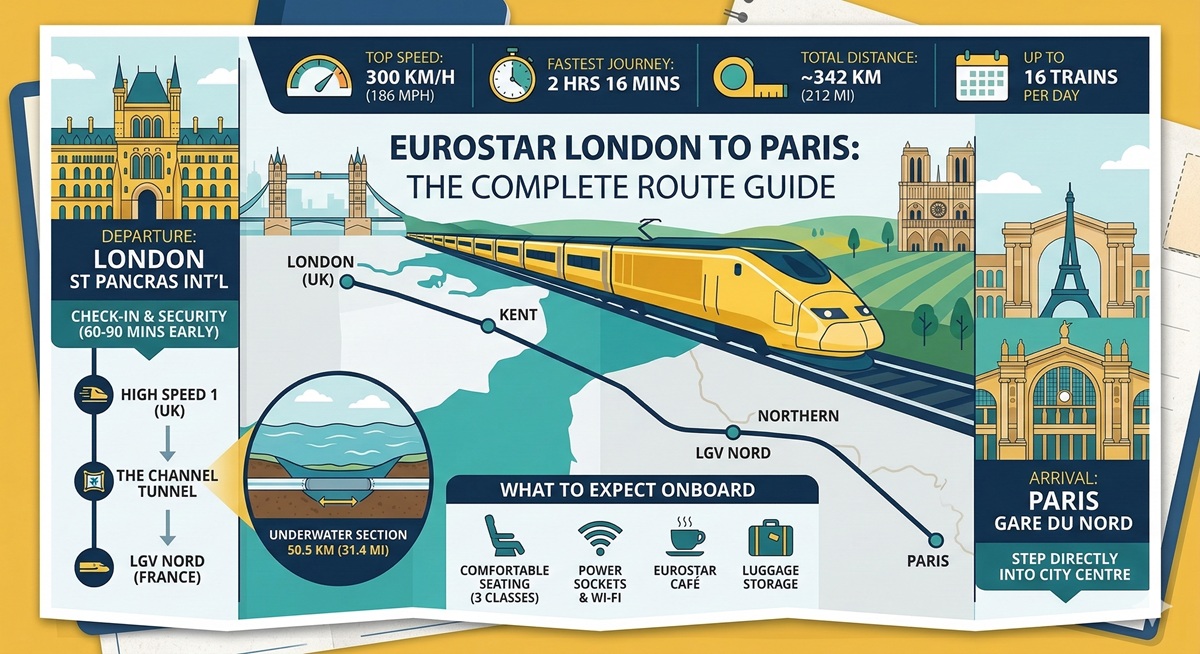
Eurostar runs from London St Pancras to Paris Gare du Nord in 2 hours 16 minutes. The train crosses south-east London and Kent, enters the Channel Tunnel near Folkestone, comes out near Calais about 20 minutes later and then runs across northern France into Paris. Add the 75 minutes Eurostar asks you to allow for check-in at St Pancras and the trip from the London terminal to a Paris street takes about three and a half hours, with no airport transfers at either end.
This guide covers the journey, how to find a reasonable fare, the three classes, check-in and what to expect when you arrive.
Quick facts:
| Departure station | London St Pancras International |
| Arrival station | Paris Gare du Nord |
| Journey time | 2 hours 16 minutes |
| Frequency | Up to 18 trains daily |
| Cheapest advance fare | From £39 one way (return booking) |
| Typical advance return | £80–150 |
The Journey
The train leaves from the Eurostar international terminal at St Pancras and runs through south-east London, then out across Kent, which is mostly green farmland, to the tunnel entrance near Folkestone.
The tunnel section takes about 20 minutes. The windows go black and you may feel a slight pressure change in your ears.
On the French side, the train emerges near Calais and heads south-east across the Pas-de-Calais, a flat agricultural plain, for roughly 80 minutes. Wi-fi works on this stretch, though it can be patchy.
Approaching Paris, the train slows through commercial districts and suburbs before pulling into Gare du Nord, a large glass-and-iron station in the 10th arrondissement, a short walk from the Grands Boulevards.
Gare du Nord: Arriving in Paris
Gare du Nord is one of Europe’s busiest railway stations. There’s no passport control when you get off the Eurostar, because you cleared French border control at St Pancras before boarding. Follow the exit signs.
From Gare du Nord, your options for getting around Paris:
- Metro: Lines 4 and 5 run from Gare du Nord into central Paris. Line 4 stops at Châtelet, Saint-Michel and Montparnasse. A single Metro-Train-RER ticket costs €2.55. Paper carnets of 10 are no longer sold; the cheapest per-trip option is Navigo Liberté+ pay-as-you-go at €2.04 a journey. The Navigo Easy card is the simplest way to load tickets and tap as you go.
- RER B: Runs south to central Paris (Châtelet–Les Halles, Saint-Michel–Notre-Dame) and north to CDG airport. Useful if your hotel is along the B line.
- Taxi / Uber: A taxi from Gare du Nord to most central Paris hotels costs €15–25. Use the official rank outside the main exit and ignore anyone who approaches you inside the station offering a ride.
- Walking: Canal Saint-Martin and much of the 10th arrondissement are within walking distance. If your hotel is in this neighbourhood, you may not need transport at all.
For what to do once you’re there, see our Things to do in Paris guide.
Tickets: How to Get the Best Price
London to Paris is Eurostar’s busiest route, and prices move with demand. The cheapest advance fares start from £39 one way (Eurostar’s advertised fare, return booking only). What you actually pay depends on how far ahead you book and which day you travel.
When to book:
- 3–6 months ahead: best selection of cheap fares, particularly for popular dates
- 6–10 weeks ahead: usually still reasonable fares available
- 2–3 weeks ahead: prices start climbing, especially on Fridays and Sundays
- Last minute: typically £150–250+ one way
Day of week matters. Friday evening and Sunday afternoon and evening trains cost the most because that’s when demand peaks. Tuesday, Wednesday and Thursday departures are usually cheaper.
Outward and return times. Each direction is priced separately, so you can pick the cheapest outward train on your date and the cheapest return time instead of being tied to a matching pair. The £39 headline fare does require a return booking.
Booking at eurostar.com gives you the full seat choice and the simplest process for changes. Trainline and Omio also list Eurostar fares and can help with comparison, but check whether they add a booking fee.
Booking a hotel as well? It’s worth pricing a train + hotel package before you book the two separately. lastminute.com’s Eurostar city breaks bundle the train and a hotel in Paris, and on some dates the package comes in cheaper than buying each on its own. On others it doesn’t, so compare both. One catch: changes to a package follow lastminute.com’s terms, not Eurostar’s free exchange rules.
For the full picture on fares, classes and booking strategies, see the Eurostar tickets guide.
Seat Classes on the London–Paris Route
All three Eurostar classes run on the London–Paris route.
Standard is fine for a journey of just over two hours. Seats are 2+2 with a fold-down tray and a power socket, and the ticket includes two bags with no weight limit. You can buy food and drinks in the Eurostar Café.
Plus (formerly Standard Premier) adds a light meal and drinks served at your seat. On the e320 trains it also gets a 2+1 seat layout instead of Standard’s 2+2. It makes most sense on a morning or evening train when you’d otherwise be buying station food.
Premier (formerly Business Premier) adds fine dining at your seat, lounge access in London, Paris and Brussels, priority gates, and fully flexible tickets you can exchange or refund free up to two days after departure. The seat is the same 2+1 seat as Plus, so you are paying for the food, the lounge and the flexibility. For a work trip where plans may change at short notice, that flexibility is the main reason to book it.
Full details on what each class includes, the rolling stock differences, and which is worth paying for are in the Eurostar seat classes guide.
Checking In at St Pancras
Eurostar recommends arriving 75 minutes before departure at St Pancras for Standard and Plus (45 minutes for Premier), and the gates close 30 minutes before departure (15 minutes for Premier). Allow a little more during school holidays and on busy Friday evenings.
The process works much like an airport:
- Go to the Eurostar international terminal at St Pancras (it’s well signposted)
- Scan your ticket or QR code at the automatic ticket gates
- Security: X-ray and metal detector, with no airport-style liquids limit
- UK exit check: a quick passport scan
- French border control: EU entry checks happen in London, before you board
- Departure lounge: seating, shops, and the Eurostar lounge for Premier passengers
- Boarding: announced by coach number
First-time travellers tend to underestimate the two passport checks. The French queue can move slowly at busy times, and since the EU’s Entry/Exit System began, non-EU passport holders, including British travellers, may also need to register their passport, photo and fingerprints at kiosks in the terminal.
The full walkthrough, including queue times, is in the Eurostar check-in guide.
Baggage
Standard and Plus tickets include two bags plus a small hand luggage item (handbag, laptop bag), with no weight limit. Premier gets three bags. You must be able to lift and stow your bags yourself.
Unlike flying, there’s no 100 ml limit on liquids, so full-size shampoo and toiletries are fine. Alcohol is the exception: Eurostar limits how much you can drink on board and bans large bottles of spirits. Bags still go through an X-ray.
For bikes, prams, and oversized items, see the full Eurostar baggage allowance guide.
Tips for the London–Paris Route
Expect the wi-fi to be patchy. If you need to work on the train, download what you need before you leave St Pancras.
Pick your seat when you book. Booking direct at eurostar.com gives you the full seat map, so you can choose a window seat.
Go to the Café early. On busy trains the queue at the Eurostar Café gets long. Go early in the journey, or buy food on the St Pancras concourse before check-in.
Watch your bags at Gare du Nord. It’s a big, busy station, and pickpockets work the crowds around the exits. Keep bags on you, ignore anyone offering help or a taxi, and follow the Metro signs.
Avoid Sunday evening on the way back. Sunday evening trains to London fill with weekend visitors and cost noticeably more. A Monday return, or an earlier train on Sunday, is usually cheaper and quieter.
Frequently Asked Questions
How long does Eurostar take from London to Paris?
The standard journey time is 2 hours 16 minutes, and most services are timetabled close to that.
How often do Eurostar trains run to Paris?
Up to 18 times a day on the busiest days. The first train usually leaves London between about 05:40 and 06:20 depending on the day, and the last between about 19:30 and 20:30. Check the timetable for your date.
How much is the Eurostar from London to Paris?
Cheapest advance fares start from £39 one way (Eurostar’s advertised fare, return booking only). A realistic return in advance typically costs £80–150 for Standard. Plus and Premier are considerably more.
Which station does Eurostar go to in Paris?
Gare du Nord, in the 10th arrondissement of central Paris. Metro lines 4 and 5 connect from here to the rest of the city.
Is Eurostar quicker than flying to Paris?
City centre to city centre, usually yes. Both St Pancras and Gare du Nord are in the middle of their cities, while flying adds transfers to and from airports outside each city plus airport security, which usually add more time than Eurostar’s 75-minute check-in.
Do I need to book in advance for Eurostar to Paris?
You don’t have to, but you’ll pay more if you don’t. The cheapest fares go weeks or months ahead. Booking the day before or on the day typically means paying £150–250+ one way.
For the full picture on Eurostar routes, classes, and booking, see the Eurostar travel guide.