Best Travel Pillow for Side Sleepers (2026)
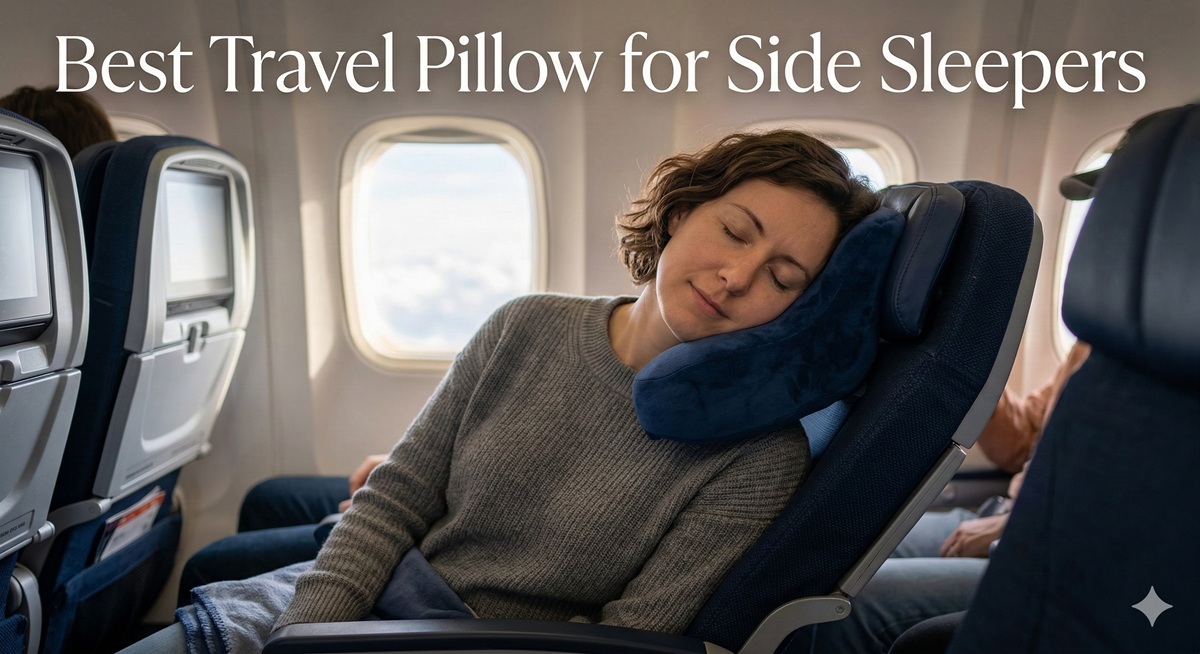
Side sleeping is how most people naturally sleep at home — which makes it particularly frustrating that economy class is almost entirely designed for sleeping upright, which almost nobody does naturally. The standard U-shaped neck pillow assumes you’ll sit with your head balanced above your shoulders. Side sleepers lean. They need something to lean into, and a standard U-pillow either gets in the way or does nothing useful.
I’m a side sleeper. I’ve spent more hours than I care to count finding pillow combinations that actually work in economy seats. This is what I know.
Why Standard Travel Pillows Fail Side Sleepers
The U-shaped memory foam pillow is the travel pillow most people think of. It wraps around your neck, provides lateral cushioning, and assumes your head will rest roughly above your spine.
For side sleepers, this model breaks down. When you lean to the right, the left arm of a U-pillow presses awkwardly into your neck. The pillow shifts position. You push it back. It shifts again. You give up and spend three hours staring at the headrest of seat 34A wondering if the person in 34B is judging you.
What side sleepers actually need is not neck cushioning — it’s lateral support. Something to lean into. A surface that stays in place when you put your full head weight on it for hours.
What Side Sleepers Should Look For
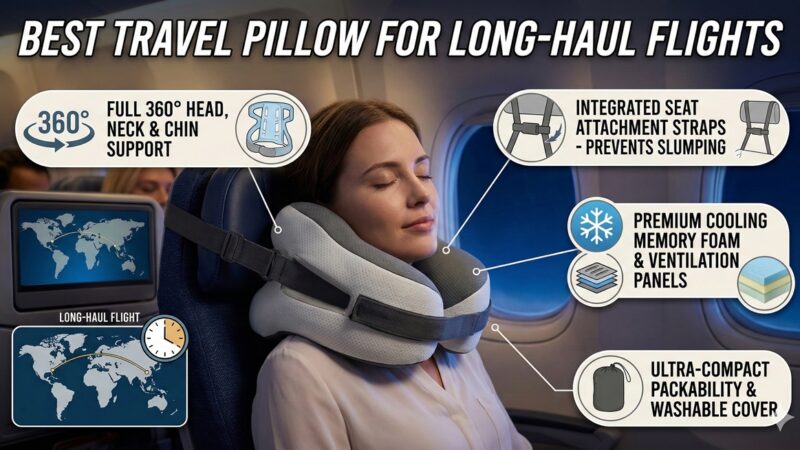
Lateral support, not just neck cushioning. The pillow needs to work when your head is at a 20–45 degree angle to your body, not balanced upright.
Chin support or a high front edge. Without this, your head slides forward off the pillow even when leaning sideways.
Stays in position. This means either a strap, an attachment point to the headrest, or a design that wedges itself into the gap between headrest and wall.
Window seat compatible. The best setup for a side sleeper is a window seat where you can lean into the fuselage. Your pillow needs to fit in that gap without being so thick it becomes uncomfortable.
Top Picks for Side Sleepers
1. J-Pillow — Best Overall for Side Sleepers
The J-Pillow was designed specifically with side sleeping in mind. The J-shape provides three-way support: the curved section fills the gap between your neck and shoulder, the chin extension prevents forward head drop, and the overall design is optimised for sleeping with your head tilted rather than upright.
I use it in a window seat with the curved section between my neck and the fuselage wall, and the chin extension curled under my jaw. It stays in position without drifting because the J-shape locks itself into place between my shoulder and the headrest. On a London to Bangkok flight (11 hours), this combination gave me around four hours of genuine side sleep.
The J-Pillow compresses to roughly half its size with the included carry bag. Not the most compact, but manageable.
Price: £35–45
Best seat: Window
Not ideal for: Aisle seats, upright sleepers, those who need a very compact pillow
Check price: J-Pillow on Amazon UK
2. SNUGL — Best Memory Foam for Side Sleepers
The SNUGL is the best U-shaped pillow for side sleepers because of one specific feature: the adjustable toggle strap. When you lean sideways with a standard U-pillow, the pillow shifts away from your neck on the lower side. The SNUGL’s strap keeps the entire pillow anchored against your neck regardless of the angle.
On a window seat, I position the SNUGL so the fuller part of the U sits on the side I’m leaning towards, and the strap keeps it in contact with my neck rather than floating loose. The 70D memory foam holds its shape well enough that it creates a genuine surface to press against, rather than compressing flat under your weight.
The SNUGL’s main limitation for side sleepers is the absence of chin support. If you sleep deeply enough that your head drops forward even while tilted, you will need to combine it with something else or choose the J-Pillow instead.
Price: £20–30
Best seat: Window
Not ideal for: Aisle seats, deep sleepers whose heads drop forward
Check price: SNUGL Travel Pillow on Amazon UK
3. Travelrest — Best for Aisle-Seat Side Sleepers
This is the pillow that changed how I sleep in aisle seats. The Travelrest is an inflatable body pillow that straps to the headrest and hangs down your side, giving you a surface to lean into wherever you’re sitting. It creates an artificial wall — you lean into it like it’s a window, regardless of seat position.
For a side sleeper in an aisle seat (which usually means no option to lean without putting your head in the aisle), the Travelrest is the closest thing to a solution. It is not as comfortable as leaning against an actual aircraft wall, but it’s dramatically better than nothing.
Strapped to the headrest at roughly ear height and inflated to about 75%, it provides enough resistance to lean against without being so firm it feels like pressing into a wall. On a 12-hour overnight to New York in seat 22C (aisle), it gave me three hours of actual side sleep I would not otherwise have had.
Price: £25–35
Best seat: Any — designed specifically to work away from windows
Not ideal for: Those who find inflatable pillows uncomfortable, upright sleepers
Check price: Travelrest Ultimate on Amazon UK
4. BCOZZY — Best Soft Option for Side Sleepers
The BCOZZY does not specifically address the lateral support problem, but its versatile positioning makes it more adaptable than a standard U-pillow. With one arm of the wraparound design tucked forward under your chin and the other arm positioned against the side you’re leaning towards, it creates a layered cushion that stays in place better than a simple U-shape.
The polyester fibre filling is softer than memory foam — this is either a pro or a con depending on your preference. Side sleepers who find memory foam too firm against their neck may prefer the softer feel. But it does mean less structure, and the pillow can compress flat under extended head weight.
The BCOZZY is not my first recommendation for side sleepers specifically, but if you already own one or prefer soft pillows, it works better for side sleeping than most standard U-pillows.
Price: £30–40
Best seat: Window
Not ideal for: Aisle seats, deep sleepers needing firm structure
Check price: BCOZZY Neck Pillow on Amazon UK
5. Portable Memory Foam Pillow — Best Budget Side Sleeper Option
The portable memory foam pillow at £15–25 is the budget route for side sleepers. The memory foam provides decent lateral cushioning in a window seat — better than polystyrene beads and more reliable than inflatables. The velvet cover is comfortable for extended leaning.
Its limitation is the same as all basic U-pillows: no chin support, no strap, and it will shift over a long flight. For short-haul side sleeping or as a backup, it is a good value option. For an 8-hour+ overnight, I would spend the extra on one of the options above.
Price: £15–25
Best seat: Window
Not ideal for: Long-haul overnight flights, aisle seats
Check price: Portable Memory Foam Travel Pillow on Amazon UK
The Window Seat Advantage
Before spending £40 on a pillow, consider this: seat selection makes a bigger difference to side sleeping in economy than any pillow.
A window seat gives you:
- The aircraft fuselage to lean against — effectively a wall
- A surface that does not move or shift
- Privacy on one side (no armrest neighbour to disturb with head movement)
- An armrest you can raise
A good pillow in a window seat is substantially more effective than an excellent pillow in a middle seat. If you are a side sleeper, prioritise window seats even if it means choosing a less convenient row.
For flights where you cannot get a window seat, the Travelrest is the closest solution to creating one.
Combining Pillow with Headrest
Most economy seats have adjustable headrest wings that fold forward. For side sleepers, fold the wing on the side you lean towards forward by about 30–40 degrees. This creates a partial cradle that supports your head from the side even before the pillow is involved.
Your pillow then fills the gap between the headrest wing and your neck rather than having to support your entire head weight alone. This combination — folded headrest wing plus a good lateral pillow — is noticeably better than either alone.
Memory Foam vs Inflatable for Side Sleepers
Memory foam wins on comfort for side sleeping — the foam creates a genuine surface to press against and does not deflate during sleep. Inflatable options are only worth choosing for side sleepers if pack size is the overriding concern.
The exception is the Travelrest, which is inflatable but specifically designed for lateral body support rather than neck cushioning. As a body pillow rather than a neck pillow, it addresses the side sleeping problem differently and works well at the job it is designed for.
For a detailed comparison of pillow materials, see memory foam vs inflatable travel pillow.
Comparison Table
| Pillow | Side Sleep Rating | Best Seat | Chin Support | Price |
|---|---|---|---|---|
| J-Pillow | Excellent | Window | Yes | £35–45 |
| SNUGL | Good | Window | No | £20–30 |
| Travelrest | Excellent (aisle) | Any | No | £25–35 |
| BCOZZY | Good | Window | Yes (soft) | £30–40 |
| Portable Memory Foam | Fair | Window | No | £15–25 |
Frequently Asked Questions
Can side sleepers use a Trtl Pillow?
The Trtl is designed for upright sleeping and works best when your head is balanced above your spine. Side sleepers who lean heavily will find the internal frame does not address lateral support needs. The Trtl works as a secondary support for light sideways leaning, but it is not the right primary tool for side sleeping on a long-haul flight.
What is the best travel pillow for sleeping on your side in economy?
The J-Pillow in a window seat, or the Travelrest in any seat. The J-Pillow’s three-way support design is the most purpose-built for side sleeping. The Travelrest solves the specific problem of aisle seats by creating artificial lateral support.
Is a window seat necessary for side sleeping on planes?
Not strictly — the Travelrest makes any seat viable for side sleepers. But a window seat makes side sleeping significantly easier with any pillow. If you can choose, always pick the window for overnight long-haul.