Best Travel Pillow for Long-Haul Flights (2026)
Long-haul flights are where a travel pillow earns its place in your bag — or earns the right to stay home forever. On a 2-hour hop to Barcelona it barely matters. On a 14-hour overnight to Singapore or a 12-hour red-eye to New York, the wrong pillow means you arrive stiff, irritable, and spending the first morning of your holiday in a horizontal recovery position rather than actually being on holiday.
I’ve done enough of those flights to know which pillows actually hold up. This guide focuses specifically on long-haul — flights over 8 hours where you genuinely need to sleep, not just nap.
What Makes a Pillow Good for Long-Haul?
Short-haul and long-haul demand different things from a travel pillow.
On a short flight, comfort for 45 minutes is enough. On an overnight long-haul, you need a pillow that:
- Maintains support for 6–8+ hours of broken sleep
- Does not cause pressure points or neck strain by hour four
- Works within the constraints of economy seating (narrow, little recline, no room to sprawl)
- Is washable — you will sweat, and pillows accumulate airline-seat bacteria
- Packs in a way that does not eat your entire carry-on allowance
Memory foam generally outlasts inflatable options over an 8-hour period — inflatables can lose firmness slowly, which you only notice when you wake up with your head at a bizarre angle. Structured scarf-style pillows (the Trtl) maintain consistent support without relying on air pressure.
Top Picks for Long-Haul
1. Trtl Pillow Plus — Best Overall for Long-Haul
The standard Trtl Pillow is good. The Trtl Plus is better for long-haul because it adds adjustable height settings, letting you find the angle that stops head drop for your specific neck length. On a 14-hour flight to Auckland, I used the Plus at a mid-height setting and managed a full 7-hour sleep block — the longest I have ever slept in economy.
The scarf-style design works in economy because it adds no bulk to the seat area — you have the same amount of elbow room and tray table access as without it. The internal plastic frame keeps your head upright consistently without relying on you leaning against a window.
Price: £45–55 (Trtl Plus)
Best for: Upright sleepers, economy flyers, compact packing
Not ideal for: Those who lean heavily sideways, anyone who finds structured pillows uncomfortable
2. SNUGL Travel Pillow — Best Memory Foam for Long-Haul
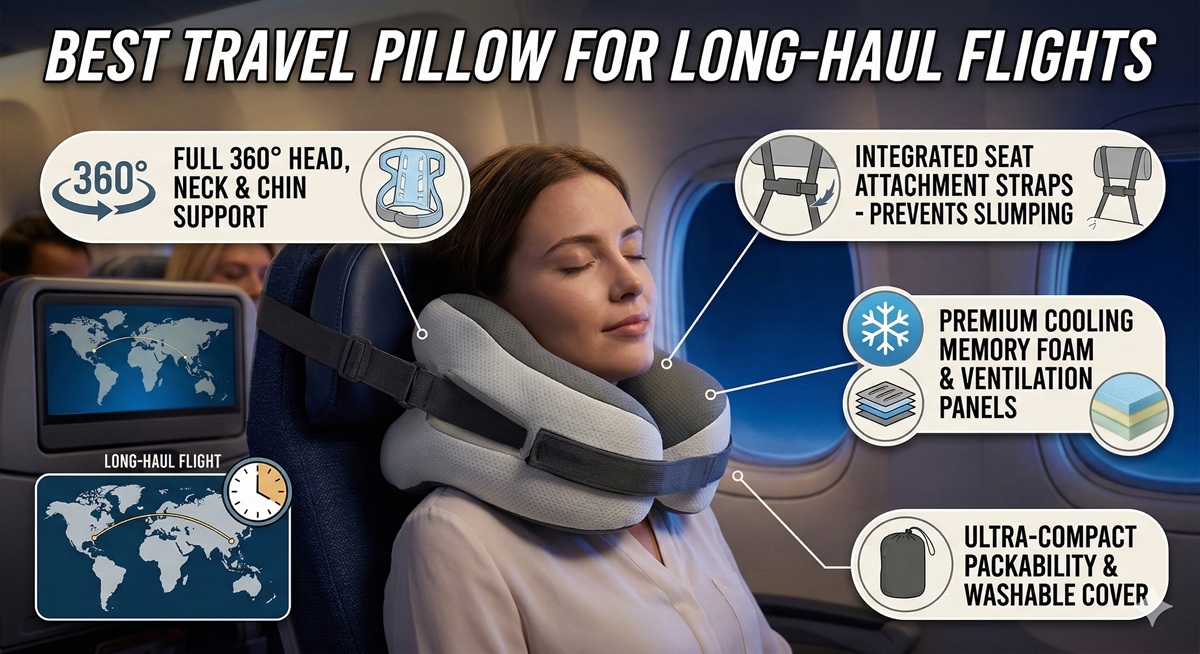
The SNUGL is the memory foam pillow I would recommend without hesitation to anyone doing a long-haul flight. The 70D VISCO-Elastic foam maintains consistent support across an entire overnight flight — it does not flatten or lose its shape after hour three the way cheaper foam does.
The adjustable toggle strap is the key feature for long flights. Standard U-shaped pillows rely on the friction of the U-shape to stay in place. Move in your sleep and they shift. The SNUGL’s strap keeps it anchored to your neck regardless of what position you end up in.
Tested across 20+ flights including London to Singapore, London to Cape Town, and London to Tokyo. After all of those, the foam still performs like new.
Price: £20–30
Best for: Side sleepers, window-seat passengers, headphone users
Not ideal for: Minimalist packers, slim neck builds
Check price: SNUGL Travel Pillow on Amazon UK
3. J-Pillow — Best for Preventing Head Drop on Long Flights
The J-Pillow solves the problem that ruins most long-haul sleep attempts: your head dropping forward when you nod off deeply. Standard U-pillows support the sides of your neck but do nothing to stop the forward fall. The J’s distinctive chin extension curls under your jaw, creating a soft stop that catches your head before it drops.
For overnight flights where you achieve proper deep sleep (which means your head will genuinely slump), the J-Pillow is the most comfortable option that prevents this. The Trtl prevents it more rigidly with its internal frame, but the J-Pillow’s soft cushioning makes it more comfortable for longer periods.
The anti-slip scarf keeps it positioned correctly through the night. I use it propped against a window seat, with the J-extension curled under my chin — four hours of uninterrupted sleep on a London to Bangkok flight.
Price: £35–45
Best for: Deep sleepers, forward head drop, window-seat passengers
Not ideal for: Those who prefer rigid structure, minimalist packers
Check price: J-Pillow on Amazon UK
4. Travelrest Ultimate — Best for Side Sleepers on Long-Haul
If you are a side sleeper and you have an aisle seat on a long-haul flight, the Travelrest is the most practical solution I have found. Instead of wrapping around your neck, it straps to the headrest and provides a lateral cushion to lean into — the equivalent of a window even in the middle of the cabin.
Worn across the torso rather than around the neck, it distributes the load across your shoulder and upper arm rather than concentrating it at your neck. On a 12-hour flight to New York where I had an aisle seat and genuinely could not sleep for the first nine hours with a standard pillow, the Travelrest finally gave me three hours by providing something to lean into.
Deflates to the size of a rolled pair of socks. Zero carry-on sacrifice.
Price: £25–35
Best for: Aisle-seat passengers, side sleepers, ultralight packers
Not ideal for: Upright sleepers, those who find inflatable pillows uncomfortable
Check price: Travelrest Ultimate on Amazon UK
5. BCOZZY — Best Soft Option for Long-Haul
For travellers who find the Trtl’s internal frame too rigid over an 8-hour flight, the BCOZZY offers a softer middle ground. The wraparound design with overlapping chin support prevents forward head drop without any rigid components — it’s all soft polyester fibre.
The trade-off is that the chin support is less absolute than the Trtl’s frame. If you sleep very deeply, your head may still move. But for lighter sleepers who just need to reduce neck strain during broken sleep, the BCOZZY’s softness makes it more comfortable over longer periods than structured alternatives.
Price: £30–40
Best for: Those who find structured pillows uncomfortable, light-to-medium sleepers
Not ideal for: Heavy sleepers who need absolute head control, minimalist packers
Check price: BCOZZY Neck Pillow on Amazon UK
What to Avoid on Long-Haul Flights
Airport shop pillows: The polystyrene bead pillows sold for £6–8 at airport shops flatten within an hour and provide no real support. If you forget your pillow and must buy at the airport, look for a memory foam option rather than beads.
Basic inflatables without pump: Blowing up a pillow in a full economy cabin is awkward. More practically, standard valve inflatables can slowly deflate overnight, leaving you unsupported by the time you reach your deepest sleep. If going inflatable, choose a pump-equipped option like the Purefly.
Oversized novelty designs: The full-head-enclosing “ostrich” pillows are impractical for economy — they take up enormous carry-on space and make using in-flight entertainment impossible.
Long-Haul Sleeping Tips
The pillow is one component of sleeping on a long-haul flight. Without the other components, even the best pillow fails.
Seat selection matters more than pillow type. A window seat lets you lean against the fuselage — this gives side sleepers a wall to push their pillow against, which makes almost any pillow work better. If you can choose your seat, window beats aisle for sleep.
Recline your seat. Fully upright economy seats are hard to sleep in regardless of pillow. Recline as soon as the seat-belt sign goes off after takeoff. Yes, it slightly affects the person behind you — so does their table being down when you’re trying to sleep. It is economy.
Combine with a sleep mask and earplugs. A travel pillow eliminates neck pain. A sleep mask eliminates light. Earplugs or noise-cancelling headphones eliminate cabin noise. All three together make economy sleep genuinely possible. The BUYUE pillow includes a 3D eye mask and earplugs — good value if you need all three.
Time your sleep to destination. Board the plane already thinking in destination time. If you’re flying overnight and arriving morning, aim to sleep through the first two-thirds of the flight rather than staying awake until midnight your home time. Being tired when you board helps — avoid caffeine for the 4–5 hours before the flight.
Dress for sleep. A light layer, compression socks, and loose trousers make a bigger difference to sleep quality than most people expect. Compression socks specifically help on long-haul because reduced circulation from sitting still causes discomfort that disrupts sleep.
For a full guide to in-flight sleep, including seat positioning and pre-flight preparation, see how to sleep on a plane.
Side Sleepers on Long-Haul
Side sleeping is the natural position most people prefer — and the hardest to achieve in economy. If this describes you, read our dedicated guide to travel pillows for side sleepers, which goes through the specific modifications and pillow choices that make side sleeping in economy achievable.
Comparison: Long-Haul Flight Pillows
| Pillow | Type | Price | Chin Support | Packs Small | Best Position |
|---|---|---|---|---|---|
| Trtl Plus | Scarf/frame | £45–55 | Yes (rigid) | Yes | Upright |
| SNUGL | Memory foam | £20–30 | No | Medium | Side leaning |
| J-Pillow | Soft chin support | £35–45 | Yes (soft) | Medium | Side/window |
| Travelrest | Inflatable body | £25–35 | No | Yes | Side (aisle) |
| BCOZZY | Wraparound | £30–40 | Yes (soft) | No | Upright/side |
Frequently Asked Questions
What is the single best travel pillow for a 14-hour flight?
The Trtl Plus for upright sleepers; the SNUGL for side sleepers who have window seats. If you can only buy one, the Trtl Plus is more versatile and works in more seat configurations. The J-Pillow is the better choice if forward head drop is your specific problem.
Can I bring a travel pillow on an economy flight?
Yes — travel pillows are personal items and are allowed in hand luggage on all airlines. They do not count as a separate bag. Inflatable pillows take up almost no space when deflated. Foam pillows can be clipped to the outside of your carry-on bag.
Is the Trtl Pillow better than the SNUGL for long-haul?
Depends on your sleep style. The Trtl is better for upright sleepers and compact packing. The SNUGL is better for side sleepers and those who prefer soft, foam-based cushioning over a rigid internal frame. Both have been tested over multiple long-haul routes — both work. Read the full Trtl review and SNUGL review to decide which suits you.