Worldwide Plug Adapter Types Guide
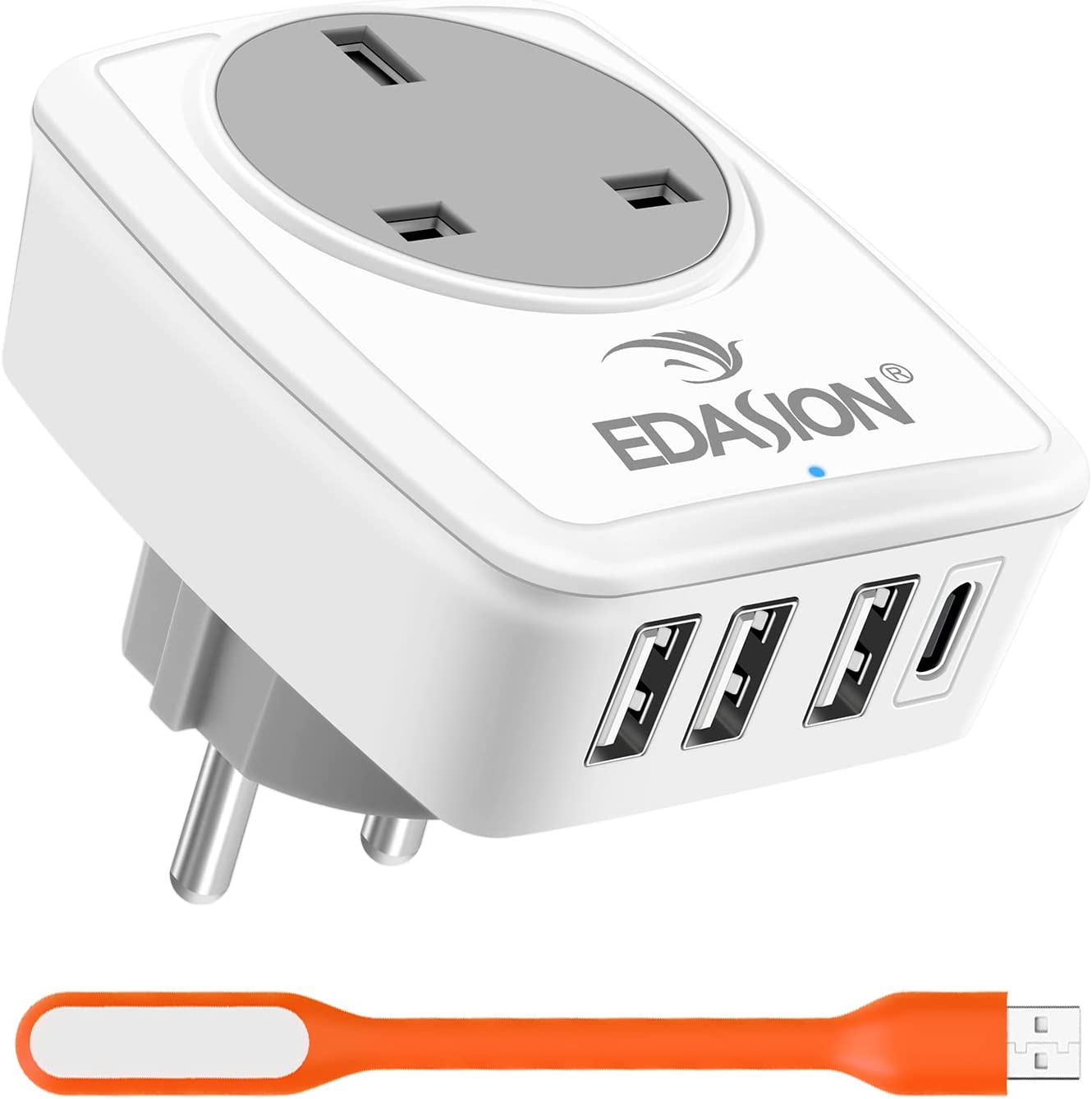

The world uses 15 different plug types. A universal adapter handles most situations, but if you know which sockets you’ll meet, you can pack a smaller, cheaper adapter for that region.
The Main Plug Types
Type A: Two Flat Pins (North America, Japan)
Used in: USA, Canada, Mexico, Japan, Central America, Caribbean
The standard American plug. Two flat parallel pins. Japan uses the same shape but different voltage (100V vs 120V).
Type B: Two Flat Pins + Ground (North America)
Used in: USA, Canada, Mexico, Japan, Central America
Same as Type A but with a third round grounding pin. Type A devices fit Type B sockets; Type B devices don’t fit Type A sockets.
Type C: Two Round Pins (Europe, South America, Asia)
Used in: Most of Europe, Russia, South America, parts of Asia and Africa
The most widely used plug type internationally. Two round pins, no ground, rated for low-power devices. Works in most European and South American sockets.
Type D: Three Large Round Pins (India)
Used in: India, Nepal, Sri Lanka and nearby countries
Three large round pins in a triangle. India uses it for small devices and chargers, and Type M for heavy appliances.
Type E: Two Round Pins + Grounding Hole (France, Belgium)
Used in: France, Belgium, Poland, Czech Republic, Slovakia
Similar to Type C but with a grounding hole for a pin in the socket. Type C plugs fit Type E sockets.
Type F: Two Round Pins + Side Clips (Germany, Europe)
Used in: Germany, Austria, Netherlands, Spain, Portugal, most of Europe
Also called “Schuko” (from German Schutzkontakt, “safety contact”). Type C plugs fit Type F sockets. Most European travel adapters cover both E and F.
Type G: Three Rectangular Pins (UK, Ireland)
Used in: UK, Ireland, Malta, Malaysia, Singapore, Hong Kong, UAE
The British plug has three rectangular pins, is larger than most plugs, and has a fuse inside the plug itself.
Type H: Three Pins in V-Shape (Israel)
Used in: Israel, Palestinian territories
Used only in Israel and the Palestinian territories. Israeli sockets accept Type C plugs, and sockets made since 1989 take both the old flat-pin and the current round-pin Type H plugs. Type E and F plugs are not reliably compatible.
Type I: Two Angled Pins (Australia, China)
Used in: Australia, New Zealand, China, Argentina
Two angled flat pins in a V shape, sometimes with a third vertical ground pin. China uses the same plug type but different voltage.
Type J: Three Round Pins (Switzerland)
Used in: Switzerland, Liechtenstein
Similar to Type C but with a third grounding pin. Type C plugs fit Swiss sockets.
Type K: Three Pins (Denmark)
Used in: Denmark, Greenland, Faroe Islands
Similar to Type F but with an earth pin on the plug instead of clips. Type C plugs fit Danish sockets. Type E and F plugs also go in, but they have no earth pin, so the appliance is not earthed.
Type L: Three Round Pins in a Row (Italy)
Used in: Italy, Chile
Three round pins in a line. Comes in two versions: 10A (smaller) and 16A (larger). Type C plugs fit the 10A and universal “bipasso” sockets.
Type M: Three Large Round Pins (South Africa)
Used in: South Africa, India (heavy appliances)
Similar to Type D but with larger pins. Used for high-power devices in India.
Type N: Three Round Pins (Brazil)
Used in: Brazil, South Africa
Brazil adopted it as national standard NBR 14136 in 2001 and began rolling it out in 2007, so older buildings may have different sockets. Type C plugs fit Type N sockets.
Type O: Three Round Pins (Thailand)
Used in: Thailand
Used only in Thailand. Most Thai sockets also accept Type A, Type B, and Type C plugs, so US and European plugs often fit without an adapter. Type A and B devices must still be dual-voltage, because they are built for 100-127V and Thailand’s supply is higher. UK visitors need a Thailand plug adapter.
Quick Reference by Region
Europe
| Region | Plug Type | Voltage |
|---|---|---|
| UK & Ireland | G | 230V |
| France, Belgium | E | 230V |
| Germany, Spain, Portugal | F | 230V |
| Italy | L (and C) | 230V |
| Switzerland | J | 230V |
| Denmark | K | 230V |
For UK travellers to Europe: You need a UK to EU adapter (Type G to Type C/E/F). See our Europe adapter guide. If you’re bringing hair tools, check the adapter’s rating, because the standard Type C plug is rated at 2.5A, which is about 575W at 230V. A hair dryer needs an adapter rated for its wattage, and in countries like Portugal the socket you will meet is Type F (what plugs Portugal uses).
Middle East
| Country | Plug Type | Voltage |
|---|---|---|
| UAE (Dubai, Abu Dhabi) | G | 230V |
| Qatar | G | 240V |
| Saudi Arabia | G | 230V (60Hz) |
| Jordan | A/C hybrid (most common), F, G | 230V |
The UAE is the useful outlier here: Dubai plug sockets are Type G, the same three rectangular pins as the UK, so British travellers need no adapter at all. Plenty of people pack one anyway. The reverse applies to your other kit: a two-pin Type C plug will not fit a Type G socket, so a device with a European plug needs a Type G adapter in the UAE.
Asia
| Country | Plug Type | Voltage |
|---|---|---|
| China | A, I, C | 220V |
| Japan | A, B | 100V |
| Thailand | O, A, B, C | 220-230V |
| India | D, M | 230V |
| Singapore | G | 230V |
Americas
| Region | Plug Type | Voltage |
|---|---|---|
| USA, Canada | A, B | 120V |
| Mexico | A, B | 127V |
| Brazil | N, C | 127V/220V |
| Argentina | I, C | 220-230V |
Oceania
| Country | Plug Type | Voltage |
|---|---|---|
| Australia | I | 230V |
| New Zealand | I | 230V |
What You Need
Universal Adapter
A universal adapter covers all major plug types in one device. It suits frequent travellers and multi-destination trips, or anyone unsure what they’ll encounter.
Region-Specific Adapter
For a single-destination trip, a simple UK-to-Europe or UK-to-USA adapter is smaller, cheaper and all you need.
Adapter vs Converter
Adapter: Changes the plug shape only. Use for dual-voltage devices (phones, laptops, cameras).
Converter: Changes the voltage (e.g., 110V to 220V). Needed for single-voltage devices like some hair dryers.
Most modern electronics are dual-voltage (check the label: “100-240V” means you only need an adapter). Hair appliances are often single-voltage. A UK dryer rated 230V works in any 220-240V country with just an adapter, but it needs a converter (or a dual-voltage model) in 100-127V countries such as the USA and Japan. Or use the hotel’s.
Frequently Asked Questions
How many plug types are there in the world?
There are 15 different plug types used around the world, labelled Type A through Type O. The most common are Type A/B (North America), Type C/E/F (Europe), Type G (UK), and Type I (Australia/China).
What is a universal travel adapter?
A universal travel adapter is a single device that includes multiple plug configurations to work in different countries. It typically covers Type A/B (USA), Type C/E/F (Europe), Type G (UK), and Type I (Australia), making it suitable for most international travel.
Do I need a voltage converter or just an adapter?
Most modern electronics (phones, laptops, cameras) are dual-voltage (100-240V) and only need a plug adapter. Check your device label: if it says “100-240V” you only need an adapter. Single-voltage devices need a voltage converter to safely use different voltage systems.
Which countries use the same plug type as the USA?
Type A/B plugs (USA) are also used in Canada, Mexico and Japan, as well as in a number of other countries in the Americas. Japan uses the same plug shape but different voltage (100V vs 120V).
What plug adapter do I need for Europe?
Most of continental Europe uses Type C, E, or F plugs (two round pins). A Type C adapter works across France, Germany, Spain, and most other European countries. The exceptions are the UK and Ireland (Type G), plus Switzerland (Type J), Italy (Type L) and Denmark (Type K), which each have their own socket. Type C plugs still fit those three, though in Italy only the 10A and universal sockets take them. Denmark is the one to watch with earthed Type E and F plugs: they go into Danish sockets, but the appliance is not earthed.
Can one adapter work for multiple countries?
Yes. A universal adapter with multiple plug configurations works in most countries worldwide and is the safest choice for multi-country trips. Type C plugs also work in many European sockets (Type E and F).