EU Plug Adapter: What UK Travellers Actually Need
I learned about EU plug adapters the hard way in 2008 — arrived in Barcelona with one slim UK-to-EU adapter, which worked perfectly until I reached Zurich and found the socket was a completely different shape. That was my introduction to the Swiss Type J. A few years later I plugged a bulky adapter into a German hotel wall and watched it slowly slide out under its own weight. And there was the Barcelona Airbnb where my MacBook chassis gave a faint buzz every time I touched it — unsettling until I understood why.
None of these are serious problems. They’re exactly the kind of things that don’t show up in the official guides but come up in every travel forum thread about charging devices in Europe. This is the guide I’d want before a first European trip.
Quick answer: For most of continental Europe, a standard EU plug adapter is all you need — no converter, no transformer. Three countries need special attention: Switzerland, Italy, and — the one everybody misses — Denmark.
What Plug Types Are Used in Europe?
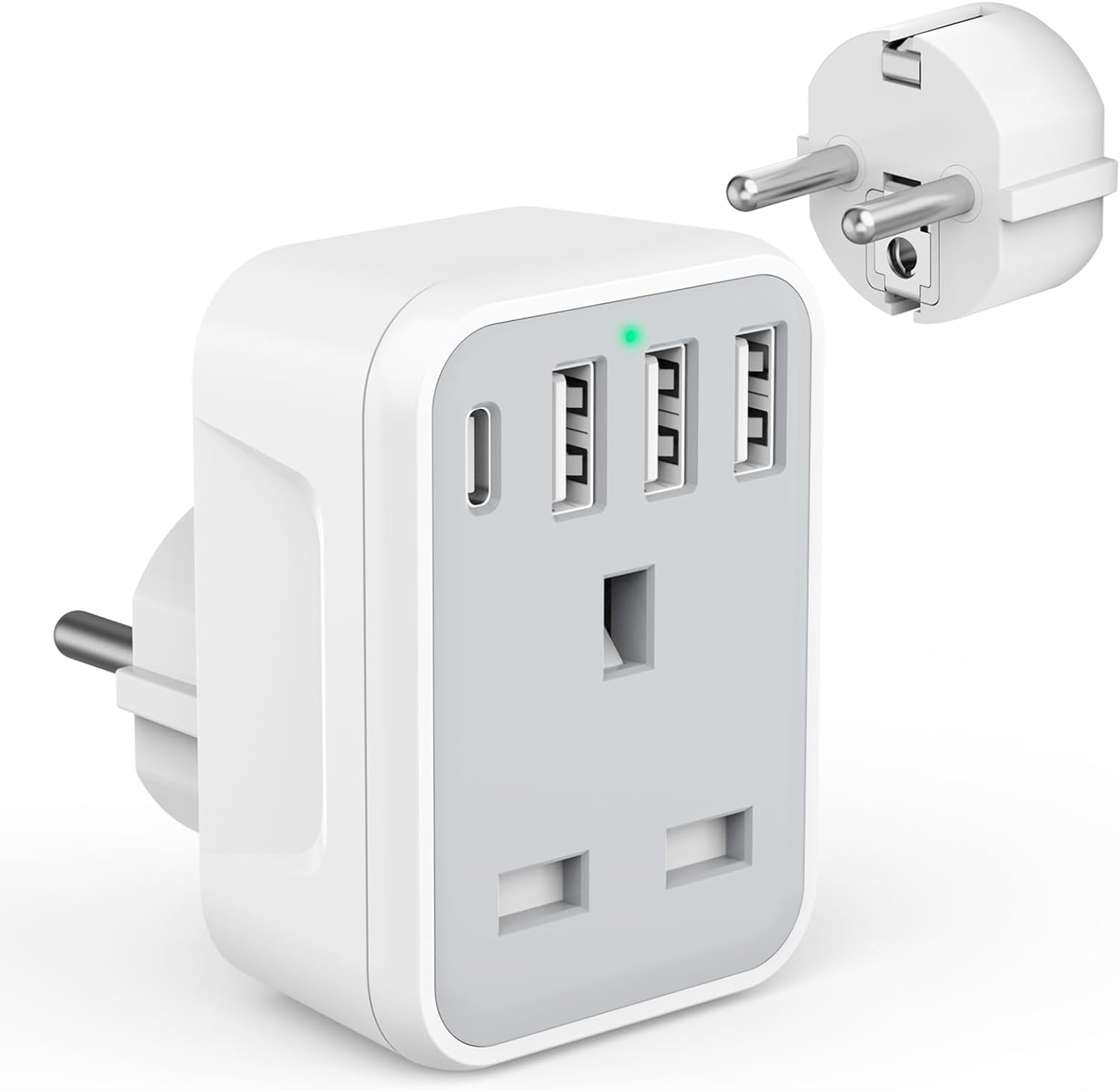
An EU plug adapter converts a UK three-pin plug (Type G) to fit the two-round-pin sockets used across continental Europe. Most EU countries use Type C, E, or F sockets, all of which accept a standard CEE 7/7 hybrid adapter.
The Standard: Types C, E, and F
Most of continental Europe uses one of three related plug types, and a good UK-to-EU adapter handles all of them:
| Type | Standard Name | Countries | Key Notes |
|---|---|---|---|
| Type C | Europlug (CEE 7/16) | All continental Europe | Two round pins, ungrounded, max 2.5A / 575W |
| Type E | CEE 7/5 | France, Belgium, Poland, Czech Republic, Slovakia | Two round pins + grounding pin in the socket |
| Type F | Schuko (CEE 7/4) | Germany, Austria, Netherlands, Spain, Portugal, Sweden, Finland, Norway, most of Eastern Europe | Two round pins + grounding clips. Sockets recessed 15mm |
| CEE 7/7 | Hybrid E/F | Most of EU | Works in both Type E and Type F sockets |
In practice: most EU adapters sold today use the CEE 7/7 hybrid standard, which means a single adapter works in France, Germany, Spain, Greece, Portugal, Netherlands, and most of Eastern Europe without you needing to think about it.
The Three Exceptions: Switzerland, Italy, and Denmark
Switzerland (Type J): Swiss sockets use three round pins arranged in a triangle. A standard EU adapter does not fit. However — and this matters — Type C (the basic two-round-pin Europlug) fits most modern Swiss sockets for low-power devices like phone chargers and laptops. If you have a UK three-pin device that needs grounding, you need a proper Type J adapter. A universal travel adapter that includes Type J is the cleanest solution for Switzerland.
Italy (Type L): Italian sockets have three round pins in a row, which is different from the rest of Europe. Again, a basic Type C adapter fits the majority of Italian hotel and apartment sockets for everyday electronics. Where you’ll hit issues is with older buildings or high-wattage devices that need a grounded connection.
Denmark (Type K): This is the one nobody mentions. Denmark uses Type K — a unique standard that looks similar to Type F but is not compatible. A standard EU adapter will not fit Danish sockets. One useful detail: Type K sockets do accept Type C (Europlug) pins, so a basic two-pin EU adapter already in your bag works for low-power ungrounded devices like phones and laptops — you just still need an adapter to convert from UK Type G. If you’re going to Copenhagen and you’re relying on a basic two-pack UK-to-EU adapter bought from Argos, you may have a problem. Most universal adapters that describe themselves as covering “all of Europe” do include Type K — but check the box before you travel.
For a country-by-country breakdown of every plug type in Europe, see the worldwide plug adapter types guide.
Do You Need a Voltage Converter with an EU Plug Adapter?
No. The UK runs at 230V/50Hz. Continental Europe runs at 230V/50Hz. They’re the same. UK devices work in European sockets with nothing more than a plug adapter — no converter, no transformer.
The “220-240V” you see on older guides and some hotel information sheets is legacy language. The current harmonised EU standard (IEC 60038, updated 1997) is 230V. You’ll sometimes see “220-240V” on device labels to acknowledge the historical range — but 230V is the number.
US travellers: US devices run at 110-120V/60Hz. Most modern electronics (phones, laptops, cameras) are dual-voltage and have “Input: 100-240V” printed on the charger brick. These work in Europe with just a plug adapter. If your device says “Input: 120V only” — a hair dryer, travel kettle, or older appliance — it will be destroyed by European voltage. Don’t risk it.
Common EU Plug Adapter Problems (and How to Fix Them)
Why Your Adapter Falls Out of the Wall
I’d bet this is the most common EU adapter frustration, and almost no guide explains it properly.
Type F (Schuko) sockets — the standard in Germany, Spain, the Netherlands, and most of continental Europe — are physically recessed about 15mm into the wall. The design is intentional: a partially inserted plug can’t arc or shock because there’s nothing exposed when the plug is partway out.
The problem is that bulky adapters protrude beyond the recess. With no wall surface to rest against, the weight of a phone charger or brick plugged into the adapter pulls it down and out of the socket. You’ve found your phone uncharged in the morning.
The solutions:
- Use a slim EU adapter — the small barrel-style ones, not chunky universal adapters. A slim adapter sits inside the recess and stays put.
- Use the UK extension lead approach: one slim EU adapter into the European wall, then plug a UK multi-socket extension lead into the adapter. All your devices plug into the strip on the table or floor. Nothing heavy is hanging off the wall. This also gives you four UK sockets from one European outlet — ideal for families.
That extension lead trick is genuinely the best approach I’ve found for hotels with limited or badly positioned sockets. The EU adapter stays put, the strip sits on the bedside table, everyone charges overnight.
The Wattage Limit: Type C Is Not for Hair Dryers
Worth knowing before you plug in a hair dryer.
A Type C Europlug (the basic ungrounded two-round-pin adapter) is rated at a maximum of 2.5 amps. At 230V, that’s 575 watts. A hair dryer draws 1,200-2,200 watts. A travel kettle draws 1,000-1,500 watts. These devices will overload a basic Type C adapter — and at worst can cause it to overheat or fail.
For high-wattage devices, you need a grounded CEE 7/7 or Type F adapter, rated to handle the current. Not a basic Type C. The voltage may be fine (UK hair dryers are 230V and work perfectly in Europe) but the adapter itself is the constraint.
In practice: most UK hair dryers work fine in Europe if you use the right adapter. The voltage is identical and modern UK hair dryers are rated at 230V. But check the adapter wattage rating before you plug in — and use a grounded adapter, not a bare Type C.
The easier answer for most travellers: European hotels provide a hair dryer in every room. Leave yours at home.
The MacBook Tingling Problem
I struggled to understand this myself the first time it happened. The explanations you find online are usually incomplete.
When you charge a MacBook using the compact EU duck-head adapter (the one that snaps directly onto the power brick), you may notice a faint vibrating or tingling sensation when you touch the aluminium body. It can feel like an electric shock but it’s not — the current involved is around 200-300 microamps, well below the threshold for any harm.
The cause: the compact duck-head adapter has only two pins. It’s ungrounded. When a MacBook (or any metal-body laptop) is ungrounded, its chassis becomes capacitively coupled to the mains supply. Touch the case while standing on a concrete floor and you complete a circuit — hence the tingle.
Use the Apple extension cable version of the charger instead of the duck-head. The extension cable (the one with the thin white cable that plugs into the brick) has a three-prong EU connector with an earth pin. It grounds the laptop properly and the tingle disappears entirely.
This applies to any metal-body laptop, not just MacBooks. If your device uses a three-pin UK plug, always use a grounded CEE 7/7 adapter rather than a basic Type C — both for the tingling reason and because the earth pin provides genuine protection if the device develops a fault.
Choosing the Right EU Plug Adapter for Your Device
Phones, tablets, and cameras
Any standard UK-to-EU adapter works. Spend £4-8 on a slim CEE 7/7 adapter and don’t overthink it. Phone chargers are low-draw and ungrounded — a basic adapter is fine.
Laptops
Use a grounded CEE 7/7 adapter. The earth pin eliminates the tingling issue and provides genuine fault protection. Costs a couple of pounds more than a basic Type C adapter and is worth it.
Hair tools and high-wattage devices
UK hair tools (GHD straighteners, Dyson Airwrap, standard hair dryers) are 230V and work in Europe with just an adapter — no converter needed. Use a grounded CEE 7/7 adapter rated for the device’s wattage. Not a basic Type C.
US hair dryers rated “120V only” will burn out immediately on 230V. If you own a dual-voltage hair dryer (100-240V on the label), it works anywhere.
CPAP machines
Almost all modern CPAP and BiPAP machines (ResMed AirSense, Philips DreamStation, Fisher & Paykel) are 100-240V universal. Check the label on the power brick — it will say “Input: 100-240V, 50-60Hz” if it’s universal. If it does, you need only a plug adapter for Europe, no voltage converter.
Use a grounded CEE 7/7 adapter for a CPAP machine — not a basic Type C. CPAP machines draw well within the Type C’s 575W limit (the ResMed AirSense draws 30-104W), but the UK power brick has a three-pin plug requiring a grounded adapter, and the earth pin provides genuine fault protection for a device you use overnight.
Do not use a voltage converter with a CPAP — it can damage the motor and pressure calibration.
Families with multiple devices
The extension lead approach solves it. One slim EU adapter into the European wall socket, one UK four-socket extension lead into the adapter. Phones, tablets, cameras, and the Nintendo Switch all plug into the strip. You need only one EU adapter for the whole room, and your UK multi-socket handles everything from there.
What to Look for When Buying an EU Plug Adapter
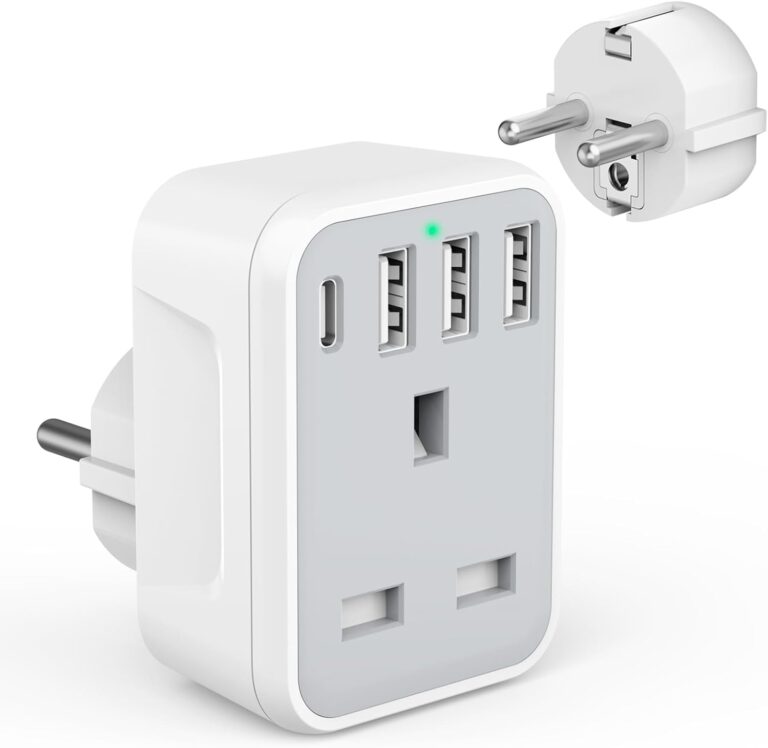
The first choice is grounded (earthed) vs ungrounded. An ungrounded (Type C) adapter is fine for phones and other low-wattage two-pin devices. For laptops, hair tools, and anything with a three-pin UK plug, use a grounded CEE 7/7 adapter — the earth pin matters.
If any of your devices charges via USB-C, look for a built-in USB-C PD port rated at 30W or above. A 5W USB-C port charges your phone overnight but barely registers on a laptop — the wattage is on the box, and it’s worth checking.
Travelling with young children? Look for adapters with shuttered contacts — the same spring-loaded covers that UK sockets have. Not all EU adapters include them.
CE marking is worth checking. Cheap unmarked adapters from no-name sellers have failed electrical safety tests, and an overheating adapter in a hotel socket is not a problem you want at 2am.
On compact vs universal: a world adapter handles every country in one unit, but they’re bulky — which is exactly what causes the recessed socket problem. Two slim EU adapters plus a UK extension lead takes up less space and causes fewer problems.
Where to Buy an EU Plug Adapter in the UK
You can buy a European plug adapter almost anywhere. Here’s what to expect on price.
Before your trip (UK):
- Amazon: widest selection, £4-20 depending on features. A grounded CEE 7/7 adapter costs £6-10.
- Argos: reliable stock, similar prices. Good for last-minute.
- Currys: worth checking for adapters with USB-C PD.
- Boots or supermarkets: basic adapters at £5-8. Fine for phones and tablets.
At Heathrow: Go Travel sells basic adapters at around £6 and USB-equipped versions at around £13. Not as bad as airport prices usually are — if you forget one, it’s not a disaster.
In Europe on arrival: MediaMarkt and Saturn (electronics chains across Germany, Spain, Austria, Netherlands) sell adapters for €5-15. Carrefour and most supermarkets stock basic ones for €3-8. Bazaar/pound-shop equivalents have €2-5 options that are functional for a week’s trip. Airport shops in Europe are typically 2-3x street price.
The best strategy: buy before you travel, bring two slim adapters plus a UK extension lead. But if you forget, you won’t be stranded anywhere in Europe — they’re available everywhere within an hour of landing.
Frequently Asked Questions
What plug adapter do I need for Europe as a UK traveller?
A standard UK-to-EU adapter (Type G to Type C/E/F) covers most of continental Europe. Three exceptions: Switzerland needs Type J, Italy uses Type L (though Type C fits most sockets), and Denmark needs Type K — check your adapter includes it.
Do I need a voltage converter for Europe?
No. The UK and continental Europe both use 230V at 50Hz. UK devices work with just a plug adapter. US travellers should check their device labels — anything showing “100-240V” needs only an adapter; “120V only” needs a converter.
Why does my EU adapter keep falling out of the wall?
Type F (Schuko) sockets are recessed 15mm into the wall. Bulky adapters protrude out of the recess and lose contact under the weight of a charger. Use a slim barrel-style adapter, or plug a UK extension lead into the adapter so heavy chargers sit on a surface rather than hanging off the wall.
Can I use a Type C adapter for a hair dryer in Europe?
No. A basic Type C (Europlug) adapter is rated at 2.5A — a maximum of 575W at 230V. A hair dryer draws 1,200-2,200W and will overload it. Use a grounded CEE 7/7 or Type F adapter rated for the wattage.
Does my EU adapter work in Denmark?
Not if it’s a standard EU adapter. Denmark uses Type K, which is different from the Type C/E/F standard. Most universal adapters labelled “all of Europe” include Type K, but basic two-packs often don’t. Check before you travel.
Will my EU adapter work in Switzerland?
A standard Type C adapter works in most modern Swiss sockets for low-power devices (phones, laptops, chargers). Swiss outlets officially use Type J, so for grounded or high-wattage devices you need a proper Type J adapter.
Can I use a CPAP machine in Europe?
Almost certainly yes. Check the label on your power brick — if it says “Input: 100-240V, 50-60Hz” it’s universal and needs only a plug adapter. Use a grounded CEE 7/7 adapter (the UK brick has a three-pin plug and you want an earthed connection for overnight use). Don’t use a voltage converter with a CPAP.
Why does my MacBook feel like it’s vibrating when I charge it in Europe?
You’re getting a mild tingling from an ungrounded charger. The compact duck-head EU adapter has no earth pin, which causes capacitive coupling through the metal chassis. Use the Apple extension cable version of the charger (the one with the thin white cable) instead — it has an earth pin and eliminates the sensation.
Related
- Travel Adapter Guide
- Worldwide Plug Adapter Types
- Type G Plug Guide (UK and Commonwealth)
- Spain Plug Adapter
- Italy Plug Adapter
- Greece Plug Adapter
- Portugal Plug Adapter – Type F at 230V, same Schuko standard as Spain and Germany
Same plug standards beyond Europe
The EU adapter you buy for France or Spain also works in several non-European destinations that use Type C and Type F sockets:
- Indonesia Power Plug Type – Type C/F, 230V (Bali, Jakarta and beyond)
- Jordan Electric Plug – mostly Type C/F at 230V, with some Type G in newer hotels
- Egypt Plug Adapter – Type C/F at 220V
- Turkey Plugs and Sockets – Type C/F at 230V
- Switzerland Travel Guide