Spain Plug Adapter Guide: Sockets, Voltage & What Actually Works
I arrived at my Barcelona hotel at midnight, exhausted from the journey, only to discover my phone charger wouldn’t fit the wall socket. The hotel reception had adapters for sale at triple the airport price. Since then I travel with at least two spain plug adapters for any European trip, and I test them before leaving home.
What nobody told me before that first trip: the problem wasn’t just that I had the wrong adapter. It was that the Spanish socket is deliberately recessed into the wall, and the chunky universal adapter I eventually bought barely fit the hole. Spain’s plug situation is simple once you understand it. Showing up unprepared just means paying over the odds or hunting through an unfamiliar city for an electronics shop.
Quick answer: Spain uses Type F (Schuko) sockets at 230V/50Hz. UK visitors need a UK-to-EU adapter but no voltage converter. US visitors need an adapter and should check devices for 120V-only labels. One adapter covers all of Spain including Tenerife, Mallorca, and Ibiza.
What Plug Type Does Spain Use?
Spain uses Type F, also known as Schuko (from the German “Schutzkontakt,” meaning protected contact). It has two round 4.8mm pins and two grounding clips on the sides of the socket body.
Older articles also mention Type C (Europlug). Type C has thinner 4.0mm pins, no grounding, and is rated only 2.5A. The distinction most guides miss:
Type C plugs fit into Type F sockets, but Type F plugs do not fit into Type C sockets.
The two look similar and travellers confuse them constantly. It matters in practice: Type C sockets handle 2.5A, which is enough for a phone charger and not much else. Spain banned new Type C socket installations because ungrounded sockets are considered unsafe for modern power demands. If you find an old flat two-pin socket (flush with the wall, no recess) in a rural finca or a very old apartment, it’s a legacy Type C. Use it for low-power charging only.
In any property built after the 1990s, you’ll have recessed Type F sockets. That’s what your spain plug adapter needs to work with.
| Feature | Type C (Europlug) | Type F (Schuko) |
|---|---|---|
| Pin diameter | 4.0mm | 4.8mm |
| Grounding | No | Yes (side clips) |
| Max rating | 2.5A | 16A |
| Socket style | Flat, flush | Recessed 15–17.5mm into wall |
| Legal for new installations? | No | Yes |
| Where found | Old buildings only | Standard in Spain |
The Recessed Socket Problem — and How to Fix It
Nobody warned me about this, and it’s the thing I wish every Spain packing guide covered. The Type F socket sits 15–17.5mm recessed inside a circular opening in the wall. It’s intentional: the recess stops fingers touching live pins during insertion. The circular opening accepts the cylindrical plug body flush with the wall.
The trouble is what this does to adapters.
Large block-shaped universal travel adapters often can’t enter the circular recess at all. The body is too wide or too square for the round opening. The ones that do fit tend to stick out at an angle under the weight of the cable, and slowly pull free. This is behind most “my adapter keeps falling out of the Spanish socket” searches.
The heavier the adapter, the worse it gets. On a wall socket that isn’t perfectly vertical, gravity does the rest.
The best fix I’ve found is also the cheapest: those thin white snap-on two-pin adapters (£1-3 each, or €2 at a Spanish bazar) often outperform expensive universal adapters. The pin head sits flush in the recess with nothing protruding, and they’re light enough not to sag.
For families or villa stays with multiple devices, a UK multi-socket extension lead works even better. One slim EU adapter goes from the wall to the extension lead. Everything else plugs into the extension using its normal UK plug. The lead sits on the floor or a table, removing all weight from the wall socket entirely.
A third option: cylindrical barrel-style UK-to-EU adapters designed to sit flush inside recessed sockets. Look specifically for ones described as “recessed socket compatible” before buying.
If you’re already in Spain and your adapter keeps falling out, rest the cable on a nearby shelf to reduce the downward pull. It’s the cable weight that causes the problem, not the connection itself.
Do You Need a Spain Plug Adapter? (By Country)
| Travelling from | Plug type | Adapter needed? | Converter needed? |
|---|---|---|---|
| UK | Type G (3 rectangular pins) | Yes | No (both 230V/50Hz) |
| USA / Canada | Type A/B (flat pins) | Yes | Only for 120V-only devices |
| Australia / New Zealand | Type I (angled flat pins) | Yes | No (both 230V/50Hz) |
| Ireland | Type G (same as UK) | Yes | No |
| Europe (Germany, France, etc.) | Type C / E / F | No | No |
| Portugal | Type F | No | No |
Do UK Visitors Need a Voltage Converter?
No. Spain runs at 230V/50Hz, the same as the UK. You need the adapter to change pin shape, not voltage.
A note on what you may read elsewhere: older articles, including spain.info (the official tourism board site), still quote “220 volts.” Spain’s official standard is 230V, harmonised under the EU’s IEC 60038 standard. The 220V figure is a legacy holdover. It makes no practical difference to your devices, but 230V is correct.
Check your device label anyway. Look for “Input: 100–240V, 50/60Hz” on the charger brick. If you see that, the device is universal voltage and you only need an adapter. “230V only” still works fine in Spain. “120V only” is a US-spec appliance that won’t work and could be damaged.
Will My Device Work in Spain?
| Device | UK version | US version |
|---|---|---|
| Phone charger / laptop | ✓ (100-240V) | ✓ (100-240V) |
| Camera charger (Canon/Nikon/Sony) | ✓ (100-240V) | ✓ (100-240V) |
| DJI drone charger | ✓ (100-240V) | ✓ (100-240V) |
| CPAP machine (ResMed, Philips) | ✓ (100-240V) | ✓ (100-240V) |
| GHD hair straighteners | ✓ (dual voltage) | ✓ (dual voltage) |
| Dyson Airwrap | ✓ (230V UK model) | ✗ (120V US model) |
| Dyson Supersonic dryer | ✓ (230V UK model) | ✗ (120V US model) |
| Hair dryer (dual voltage, 100-240V) | ✓ | ✓ |
| Hair dryer (120V only) | N/A | ✗ — will burn out |
| E-bike charger (Bosch, Shimano) | ✓ (100-240V) | ✓ (100-240V) |
| Baby monitor power brick | ✓ (check label) | ✓ (check label) |
The Dyson Airwrap and Supersonic are single-voltage by market, not dual voltage. A UK-bought Airwrap is 230V and works in Spain with just an adapter. A US-bought Airwrap is 120V and won’t work on Spain’s 230V even with an adapter — an adapter changes pin shape only. Check the voltage on the motor unit itself, not the cable.
GHD straighteners (Platinum+, Gold, Helios) are all dual voltage (100–240V). Check the label near the cable on the device itself, not the box. Some older GHD models, including the 3.1b, have a label reading “230V only” rather than “100–240V” — that still works fine in Spain, since Spain’s supply is 230V.
Almost all modern CPAP machines — ResMed, Philips Respironics, DeVilbiss — are 100–240V universal. Check the power brick label. A surge protector is worth packing for villa or rural stays where supply quality can be patchier than in city hotels.
A 120V-only US hair dryer won’t survive Spain’s 230V supply. Leave it at home. Spanish hotels have dryers in the rooms; for villa stays, a dual-voltage travel dryer is the answer.
For e-bike chargers, use only the recessed Type F Schuko sockets. Don’t plug a high-draw charger into an old flat Type C socket.
Charging USB-C Devices in Spain
Most USB-C charger bricks — phones, laptops, tablets — are 100–240V universal voltage regardless of where they were bought. The pin shape is the only obstacle, and a spain plug adapter sorts it.
If your USB-C charger has a UK Type G plug on the brick, that’s all you need to swap. The charger itself handles Spain’s 230V without issue. If you’re using a compact GaN charger — Anker Nano, Ugreen Nexode, Baseus — check the prongs before you pack. Many of these ship with EU prongs or have a dedicated EU version, so you may not need a separate adapter at all.
There’s one thing nobody warns MacBook users about. If you’ve plugged in at a Spanish hotel and felt a mild vibration or static through the aluminium case, the cause is an ungrounded Type C adapter. Without an earth connection, leakage current has nowhere to go except through the chassis and into you. It’s harmless — the current is well below any dangerous level — but it’s alarming if you don’t know what’s happening. Switch to a grounded Type F (Schuko) adapter. Both Type C and Type F adapters physically fit Spanish sockets, but only Type F provides a proper earth path and stops the tingle.
iPhone 15+, iPad Pro, and AirPods Pro are all USB-C. If your charger already has EU pins, nothing extra is needed. UK plug on the brick: one EU adapter handles it.
What About the Shaver Socket in Hotel Bathrooms?
If you’ve used a Spanish hotel bathroom, you’ve probably spotted the small oval socket near the mirror. It’s not a standard Type F power point. It’s a dedicated shaver socket, isolated by a transformer for bathroom safety.
These sockets take EU-style round pins and are rated for low current only: electric shavers and electric toothbrushes are fine. Don’t try to plug in a hair dryer, straighteners, or a laptop. They can’t handle the load, and some simply won’t connect the circuit at all.
For anything beyond a shaver or toothbrush, use your EU adapter in the main room socket. If the bathroom socket is awkwardly positioned behind the mirror, it’s usually easier to charge a toothbrush from a USB port on your travel adapter in the bedroom.
Why Spanish Sockets Have No On/Off Switch
UK visitors often notice the absence of a switch on Spanish (and all continental European) sockets. It feels odd if you’re used to the UK. It isn’t unsafe.
The UK’s ring main system connects multiple sockets around a shared circuit with a high-rated circuit breaker. That breaker is too coarse to protect individual appliance cables, so the solution was the fused plug — a fuse in every plug, sized to the specific appliance. Socket switches came along around 1967 as a separate convenience feature, unrelated to the ring circuit design, and they’ve never been required by any wiring regulation. Continental Europe uses radial circuits with smaller breakers sized to each socket, so neither fused plugs nor socket switches were needed. Different approach, same safety outcome.
There’s no practical risk from an unswitched socket. Unplug things if you prefer, but you don’t need to.
Is It the Same in Tenerife, Mallorca, and Ibiza?
Yes. Whether you’re going to Tenerife, Gran Canaria, Lanzarote, Fuerteventura, Mallorca, Menorca, Ibiza, or Formentera, the same 230V/Type F standard applies as mainland Spain. One adapter covers every Spanish destination.
Same Adapter for Portugal, France, Germany, and Italy?
If you’re combining Spain with other European destinations, one EU adapter covers most of it:
| Country | Plug Type | Same Spain Adapter? |
|---|---|---|
| Portugal | Type F | Yes — identical |
| France | Type E | Yes — CEE 7/7 plug works in both |
| Germany | Type F | Yes — identical to Spain |
| Netherlands | Type F | Yes |
| Greece | Type F | Yes |
| Italy | Type F / Type L | Mostly yes — Type L sockets in older Italian buildings won’t accept a standard EU adapter |
Spain and Portugal are identical: same plug, same voltage, no change needed.
France uses Type E (not Type F), but the CEE 7/7 plug sold by most UK adapter brands works in both French and Spanish sockets. No swap needed.
Italy is mostly fine with an EU adapter. The catch is older Italian buildings use Type L (three pins in a row), where a standard EU adapter won’t fit. For a week in Rome you’ll almost certainly be fine. For rural Italy, pack an Italy-specific adapter as backup.
Choosing a Spain Plug Adapter
The cheapest option — a basic 2-pin snap-on adapter at £3–5 — is all most people need for a short trip. It converts pin shape and nothing else. No USB, no bulk, and critically, the small head fits Spanish recessed sockets without fighting. Buy a 2-pack: they’re cheap enough and easy to lose.
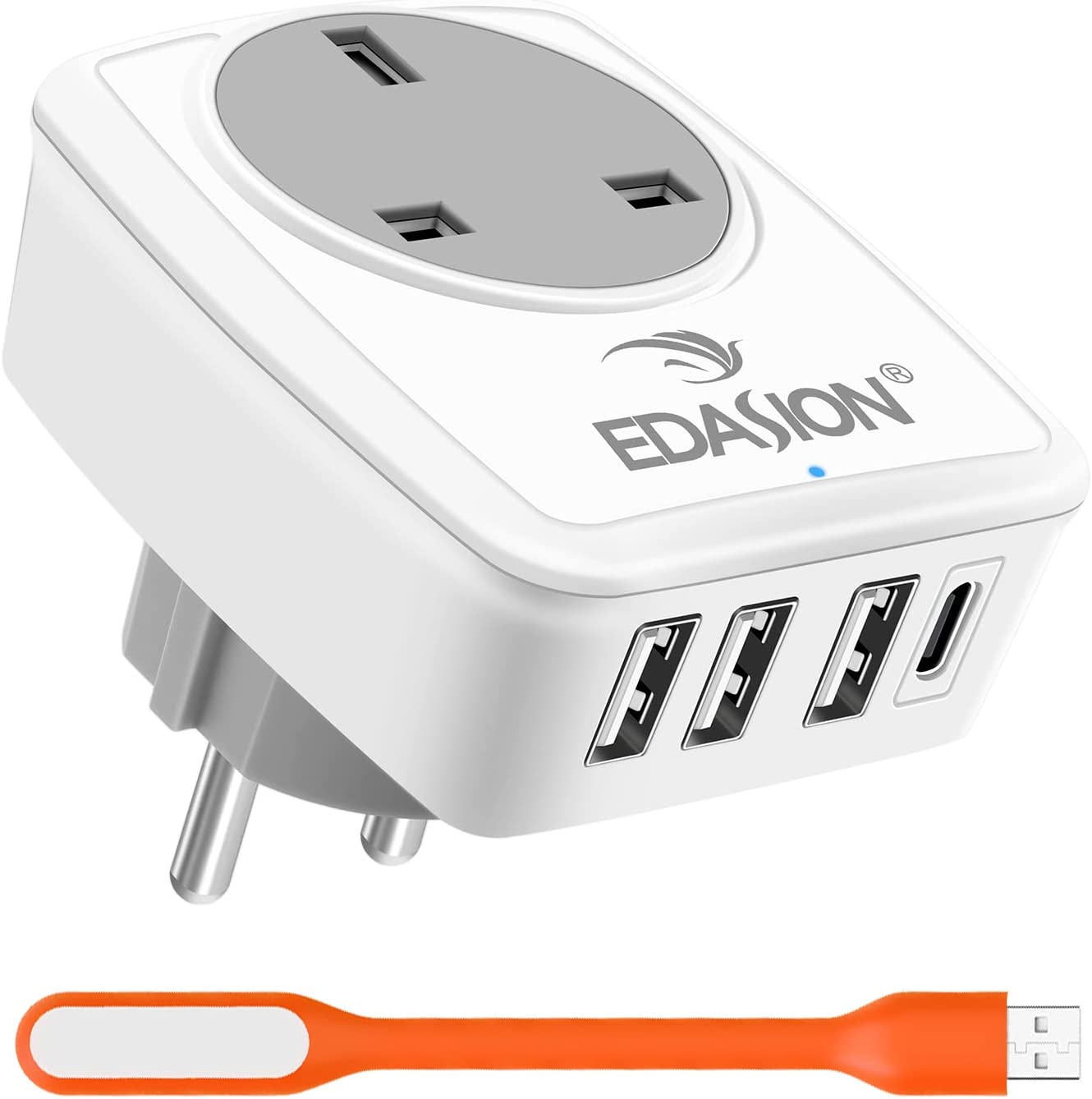
For families or anyone with multiple devices to charge, an adapter with USB-A and USB-C ports (£8–15) saves fussing with a separate charging hub. Check the head dimensions before buying; some USB adapter blocks are too wide for deeply recessed sockets.
Universal adapters at £15–25 cover EU, US, Australia, and the UK in one unit. Good for frequent multi-region travellers, but bulkier. Test it fits in a Spanish socket before relying on it.
My own preference for villa stays: one basic adapter into the wall, a UK extension lead into the adapter, and everything else charges normally off the extension. No adapter weight on the socket, no sagging, one adapter for the whole room.
Spain Plug Adapter Tips for Families
A family of four on a Mallorca or Tenerife trip might arrive with two phones, two tablets, a baby monitor, and a bottle warmer. That’s five or six devices from whatever sockets the holiday apartment has — often just two or three, positioned at floor level or half behind the wardrobe.
One slim EU adapter from the wall to a UK extension lead is far simpler than buying multiple adapters or playing musical sockets. Everything charges normally off UK plugs; the adapter carries no weight from the socket.
Newer Spanish properties have shuttered sockets as standard, so the holes won’t accept anything but a proper plug. Older holiday apartments — rural fincas, some coastal properties built before the mid-2000s — may not. If you’re travelling with toddlers, look specifically for adapters with built-in safety shutters; they’re labelled as such on Amazon and in travel shops.
Baby bottle warmers (Philips Avent, Tommee Tippee, MAM) are typically rated 220–240V on UK models — check the label on the base of the unit. They work in Spain because Spain’s 230V supply falls within that range. Baby monitor power bricks (Motorola, VTech, Philips Avent) are switching adapters, typically 100–240V universal. Either way, only a spain plug adapter is needed to sort the pin shape.
Spain Plug Adapter Setup for Long Stays and Digital Nomads
Spain is one of Europe’s top digital nomad destinations — Valencia, Barcelona, and Malaga all have established co-working scenes, and the Digital Nomad Visa has been accepting applications since 2023. For a month-long stay, one adapter in the wall isn’t really going to cut it.
Worth buying a Spanish power strip at MediaMarkt or FNAC when you arrive. Around €8–15 gets you a Type F plug on the bar with multiple Spanish sockets along it. Plug it into the wall and everything charges at desk height without a separate adapter for each device. Leave it when you go, or pack it for the next trip.
If you’d rather not buy locally, the UK extension lead approach works just as well: one EU adapter to the wall, extension lead to the desk.
One thing worth knowing about older apartments in Madrid and Barcelona: supply fluctuations in summer are more common than in city hotels, particularly during peak air conditioning load. For a long stay with a laptop you care about, a travel surge protector (£8–15 on Amazon) is worth the space in the bag.

Where to Buy a Spain Plug Adapter
Amazon before you travel is the sensible choice. A 2-pack of basic EU adapters costs £4–6; one with USB ports runs £8–15. Buy before you go — airport prices are roughly 2–3x street price.
Large supermarkets (Tesco, Sainsbury’s) stock basic EU adapters for £3–6 near the travel accessories section.
At UK airports, Dixons and WHSmith will have something for £10–20. Useful if you’ve forgotten, expensive as a plan.
Already in Spain? MediaMarkt is your best bet in most cities, at around €5–15 for something decent with USB ports. FNAC is in Madrid, Barcelona, Valencia, Seville, and Bilbao, around €8–20. El Corte Inglés charges more (€10–30) but quality is reliable. Carrefour and Hipercor stock basics for €3–8. The small bazar shops you’ll find on almost every Spanish high street usually have unbranded adapters for €2–5 that work perfectly well for phone charging on a short trip.
Spanish airports — Malaga, Barcelona El Prat, Palma — run €12–18 for a basic adapter. All prices are approximate and vary by location.
Buy a 2-pack from Amazon before you leave. The cost of one airport adapter gets you three from Amazon with change.
UK Caravans and Motorhomes at Spanish Campsites
Something that almost never gets covered:
Most Spanish campsites use the standard CEE17 blue 16A hook-up, identical to UK campsite standard. Your UK hook-up cable plugs straight in, no adapter needed.
Some older Spanish sites use domestic Type F (Schuko) sockets for hook-up instead. In that case you’ll need a Schuko-to-CEE17 adapter, available from caravan dealers and Amazon UK for around £8–15.
One thing to watch for at Spanish (and most European) campsites: reversed polarity. The live and neutral wires may be swapped at the campsite bollard. Appliances still run, but it can trigger a reversed polarity warning in UK caravan control systems (Sargent boxes and similar). A reversed polarity tester costs around £5; a polarity correction adapter cable runs £10–15 from Towsure or most caravan dealers. Worth carrying if you’re touring Europe regularly.
Travel Tips
Pack two slim EU adapters rather than one large universal adapter. They’re cheaper, they fit Spanish recessed sockets more reliably, and when one goes missing (it happens), you have a spare. A UK extension lead weighs almost nothing and turns a single Spanish socket into a full charging station for a family of four.
For rural villa or finca stays, a small surge protector is worth packing for laptops and anything expensive. Supply quality varies more in rural areas than in city hotels.
Related Guides
Destinations
Travel Adapters
Travel Essentials
Frequently Asked Questions
What plug adapter do I need for Spain?
You need a UK-to-EU adapter that converts your UK three-pin plug (Type G) to the two-round-pin format used in Spain (Type F/Schuko). Spain uses 230V at 50Hz, the same as the UK, so no voltage converter is needed. Look for a slim, cylindrical adapter head that fits inside Spain’s recessed sockets rather than a large block-style universal adapter.
What plug type does Spain use?
Spain uses Type F sockets (Schuko): a recessed round socket with two 4.8mm round holes and grounding clips on the sides. Type C (Europlug) was used in older buildings but is banned for new installations. In any modern Spanish property you’ll encounter recessed Type F sockets.
Do I need a voltage converter for Spain?
No, if you’re coming from the UK, Ireland, or Australia — all run at 230V, same as Spain. US visitors should check device labels: if it says “100–240V,” only a plug adapter is needed. If it says “120V only” (common with US hair dryers and older appliances), the device can’t be used in Spain without a step-down converter.
Why does my adapter keep falling out of the Spanish wall socket?
Spanish Type F sockets are recessed up to 17.5mm into the wall as a safety feature. Heavy or bulky adapters protrude from the recess and sag under cable weight, losing contact. The fix: use the thinnest, lightest EU adapter you can find (the cheapest ones often work best), or bring a UK extension lead with one slim adapter from the wall, removing all the weight from the socket.
Will my Dyson Airwrap work in Spain?
It depends where it was bought. A UK-purchased Dyson Airwrap is 230V and works in Spain with a UK-to-EU adapter. A US-purchased Airwrap is 120V and won’t work on Spain’s 230V supply even with an adapter, which only changes pin shape. Check the voltage label on the motor unit itself.
Do the Canary Islands use the same plugs as mainland Spain?
Yes. Tenerife, Gran Canaria, Lanzarote, Fuerteventura, and the other Canary Islands all use 230V/50Hz Type F sockets, identical to mainland Spain. The same adapter works everywhere in Spain including the islands.
Is the plug the same in Spain and Portugal?
Yes. Portugal uses Type F sockets at 230V/50Hz, identical to Spain. The same adapter works in both countries.
Where can I buy a plug adapter in Spain?
MediaMarkt and FNAC in major cities sell decent adapters for €5–20. Carrefour and Hipercor supermarkets sell basics for €3–8. Bazar shops on most high streets have unbranded adapters for €2–5, fine for phone charging. Spanish airports charge €12–18. Best value: buy a 2-pack on Amazon before you travel.
What is the shaver socket in Spanish hotel bathrooms?
The small oval socket near the bathroom mirror is a dedicated shaver socket, isolated by a transformer for bathroom safety. It accepts EU round pins and is rated for low current only: shavers and electric toothbrushes. Don’t plug a hair dryer, straighteners, or laptop into it. Use a standard EU adapter in the main room socket for anything with higher power demands.
Why does my MacBook vibrate or tingle when charging in Spain?
Nothing is wrong with the socket or your adapter. The effect happens when using an ungrounded Type C adapter — with no earth connection, leakage current has nowhere to go except through the laptop chassis and you. It’s harmless but unsettling. The fix is to use a grounded Type F (Schuko) adapter rather than an ungrounded Type C. Both physically fit Spanish sockets, but only Type F provides a proper earth path and eliminates the sensation.
Do I need a different adapter for a long stay in Spain?
For a short trip, one slim EU adapter works fine. A month or more is a different matter — Spanish apartment sockets are frequently at floor level or behind furniture, which gets old fast. Buy a Spanish power strip at MediaMarkt or FNAC when you arrive (around €8–15). It plugs directly into the wall and gives you sockets at desk height without the adapter juggling.
Can I use my baby bottle warmer in Spain?
Most UK baby bottle warmers (Philips Avent, Tommee Tippee, MAM) are rated 220–240V — check the label on the base of the unit. They work in Spain because Spain’s 230V supply falls within that range. If your label says 100–240V, that’s universal voltage and works anywhere. The only models to avoid are 120V-only, which are US-spec and won’t survive Spain’s 230V supply. In all cases, only a spain plug adapter is needed to sort the pin shape.