Type G Plug: Countries, Voltage and Travel Adapter Guide
The first time I genuinely thought about the Type G plug was when I tried to charge my phone in Singapore in 2018. I’d packed for what I assumed would be a Type C or Type F country and arrived to find the same chunky three-pin sockets I have at home in Oxfordshire. No adapter needed. That was useful — but it also flipped the usual question: instead of asking which adapter I needed for Singapore, I started wondering which other countries use Type G, and which ones look like they might but don’t.
The Type G plug is the British three-pin standard. It is used in roughly fifty countries and territories around the world, mostly former British colonies and Commonwealth members. If you live in the UK, the Type G plug is the only one you ever see at home — but knowing where else it works (and where it doesn’t) genuinely changes how you pack.
What is a Type G plug?
The Type G plug is the rectangular three-pin plug used as standard across the United Kingdom and Ireland. It is defined by British Standard BS 1363, first published in 1947 and still the spec in force today.
Three features make it different from every other plug type in the world:
- Three rectangular pins in a triangular layout — earth pin on top, live and neutral pins below
- A built-in fuse in the plug itself (typically 3 A, 5 A, or 13 A)
- An earth pin that operates a shutter inside the socket, which only opens when the longer earth pin is inserted first
That last detail is the one most people never notice. Try pushing a paperclip into a UK socket without a plug in it — you cannot reach the live or neutral terminals. The shutter only opens when the earth pin pushes it aside. It is the safest mains plug design in the world, and it is also the largest and heaviest.
Type G plug countries: where Type G is used
I have travelled to most of the obvious Type G countries (UK, Ireland, Hong Kong, Singapore) and a few of the less obvious ones (Malta, Cyprus, the UAE). The full list is longer than most travellers realise.
| Country / territory | Type G | Other types in use |
|---|---|---|
| United Kingdom | Yes — universal | None |
| Ireland | Yes — universal since 1973 | Type F (Schuko) very occasionally in pre-1973 properties |
| Cyprus | Yes — universal | None officially |
| Malta | Yes — universal | Some Type F in modern hotels |
| Gibraltar | Yes — universal | None |
| Singapore | Yes — universal | None |
| Hong Kong | Yes — universal | Some older buildings have Type D or Type M |
| Malaysia | Yes — common | Type C and Type M also widespread |
| Brunei | Yes — universal | None |
| United Arab Emirates | Yes — common | Type C and Type D in older buildings |
| Saudi Arabia | Yes — common | Type A and Type B in newer buildings |
| Bahrain | Yes — universal | None |
| Qatar | Yes — common | Type D in older buildings |
| Yemen | Yes — common | Type A and Type D also in use |
| Iraq | Yes — common | Type C and Type D also in use |
| Kenya | Yes — universal | None |
| Uganda | Yes — universal | None |
| Tanzania | Yes — universal | None |
| Ghana | Yes — universal | None |
| Nigeria | Yes — common | Type D also in older buildings |
| Botswana | Yes — universal | None |
| Zimbabwe | Yes — universal | Type D in older buildings |
| Sri Lanka | Yes — common | Type D also widespread |
| Maldives | Yes — common | Type C, D, J, K, L all in use |
There is no universal rule. In Sri Lanka, for example, a beach resort built in 2010 will use Type G; a smaller guesthouse in Galle might still use Type D. In the UAE, Dubai’s modern hotels are reliably Type G, but I have seen Type C and Type D in older buildings in Sharjah. Pack a multi-region adapter when you are not certain.
Type G plug voltage and frequency
The Type G plug is rated to carry up to 240 V and 13 A, but actual mains voltage varies by country.
| Country | Voltage | Frequency |
|---|---|---|
| United Kingdom | 230 V (officially) — typically 240 V in practice | 50 Hz |
| Ireland | 230 V | 50 Hz |
| Singapore | 230 V | 50 Hz |
| Hong Kong | 220 V | 50 Hz |
| Malaysia | 240 V | 50 Hz |
| United Arab Emirates | 220 V | 50 Hz |
| Kenya | 240 V | 50 Hz |
| Cyprus and Malta | 230 V | 50 Hz |
For most travellers, voltage is not something to worry about between Type G countries. Anything that runs at home in the UK runs everywhere on this list. The 220–240 V range is well within the tolerance of any modern device. American visitors carrying 110 V-only equipment (some hair dryers, older shavers) need a step-down converter, not just an adapter.
The BS 1363 fuse: what makes Type G unique
Every Type G plug contains a cartridge fuse. The fuse rating is matched to the appliance:
- 3 A fuse — devices up to 700 W (radios, lamps, phone chargers)
- 5 A fuse — devices up to 1,200 W (some older small appliances)
- 13 A fuse — devices up to 3,000 W (kettles, hair dryers, heaters)
If the appliance draws more than its fuse allows, the fuse blows before the cable can overheat. This is why a UK kettle plug is bigger and heavier than a European one — the fuse is built into the plug itself, not into a wall fuse box covering an entire room. It is also why a snapped-off, cheap travel adapter can be more dangerous than the original UK plug it replaced.
When you buy a travel adapter for use abroad, check whether it has its own fuse. Better adapters do. Cheap ones bypass the fuse entirely, which is fine for a phone charger but not for anything that draws real current.
The Irish electrical plug: same as the UK
The Irish electrical plug is Type G — the same three-pin rectangular plug used in the United Kingdom. Ireland made Type G its sole standard in 1973, transposing BS 1363 into Irish standards I.S. 401 and I.S. 411. There is no functional difference between the plug used in Dublin and the plug used in London.
For UK travellers visiting Ireland:
- No travel adapter needed.
- Voltage is 230 V at 50 Hz, identical to the UK in practice.
- Every UK device — phone charger, laptop, hair dryer, kettle plug — works straight into an Irish socket without a converter.
For travellers from outside the UK or Ireland:
- US visitors need a Type A/B-to-G adapter, plus a step-down voltage converter for any 110 V-only equipment.
- EU visitors need a Type C/E/F-to-G adapter (a standard “EU to UK” travel adapter).
- Australian or New Zealand visitors need a Type I-to-G adapter.
One caveat: before 1973 Ireland had no single standard, and both German Schuko (Type F) and British Type G were installed. Type F sockets can still very occasionally be found in pre-1973 rural homes and small B&Bs. This is rare, and you will not encounter it in modern hotels, Airbnbs, or city-centre rentals. If you do, a basic two-pin Europlug fits a Schuko socket.
The fuse system inside the Irish electrical plug is identical to the UK system: 3 A, 5 A, or 13 A cartridge fuses inside each plug, matched to the appliance’s power draw.
Travel adapters: when you need one
The decision tree is simple.
UK traveller going to a non-Type G country
You need a UK-to-local adapter. The right one depends on the destination.
- France, Spain, Portugal, Germany, Italy — Type C and E/F adapter
- France specifically — Type E
- Germany — Type F
- Italy — Type C, F, and L
- Spain — Type C and F
- Portugal — Type C and F
- Croatia — Type C and F
- Egypt — Type C and F
- Japan — Type A and B (also voltage difference: 100 V)
- Thailand — Type A, B, and C; some Type F
- Turkey — Type C and F
UK traveller going to a Type G country
No adapter needed. Your kettle, hair dryer, and laptop charger work straight out of the suitcase. Pack a UK-style plug strip if you have multiple devices and the room only has one socket.
The exceptions to watch for: older hotels in Hong Kong, Malaysia, Sri Lanka, the UAE, and Saudi Arabia sometimes use Type D or Type C alongside Type G. A multi-region adapter solves this for under £15 and means you do not have to worry about it on arrival.
Visitor from a non-Type G country coming to the UK
You need a local-to-UK adapter. EU travellers need a Type C/E/F-to-G adapter, US travellers need an A/B-to-G plus possibly a voltage converter, Australian travellers need an I-to-G.
Recommended adapter for travel between Type G and other regions
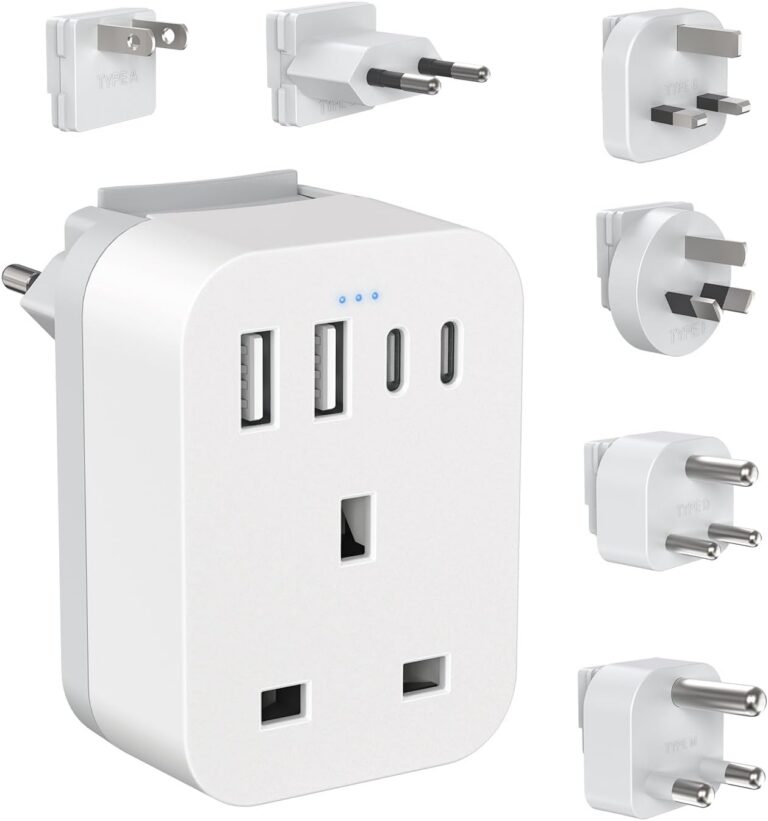
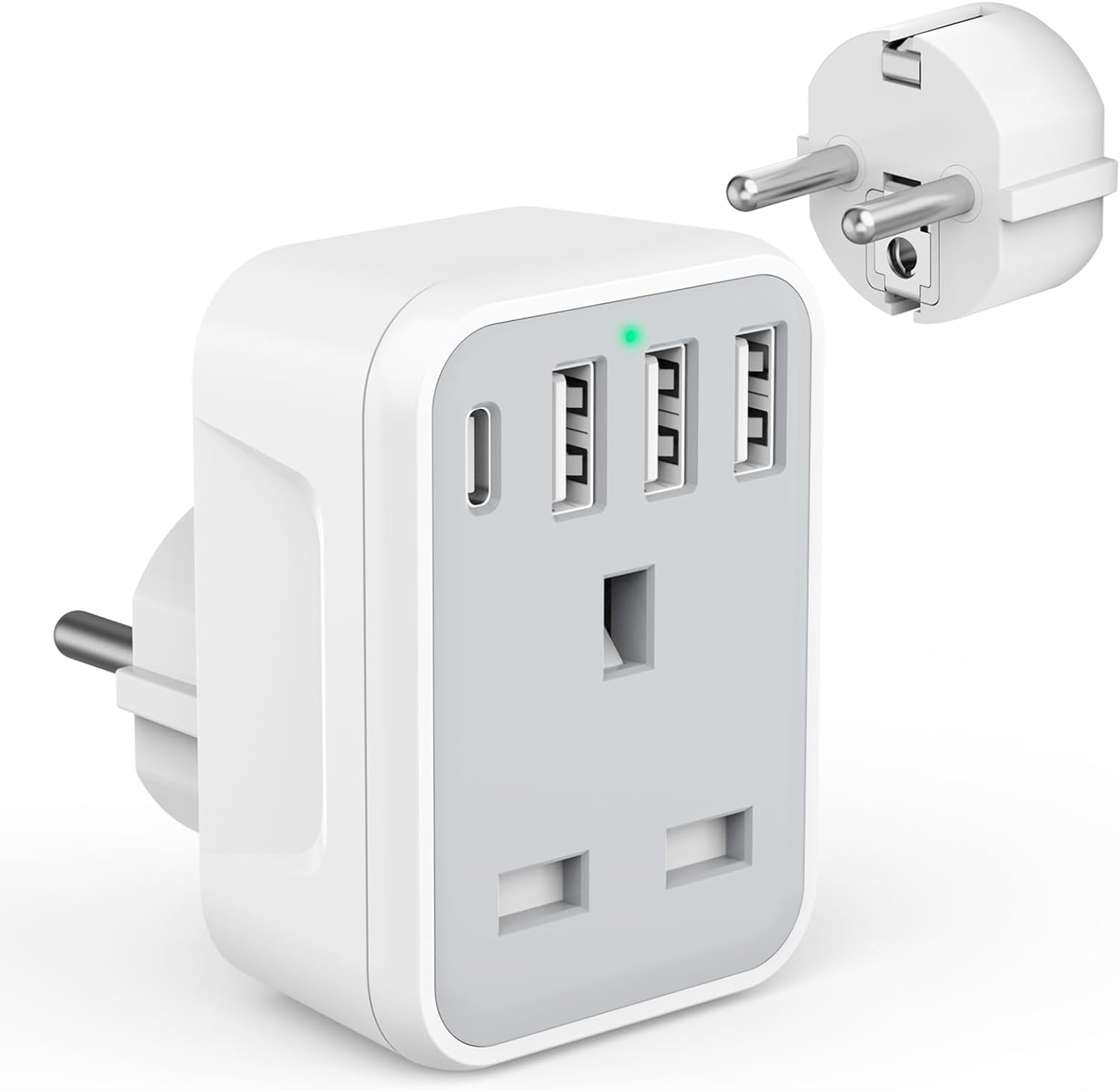
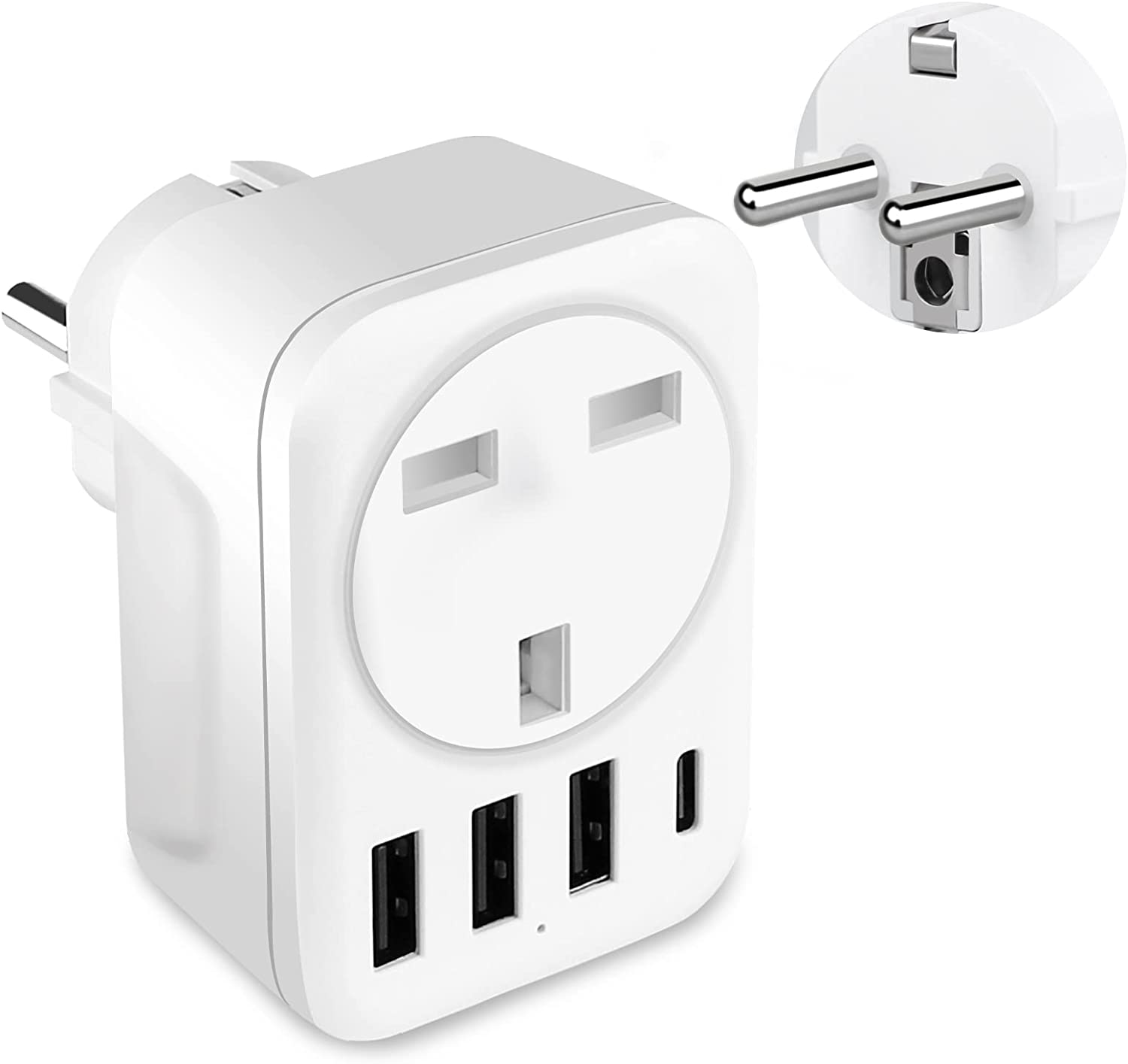
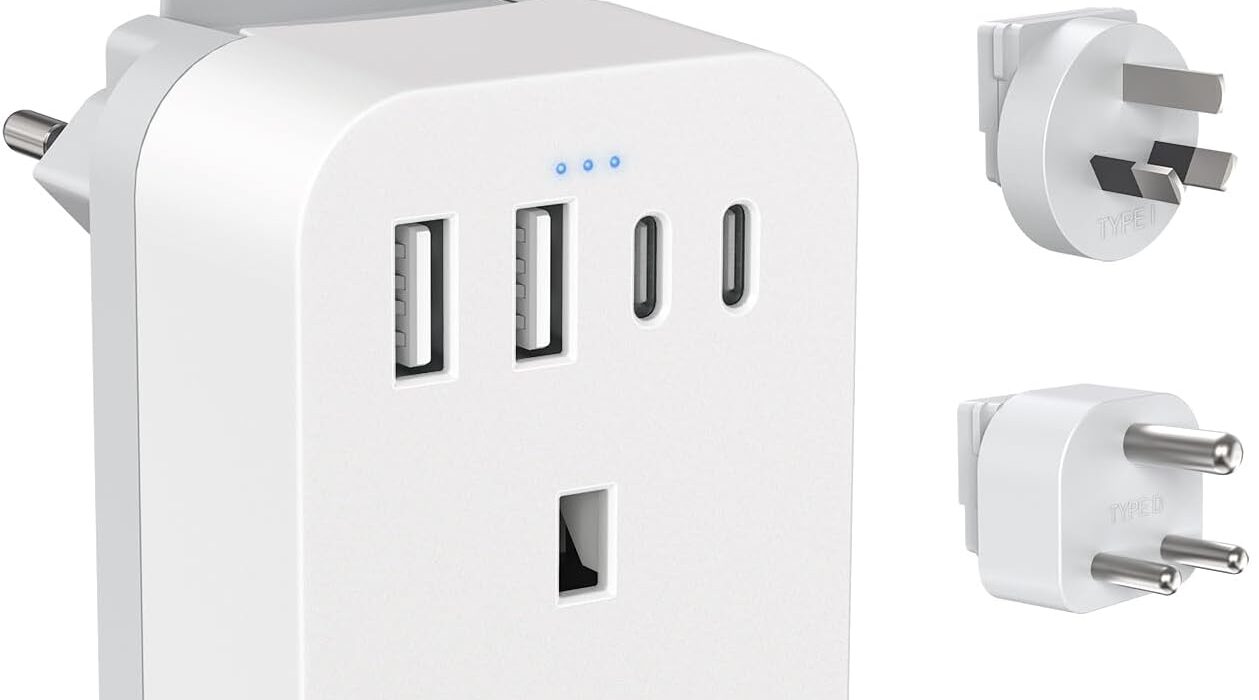
For UK travellers leaving Type G countries for Europe, a UK-to-European adapter is the single most-used adapter to pack — it accepts a Type G input and fits Type C and Type F (Schuko) sockets across France, Spain, Italy, Germany, Portugal, the Netherlands, and most of central Europe. A basic version costs under £10. Look for one with built-in USB-A and USB-C ports and a fuse for safety.
If you travel further afield (US, Asia, Australia), a true multi-region universal adapter (Type A/B/C/F/G/I in one unit) at £15-20 is worth the step up. The same unit handles every developed country on one device.
For inbound travel to the UK from elsewhere, you need an adapter going in the opposite direction (from your home plug shape to Type G). Amazon UK has a wide selection of inbound travel adapters — most cost £8–15 and fit any standard non-UK plug.
Type G plug versus other plug types
Quickly, how Type G compares to the other plugs you might encounter on the same trip.
| Type | Pins | Earth | Voltage | Where used |
|---|---|---|---|---|
| Type G (UK) | 3 rectangular | Yes (top pin) | 230–240 V | UK, Ireland, Singapore, Hong Kong, UAE, Kenya, etc. |
| Type C (Europlug) | 2 round | No | 220–240 V | Most of Europe, plus low-power devices worldwide |
| Type E (France) | 2 round + socket pin | Yes (socket) | 230 V | France, Belgium, Poland, Czech Republic |
| Type F (Schuko) | 2 round + side clips | Yes (side clips) | 230 V | Germany, Spain, Netherlands, most of central Europe |
| Type I (Australia/NZ) | 3 angled flat pins | Yes | 230 V | Australia, New Zealand, China |
| Type A (US flat) | 2 flat | No | 110–120 V | USA, Canada, Mexico, Japan |
The practical takeaway: a multi-region adapter that covers Type C, E/F, G, A/B, and I will handle every developed country in the world. That is what I pack now, and I have not opened my “destination-specific” adapter drawer in two years.
Frequently asked questions
What is a Type G plug?
A Type G plug is the British three-pin plug defined by BS 1363. It has a triangular layout — earth pin on top, live and neutral on the bottom — and a built-in fuse rated 3 A, 5 A, or 13 A. It is used across the UK, Ireland, and most former British colonies and Commonwealth countries, including Singapore, Hong Kong, Malaysia, the UAE, and much of east Africa.
Which countries use Type G plugs?
Around fifty countries use Type G as standard or alongside other types. The main ones are the United Kingdom, Ireland, Cyprus, Malta, Gibraltar, Singapore, Hong Kong, Malaysia, Brunei, the UAE, Saudi Arabia, Bahrain, Qatar, Iraq, Yemen, Kenya, Uganda, Tanzania, Ghana, Nigeria, Botswana, Zimbabwe, Sri Lanka, and the Maldives. Some of these countries also use Type C, D, or other plugs in older buildings.
Do I need an adapter to use a Type G plug abroad?
Only if you are going to a country that does not use Type G. The UK uses Type G, so any device with a UK plug works in any other Type G country (Ireland, Singapore, Hong Kong, the UAE, Kenya, etc.) without an adapter.
What voltage is a Type G plug?
Type G plugs are rated for 240 V and 13 A. Actual mains voltage in Type G countries ranges from 220 V to 240 V — for example, the UK is 230 V (effectively 240 V in practice), Hong Kong is 220 V, and Kenya is 240 V. All are within the operating range of any modern UK appliance.
Why does a Type G plug have a fuse?
The fuse is part of BS 1363, the British plug standard. It protects the appliance cable from overheating if the device draws more current than the cable can handle. UK fuse boxes protect the wiring in the wall; the fuse in the plug protects the flex (the cable) running between the wall and the appliance.
Is the Type G plug the safest plug in the world?
Most engineers would say yes. The combination of a recessed live and neutral pin, a longer earth pin that opens an internal socket shutter before the live pins enter, and a per-appliance fuse means a Type G socket is harder to misuse than any other major plug standard. The trade-off is size and weight — Type G plugs are the largest mains plugs in common use.
Can I use a Type G plug in Spain or France?
Not directly. Spain uses Type C and F, France uses Type C and E. You need a UK-to-EU adapter to plug a UK device into Spanish or French sockets. See our Spain plug adapter guide and France plug adapter guide for the right adapter to buy.
Is the Irish electrical plug the same as the UK?
Yes. The Irish electrical plug is Type G, identical to the UK’s three-pin rectangular plug under the BS 1363 specification. UK travellers visiting Ireland do not need an adapter. The voltage is 230 V at 50 Hz, the same as the UK in practice.
Does Hong Kong use Type G plugs?
Yes. Hong Kong uses Type G as standard, the same as the UK, so no adapter is needed. Voltage is 220 V (versus 230 V in the UK), but UK appliances tolerate that range without issue.
Does Singapore use Type G plugs?
Yes. Singapore uses Type G as the universal mains plug at 230 V. UK travellers do not need an adapter.
Does Dubai use Type G plugs?
Most modern Dubai hotels use Type G. Older buildings sometimes have Type C or Type D sockets. A multi-region travel adapter is a safer bet than relying on Type G alone — see our Dubai travel adapter guide for specifics.
Related
- EU Plug Adapter
- France Plug Adapter
- Germany Plug Adapter
- Spain Plug Adapter
- Italy Plug Adapter
- Portugal Plug Adapter
- Croatia Plug Adapter
- Egypt Plug Adapter
- Indonesia Power Plug Type
- Japan Travel Adapter
- Jordan Electric Plug — Type G in newer hotels, mixed C/F/G across the country
- Thailand Plug Adapter
- Turkey Plugs and Sockets
- Dubai Travel Adapter