Eurostar Check-In: What to Expect at St Pancras
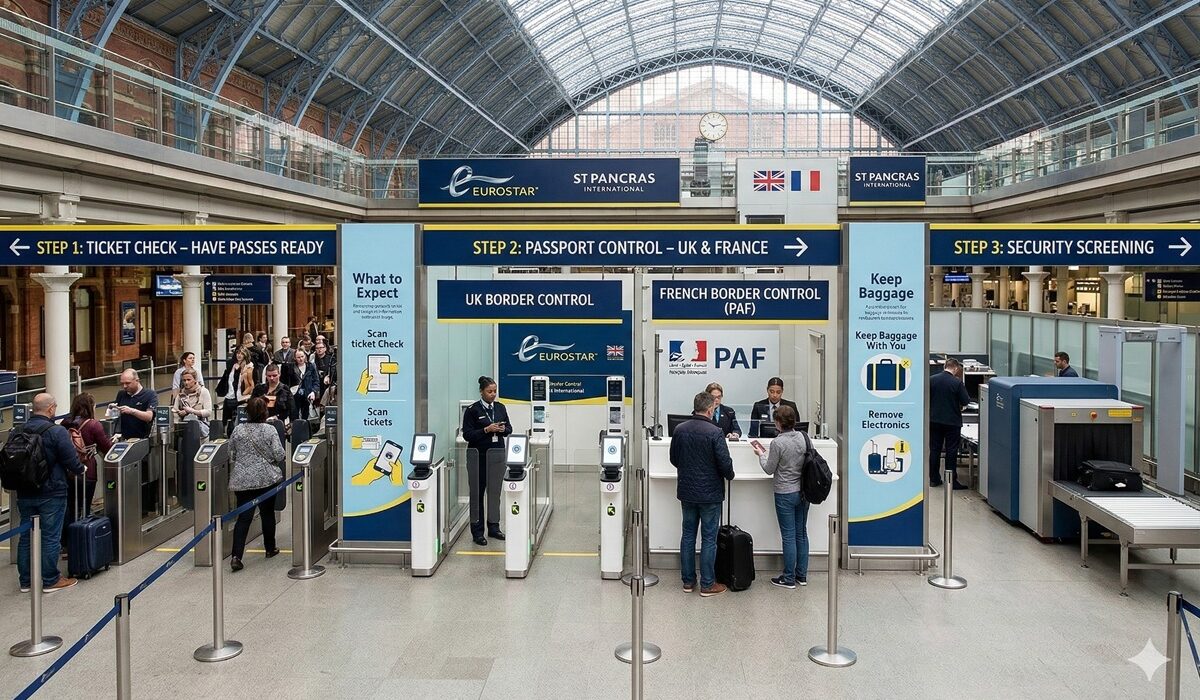
Eurostar check-in at St Pancras works like a small airport: a ticket gate, a security scan and two passport checks, all before you reach the platform. It is usually calmer than an airport, but the queues at passport control vary a lot, which is why Eurostar asks you to turn up well ahead of departure.
This guide follows the process in order, from arriving at St Pancras to boarding the train.
Where to Go at St Pancras
St Pancras International is the only Eurostar departure point in London. It sits next to King’s Cross, and the Underground station serving both is called King’s Cross St Pancras, so you’ll see both names on signs.
If you’re arriving by Tube (Northern, Victoria, Piccadilly, Circle, Hammersmith & City or Metropolitan lines), follow the signs for St Pancras International rather than King’s Cross. Inside the station, the Eurostar departures area is clearly signposted.
If you’re arriving by taxi or on foot from the Euston Road, follow the Eurostar signs from the entrance. The station is large, so allow a few minutes to walk to the ticket gates.
How Early Should You Arrive?
Eurostar’s official recommendation at St Pancras is 75 minutes before departure for Standard and Plus, and 45 minutes for Premier. The gates close 30 minutes before departure (15 minutes for Premier), and the cut-off is strict.
Take the 75 minutes seriously. You go through security and two separate passport checks, UK exit and EU entry, and if any one of those queues is long, arriving close to gate closure is a real risk. The French border check in particular can be slow during school holidays and other peak periods.
Coming back, the advice differs by station: Eurostar suggests 75–90 minutes at Paris Gare du Nord and 45–60 minutes at Brussels-Midi for Standard and Plus.
The busiest times to check in are:
- Friday mornings, early afternoons and evenings (London outbound)
- Sunday afternoons and evenings (return trips into London)
- The start and end of school holidays
- July and August
At these times, treat 75 minutes as the minimum rather than a comfortable buffer.
Step-by-Step: The Check-In Process
1. Ticket Check-In
The automated ticket gates accept the QR code on your ticket, either in the Eurostar app or printed. Scan it and walk through. Staffed desks sit alongside the gates for anything the gates can’t handle, such as group tickets or name problems.
You don’t need to print your ticket. Save it in the app for offline use before you set off so you aren’t relying on a signal at the station.
2. Security
Security is airport-style: your bags go through an X-ray machine and you walk through a scanner. The difference is that there is no 100 ml liquids restriction on Eurostar, so full-size shampoo or a bottle of wine can stay in your bag. Bags are still X-rayed.
Expect to put coats and belts in a tray, and you may be asked to take a laptop out of its bag. You may also have to lift large bags onto the belt yourself.
Prams and pushchairs are folded and go through separately, so allow a little extra time if you’re travelling with a buggy.
3. UK Passport Control (Exit)
Next comes a UK exit check, which records your departure from the UK. It is normally a quick passport scan. Have your passport open at the photo page and keep it to hand from the moment you enter the check-in area.
4. French or Belgian Border Control (EU Entry)
This is the stage that catches most first-time travellers out.
Before you board in London, you go through EU entry control for the Schengen Area. These checks are run at St Pancras by the French border police, who also handle entry for passengers travelling to Belgium. It counts as crossing the EU’s external border, and it all happens in London before departure.
The officers check your passport, or national identity card for EU citizens. EU and EEA citizens usually move through quickly. Non-EU passport holders, including UK passport holders since Brexit, use separate lanes and may be asked about the purpose of the trip, where they’re staying and when they’re coming back, so keep your hotel booking and return ticket easy to find. The EU’s Entry/Exit System (EES) has been fully operational since 10 April 2026, so non-EU travellers are registered digitally at this check.
Entry requirements for UK passport holders visiting France or Belgium:
- Visa-free stays of up to 90 days in the Schengen Area within any 180-day period
- At least 3 months of passport validity beyond your planned stay
- You may be asked to show proof of accommodation or funds; this is rare but possible
Important for the future: The EU’s ETIAS (European Travel Information and Authorisation System) is not yet in operation, and no launch date has been announced. The EU says it will confirm the date several months before launch. Once it is live, UK passport holders will need to apply online before travelling to Schengen countries, much like the US ESTA. Check the current rules at GOV.UK before you travel.
5. The Departure Lounge
Once through the controls, you wait in the Eurostar departure lounge, a secure area with seating, shops, food outlets and toilets. Premier (formerly Business Premier) passengers can use the separate Eurostar lounge, which is quieter and has complimentary food and drinks.
The main departure lounge can feel crowded on busy mornings. If you’re in Standard and want to sit down with a coffee before boarding, aim to be through the controls with 30 minutes or more to spare.
6. Boarding
Boarding is announced on screens and by staff in the departure lounge. Your coach number is on your ticket; follow the signs to the platform and walk down to your coach.
Premier passengers use dedicated priority gates. If you’re in Standard with large bags, board promptly when your train is called, because the luggage racks at the ends of each coach fill up quickly on busy trains. The Eurostar baggage allowance guide has more on managing luggage when you board.
Returning to the UK via Eurostar
Coming back from Paris (Gare du Nord), Brussels (Brussels-Midi) or Amsterdam (Amsterdam Centraal), the process is similar: ticket gates, security and passport control before you board.
At Gare du Nord, UK Border Force checks your passport in Paris before you board, the same pre-clearance model as St Pancras. Because you clear UK immigration there, you walk straight off the train at St Pancras like a domestic arrival.
Queues at Gare du Nord can be longer than at St Pancras, particularly on Sunday evenings when many people are heading back to London. Eurostar recommends arriving 75–90 minutes before departure there, and that is worth sticking to on a Sunday. Follow the Eurostar signs from the main station.
Brussels-Midi works the same way, with UK Border Force checks in the dedicated Eurostar departure area before boarding.
Tips for a Smooth Check-In
Save your ticket for offline use before you leave. Don’t rely on loading it over station Wi-Fi at the last minute.
Keep your passport in a jacket pocket. You show it twice in quick succession, once at UK exit and once at EU entry, and digging it out of a bag each time slows everyone down.
Know your coach number. It’s on your ticket, and knowing it before you reach the platform saves time.
Use the toilet before you go through the gates. The departure lounge is a more confined space, and the toilets on the main station concourse are usually easier to get to.
Travelling with children: The process is the same but takes longer. Allow 75–90 minutes before departure if you have young children and a pushchair, which has to go through the X-ray folded.
Early morning trains (before 7am): Check-in is quieter, but getting to St Pancras that early means a very early start. If that’s your train, consider staying near St Pancras the night before.
What You Cannot Bring Through Security
Items refused at airport security are refused here too. Eurostar’s list includes:
- Gas canisters (camping gas, large aerosols)
- Knives with blades over 3 inches
- E-scooters and hoverboards
- Firearms and replica weapons
For the full rules on what you can carry, including the no-weight-limit baggage allowance, bikes, prams and customs, see the Eurostar baggage allowance guide.
Frequently Asked Questions
How early should I arrive at St Pancras for Eurostar?
Eurostar recommends 75 minutes before departure for Standard and Plus (45 minutes for Premier), and the gates close 30 minutes before departure. On busy Friday and Sunday departures or during school holidays, allow a little more than 75.
Do I need to print my Eurostar ticket?
No. The app stores your ticket offline. A QR code on your phone or a printed ticket both work at the automated gates.
Do I need a passport for Eurostar?
Yes. Eurostar crosses an international border, and you go through UK and EU passport control before boarding. You need a passport, or an EU national ID card if you’re an EU citizen.
What happens at passport control for UK travellers going to France?
UK passport holders are checked at the EU external border by French border officers, who may ask about your trip, accommodation and return ticket. UK citizens can stay in the Schengen Area for up to 90 days without a visa.
Is there a lounge at St Pancras for Eurostar?
Yes. The Eurostar lounge is for Premier ticket holders (Premier was formerly called Business Premier). It’s a separate space from the main departure area, with food and drinks.
Can I take liquids through Eurostar security?
Yes. The 100 ml liquids restriction does not apply on Eurostar, so you can carry full-size toiletries, wine or other liquids. Bags still go through an X-ray machine.
For the complete guide to travelling on Eurostar, covering routes, tickets, seat classes and baggage, see the Eurostar travel guide.