Ryanair Seat Map 2026: Best Seats, Costs and Which to Avoid
I paid £14 for seat 17F on a Stansted to Pisa flight because the booking page told me it was an extra legroom seat, which it was. What the booking page did not tell me was that 17F on that particular aircraft sits directly in front of the row that does not recline, next to an emergency exit door that radiates cold for two hours, and beside a window that is set slightly too far forward to actually look out of without turning your head like an owl.
The seat was fine. It was also not the seat I would have picked if I had understood what I was looking at.
That is the problem with the Ryanair seat map. It is a grid of coloured rectangles with prices on it, and the prices tell you what Ryanair thinks each seat is worth rather than what it is actually like to sit in. This guide is the missing layer: what each part of the cabin is really like, on both aircraft Ryanair flies, and which seats are worth paying for.
For everything else about the airline, the Ryanair hub collects bags, fees, boarding and rights in one place.
The short answer
You do not have to pay for a seat. Skip seat selection and Ryanair assigns you one free when you check in, which opens 24 hours before departure and closes 2 hours before. Paying only buys you the choice.
Whether the choice is worth buying is the rest of this article. If you are travelling with children under 12, jump to the family section first, because a lot of parents pay for something they were entitled to anyway.
What Ryanair seat selection costs
Ryanair splits the cabin into three price bands. The exact figure moves by route, date and how full the flight is, so treat these as ranges rather than fixed prices. These are the ranges in Ryanair’s published fee table.
| Seat type | Where it is | At booking | After booking |
|---|---|---|---|
| Standard | Mid and rear cabin | £3–£27.50 | £3.50–£29.50 |
| Front | Front rows, ahead of the wing | £18–£41 | £18.50–£42.50 |
| Extra legroom | Row 1, bulkhead, exit rows | £12.50–£27.50 | £8.50–£38 |
Prices climb as the flight fills. A standard seat booked two months out on a quiet Tuesday route sits near the floor. The same seat bought the night before a full Friday evening return to Alicante sits near the ceiling. Nothing about the seat has changed. Only the demand has.
Before you reach for your card, check what your fare already includes. Regular and Plus both come with a free standard seat. Flexi Plus covers a reserved seat in any category, extra legroom included. Time Saver gives you the front rows. Pay again at the seat map on one of those and you have bought the same thing twice, which is easier to do than it sounds because the booking flow does not stop you. The full breakdown is in Ryanair Fares Explained.
There is also a side effect people miss. Paying for a seat moves your check-in window forward to 60 days before departure instead of 24 hours. The full timings are in the Ryanair check-in guide. If you would rather have the boarding pass sorted than set a reminder, that is worth something on its own.
For every other charge on the booking flow, see the complete Ryanair fees list.
The two Ryanair seat maps
Here is the part most guides get wrong: Ryanair does not have one seat map. It has two, and the exit rows are in different places on each.
Which one you get depends on the aircraft assigned to your flight, and that can change after you book. If you have paid for a specific seat and the aircraft type swaps, your seat number moves with you to the equivalent position, which is not always the equivalent seat.
Boeing 737-800
The workhorse. 189 seats, all economy, in a 3-3 layout across roughly 33 rows.
| Zone | Rows | What it is like |
|---|---|---|
| Front rows | 1 to 5 | Quick off. Row 1 has no seat in front, tray tables in the armrests |
| Forward cabin | 6 to 15 | Standard seats, ahead of the engines, quieter than the back |
| Exit rows | 16 and 17 | The legroom seats. Around 8 extra inches |
| Mid cabin | 18 to 25 | Row 18 is the quiet win, see below |
| Rear cabin | 26 to 33 | Noisiest, last off, closest to the toilets |
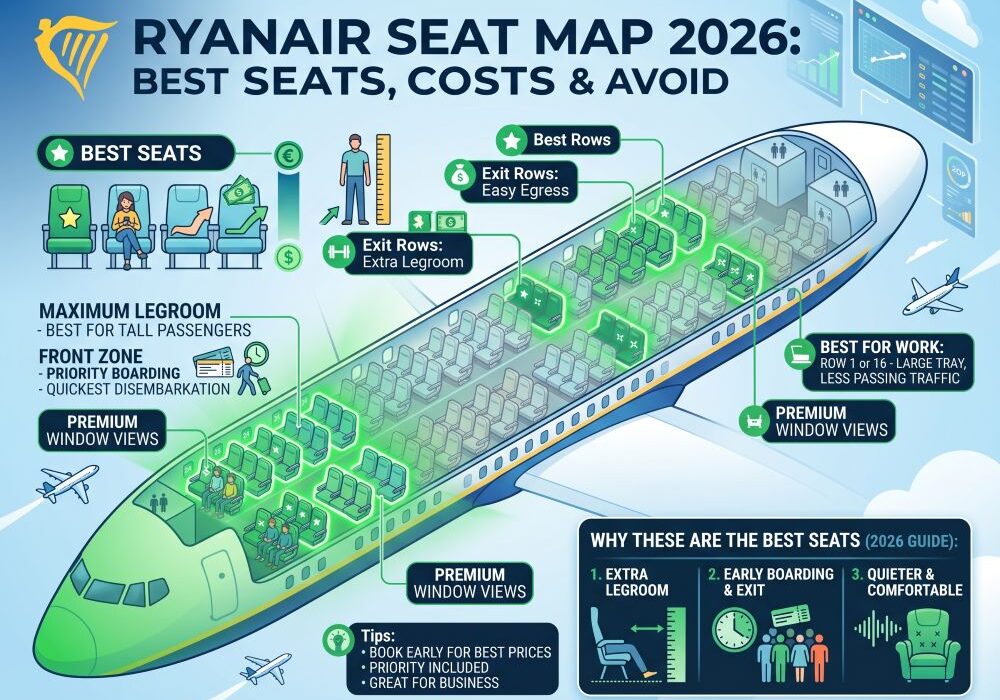
Exit rows are 16 and 17. These are the seats sold as extra legroom, and on this aircraft they genuinely deliver. Roughly 8 extra inches over a standard seat, which on a 30-inch pitch is the difference between tolerable and comfortable.
Seats 11A, 12A and 12F have no window. This is the single most searched-for fact about the Ryanair cabin and it catches people out constantly. Air conditioning ducting runs through the wall at that point, so you get a seat labelled “window” with a blank plastic panel where the window should be. If you are booking A or F specifically for the view, avoid these three.
Row 18 is the value pick. It sits directly behind the exit row and prices as an ordinary standard seat.
Boeing 737 MAX 8-200 (the “Gamechanger”)
The newer aircraft, and the one Ryanair has been adding steadily. 197 seats, which is eight more than the 737-800 in a similar airframe, achieved with slightly tighter pitch and an extra row at the back. Row numbering runs higher, up to the mid-30s.
The practical differences:
- Exit rows are 17 and 18, not 16 and 17. Row 1 also has exit-row characteristics at the front.
- Pitch is tighter through most of the cabin, closer to 28 to 28.5 inches against roughly 29 to 30 on the 737-800. On a short hop you will not notice. On three hours to the Canaries you might.
- The windowless seats are in different places. They exist on this aircraft too, but they are not 11A, 12A and 12F.
If you are paying specifically for extra legroom, this matters. Booking “row 16 because that is the exit row” is 737-800 advice, and on a Gamechanger row 16 is an ordinary seat at an ordinary pitch.
How to tell which aircraft you are on
The seat map in the Ryanair booking flow is drawn for the actual aircraft scheduled on your flight. That is the authoritative source, and it is free to look at before you commit to a seat. Count the rows: if the map runs past row 33, you are on a MAX 8-200. If the exit rows are highlighted at 17 and 18 rather than 16 and 17, same answer.
Do not book a seat number from an article, including this one. Book a position from the live map, using an article to understand what the position means.
Best seats on a Ryanair flight
There is no single best seat, only the best seat for whatever you actually care about.
If it is legroom, the exit rows win and nothing else comes close. Row 1 is the runner-up, since there is no seat in front of it at all, but it carries a catch that the seat map does not mention: with no seat in front, there is nowhere to stow your personal bag for takeoff and landing. It goes overhead and stays there until the seatbelt sign goes off. If that bag holds your book, your headphones and your snacks, the first twenty minutes are quite dull. Worth thinking about when you pick which bag to bring, and there is a full rundown in the best cabin bags for Ryanair guide.
If you want off the aircraft fast, take an aisle seat in the first five rows. Ryanair usually opens both the front and rear doors, but the front stairs tend to be connected first, so the front is the safer bet when you have a connection or a passport queue to beat.
For sleeping, pick a window seat between rows 6 and 15. You are ahead of the engines, you have a wall to lean on, and you are nowhere near the rear galley traffic. Just check the seat number first, for reasons covered above.
Nervous flyers should sit over the wing, which is the structural centre of the aircraft and where turbulence feels least dramatic. The proximity to an exit door reassures some people and unnerves others, so take the row just outside the exit rows if the door itself is the problem.
Two people travelling together should book A and B, or E and F, and simply leave the middle seat of the other trio alone. You cannot get a row to yourselves on a 3-3 layout, but you can stop the algorithm separating you.
And the best-value seat on the aircraft is the row directly behind the exit row. On most airlines that row is the one to avoid because it cannot recline. No Ryanair seat reclines, so the usual penalty does not exist, and you get marginally more room than a standard seat at the standard price.
Seats to avoid
The back row is the obvious one. It sits against the rear bulkhead, which makes it the narrowest part of the cabin, it is next to the toilets and the galley, and you will be among the last off. It is frequently the cheapest paid seat on the map. That is not a coincidence.
Beyond that: the windowless seats if you booked A or F for the view, and the exit rows if you are travelling with an infant, since you will not be permitted to sit there and the rule is enforced at the gate.
One thing you cannot avoid by spending more is the recline, because there isn’t any. Every seat on every Ryanair aircraft is fixed in a slightly pre-reclined position, front row and exit row included. It is a design decision, not a fault, and no amount of money changes it.
Extra legroom and exit row rules
Exit row seats come with legal obligations, not just extra space. Ryanair will refuse to seat you there if you do not meet the criteria, and it will not necessarily refund you for noticing at the gate.
To sit in an emergency exit row you must be:
- 16 years or older
- Willing and able to help in the event of an emergency
- Travelling without an infant, which also applies to passengers in the seats leading to the exit rows
- Not requiring airport assistance of any kind
- Not requiring a seat belt extender
- Without an extra comfort seat booked
The full wording is on Ryanair’s emergency exit row page. The infant restriction is the one that catches families out. If you are travelling with a lap infant, the exit rows and the rows leading to them are closed to your whole party, regardless of what the seat map lets you click.
One more practical note: exit row seats have the tray table built into the armrest. That is what makes the seat itself marginally narrower than a standard one. You are trading a little width for a lot of legroom, which is the right trade for most people and the wrong one for a few.
Families, children and the free seats most people miss
This is the section that saves the most money, and it is the part Ryanair advertises least.
Under Ryanair’s family seat policy, children aged 2 to 11 must sit next to an accompanying adult for safety reasons, and infants from 8 days to 23 months must travel on an adult’s lap. That is a safety requirement rather than a product, which means Ryanair has to make it happen either way.
So you have two options, and both work:
Reserve seats. You choose exactly where everyone sits, the children’s seats must be selected next to the adult’s reserved seats, and check-in opens 60 days out. You pay for every seat.
Take random allocation. Children are seated next to an accompanying adult on the same booking free of charge. You pay nothing. Check-in opens 24 hours before departure.
The catch is in the wording, and it is worth reading twice: other adults and teenagers on the booking may be allocated seats separately. So a family of two adults and two under-12s will not be split from the children, but the two adults may well end up in different parts of the cabin, each sitting with one child. For most families that is an entirely acceptable outcome for £0. For some it is not, and £3 a seat is a cheap fix.
Teenagers are the trap. A 13-year-old is not covered by the under-12 rule, so if you want to sit with them you either pay or take your chances.
Groups and travelling companions
Adults travelling together get no free equivalent of the family rule. Ryanair’s own advice is to reserve seats if sitting together matters, and it is honest about why: free seats come from whatever is left once everyone who paid has chosen, and on a full flight what is left is scattered singles.
Booking on the same reservation helps slightly, but Ryanair does not present it as a guarantee and neither should anyone else. If it genuinely matters, paying is the only reliable route.
Changing a seat after you have booked
Go to My Booking and select change seats. This works after booking and after check-in, and moving up a category means paying the difference. If you never paid for a seat there is nothing to change until check-in assigns you one, and you cannot swap a free seat for a different free seat.
Is Ryanair seat selection worth paying for?
After a decade of flying this airline six or seven times a year, my position is that the flight decides, not the policy.
The variable that matters most is duration. The gap between an exit row and a rear middle seat barely registers on 55 minutes to Dublin. On three hours to Tenerife it is most of what you will remember about the trip. Height is the other one. At 6ft plus, standard Ryanair pitch is genuinely uncomfortable and more so on the Gamechanger, and the exit row is the best-value thing the airline sells. Add a connection or a passport queue at the other end and a front aisle seat reliably buys back ten or fifteen minutes.
Against that, there is a decent case for paying nothing at all. On a short off-peak flight, travelling alone, random allocation gives you a seat and sometimes gives you an empty row either side. I have had better luck with the free seat on quiet Tuesday flights than with anything I have paid for.
The one mistake worth actively avoiding is paying twice. Every fare above Basic includes seating of some kind, and the booking flow will cheerfully sell you an upgrade you already own. Same trap as the cabin bag question, which I have worked through in Ryanair Priority Boarding: Is It Worth It?.
FAQ
Does Ryanair have a seat map I can see before booking?
Yes. The seat map appears in the booking flow after you select flights, and it is drawn for the specific aircraft scheduled on your route. It is free to look at, and you can leave without buying a seat. That live map is more reliable than any published seat chart, because Ryanair can swap aircraft types between the 737-800 and the MAX 8-200.
Which Ryanair seats have extra legroom?
On the Boeing 737-800, the exit rows are 16 and 17, plus row 1 at the front. On the newer 737 MAX 8-200, the exit rows are 17 and 18, plus row 1. Exit row seats give roughly 8 extra inches of legroom over a standard seat. Which aircraft you are on determines which rows apply, so check the live seat map rather than assuming.
Which Ryanair seats have no window?
On the Boeing 737-800, seats 11A, 12A and 12F have no window because air conditioning ducting runs through the cabin wall at that point. They are still sold as window seats. The MAX 8-200 also has windowless positions, but at different seat numbers, so check the map for your aircraft.
How much does it cost to choose a seat on Ryanair?
Standard seats cost £3–£27.50 at booking, front seats £18–£41 and extra legroom seats £12.50–£27.50. Bought after booking, the ranges are £3.50–£29.50, £18.50–£42.50 and £8.50–£38. Prices vary by route, date and how full the flight is. The figure shown in your booking flow is the actual price for your flight.
Do I have to pay to select a seat on Ryanair?
No. If you do not pay, Ryanair allocates a seat free of charge when you check in, between 24 hours and 2 hours before departure. Paying only buys you the choice of where to sit, plus earlier check-in.
Do Ryanair seats recline?
No. Every seat on every Ryanair aircraft is fixed in a slightly pre-reclined position and does not recline further. This applies across the whole cabin, including extra legroom and front row seats, so paying more does not change it.
Can my child sit next to me on Ryanair for free?
Yes, if the child is aged 2 to 11 and you take free random seat allocation. Ryanair seats children next to an accompanying adult on the same booking at no charge. Infants from 8 days to 23 months travel on an adult’s lap. Other adults and teenagers on the booking may still be allocated seats separately.
Who can sit in a Ryanair emergency exit row?
You must be 16 or over, willing and able to assist in an emergency, travelling without an infant, not requiring airport assistance, not requiring a seat belt extender, and without an extra comfort seat booked. The infant restriction also applies to the seats leading to the exit rows.
When does Ryanair check-in open?
60 days before departure if you have paid for a reserved seat. 24 hours before departure if you are on free random seat allocation. Check-in closes 2 hours before the flight in both cases.
Can I change my Ryanair seat after booking?
Yes. Go to My Booking and select change seats on your upcoming trip. You can do this after booking and after checking in. Moving up a category means paying the difference.
How many seats does a Ryanair plane have?
The Boeing 737-800 is configured with 189 seats in a single economy cabin. The newer Boeing 737 MAX 8-200, which Ryanair calls the Gamechanger, carries 197 seats in a similar airframe with slightly tighter seat pitch.
What is the best seat on a Ryanair flight?
It depends what you are optimising for. Legroom means an exit row. Getting off quickly means an aisle seat in the first five rows. Sleeping means a window seat ahead of the engines, roughly rows 6 to 15. Best value is the row directly behind the exit row, which is priced as a standard seat but sits in a slightly roomier part of the cabin.
Verdict
The Ryanair seat map stops being confusing the moment you accept that it is two maps rather than one, and that the exit rows move between them.
Everything after that is a straight trade between money and comfort, and on a short quiet flight the free seat wins that trade more often than the booking flow would like you to believe. The genuinely bad outcome is not overpaying. It is paying for something you already had. Check your fare, check whether your children are covered, then open the live map and decide from there.
For the rest of the airline in one place, start at the Ryanair hub, or go straight to the Ryanair baggage allowance guide if bags are the next thing on your list.