Ryanair Check-In 2026: Times, Digital Boarding Pass and the £55 Fee
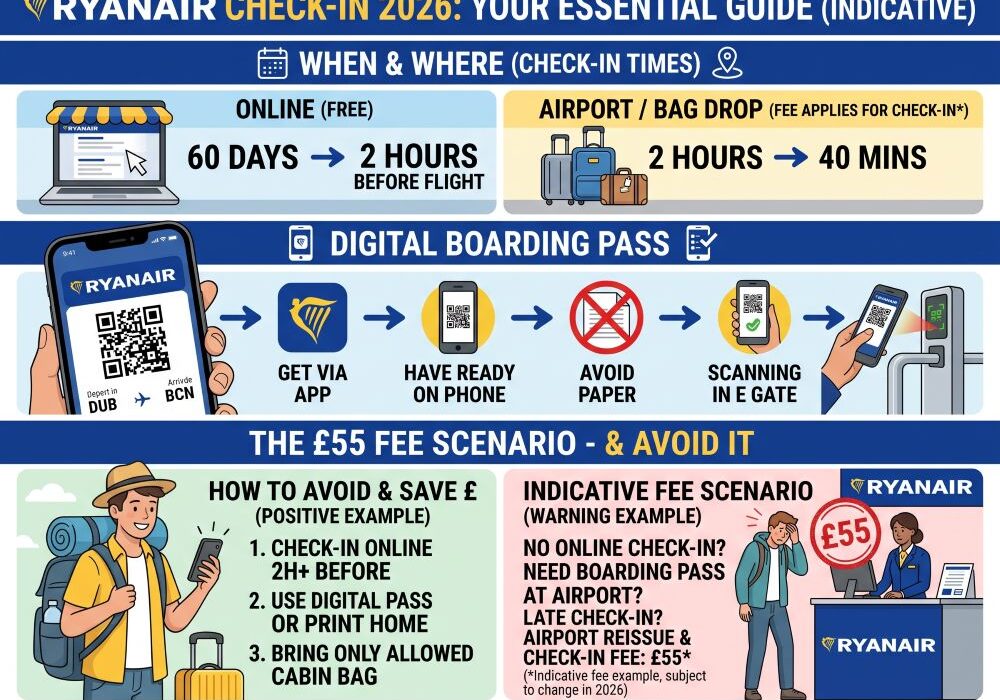
Ryanair check-in is simple once you know four numbers and one rule, and most of the money the airline collects at the airport desk comes from passengers who knew neither. Everything below is checked against Ryanair’s own help centre rather than the older articles that still tell you to print something.
The rest of the airline is covered on the Ryanair hub.
The short answer
Check in online before you go to the airport. Skip it and the desk charges £55 a head.
If you have paid to reserve a seat, or your fare includes one, check-in opens 60 days before departure. Otherwise it opens 72 hours before. Either way it closes 2 hours before the flight, your boarding pass appears in the Ryanair app, and no paper is involved.
When Ryanair check-in opens and closes
| Situation | Opens | Closes |
|---|---|---|
| Reserved seat (paid, or included in your fare) | 60 days before departure | 2 hours before departure |
| Free random seat allocation | 72 hours before departure | 2 hours before departure |
| Airport check-in desk and bag drop | At least 2 hours before departure | 60 minutes before departure |
| Non-EU visa / document desk | At least 2 hours before departure | 60 minutes before departure, strictly |
The 60-day rule has a trap that catches people every summer. With reserved seats, both your outbound and your return flight have to fall inside the 60-day window before you can check in for either. Book a three-week holiday 70 days out and the outbound won’t open when you expect, because the return is still outside the window.
The 2-hour cutoff is earlier than people assume. Two hours before a 06:30 departure is 04:30, when you are more likely to be in a taxi than looking at your phone. Check in the night before.
Paper boarding passes are gone
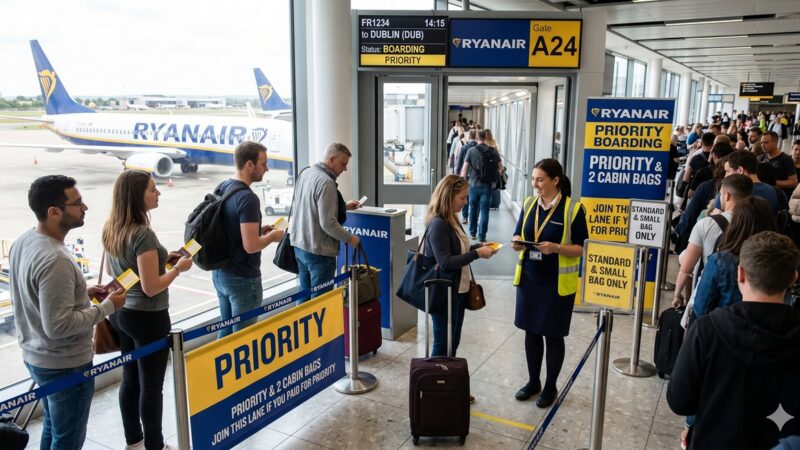
Since 12 November 2025, Ryanair has issued 100% digital boarding passes. They are not printed at home, and the airport doesn’t print them as a matter of routine. When you check in online, the pass appears in the Ryanair app and you show your phone at security and at the gate.
Ryanair gives cost and housekeeping reasons: cheaper airport operations, easier rebooking during disruption, and an estimated 300 tonnes of paper a year saved. Whether any of that reaches your fare is a separate argument.
In practice the app is no longer optional. Checking in on ryanair.com still works, but the website sends you to the app for the pass itself, so the old routine of checking in on a laptop and printing the result has gone.
Ryanair emails check-in reminders, so keep them out of your spam folder. Miss the online window and the only option left is the paid airport desk.
“No phone, no flight” is not actually the rule
Much of the coverage got this part wrong. When the change was announced, a lot of headlines said a dead battery would strand you. It won’t, provided you checked in online first. Ryanair’s help pages cover all three versions of the problem:
- Phone dies before security? If you have already checked in online, you get a boarding pass at the airport free of charge.
- Phone lost or dead after security but before boarding? Your details are already in the system and you will be assisted at the gate.
- Do not own a smartphone or tablet at all? Check in online, and you will be issued a free paper boarding pass at the airport. You lose the real-time flight updates and the smoother handling during disruption, but you fly.
Check-in and ticket desks still exist at every airport Ryanair serves.
So the rule is closer to “no online check-in, no free boarding pass”. The fee is for skipping check-in, and the device you own doesn’t come into it. A passenger with a flip phone who checked in at home is better placed than one with a new iPhone who didn’t.
The source for all of this is Ryanair’s own digital boarding pass help pages, which are calmer reading than the headlines were.
Portugal’s civil aviation regulator, ANAC, objected shortly after launch, saying passengers who rely on paper, such as older travellers and people without smartphones, should not be penalised, and told Ryanair to keep providing paper passes free of charge. Ryanair’s published policy is that it does not charge passengers who checked in online, which fits everything above.
How to check in, step by step
- Open the Ryanair app or go to ryanair.com. Either works for the check-in itself.
- Log in to myRyanair, or retrieve the booking with your reservation number and the email address used to book. If someone else booked for you, you need their email, not yours.
- Select check-in and enter your travel document details.
- Confirm your seat, or accept the random allocation. If you are choosing, the Ryanair seat map guide covers which rows are worth paying for.
- Let the digital boarding pass load into the app. Open it once, at home, on wifi, to make sure it is there.
The pass caches in the app once opened, so doing step 5 at home means you are not depending on airport wifi or a mobile signal in a concrete departures hall.
Ryanair also requires check-in to be completed by you, another passenger on the booking, or someone with personal knowledge of you and your luggage. It reads like boilerplate, but it is the legal basis for the security declarations you are agreeing to.
The £55 airport check-in fee
The fee is per passenger, not per booking, so a family of four arriving unchecked-in is £220 down before anyone has bought a coffee.
You can still check in at the desk up to 60 minutes before departure, so forgetting costs money rather than the flight. Of everything on the Ryanair fee list it is the easiest to avoid, because bags, seats and flexibility all involve a judgment call and this one doesn’t.
For where it sits against everything else the airline charges for, see the complete Ryanair fees list.
When check-in won’t work
Ryanair’s check-in fails in a few predictable ways, and only one of them is the website having a bad day.
The one that catches most people is a request to verify your identity before you can proceed. It happens when the booking is flagged as coming from a third-party travel agent with no commercial agreement with Ryanair, which is common with smaller comparison sites and cheap-flight aggregators. Check-in won’t open until the verification is finished, so the morning of the flight is a bad time to find out. If you book through an OTA out of habit, this is the strongest practical argument for booking direct.
Being told you are too early is almost always the 60-day return-flight rule, or a seat reserved on one leg but not the other.
Documents are the other recurring problem. Ryanair accepts a valid passport or a valid national identity card and nothing else: not a driving licence, not a birth certificate, for any destination, and for children as much as adults. Parents are the ones this surprises.
Genuine outages are rarer than the search volume suggests. The app and the website are separate paths, and the 2-hour window leaves room to try both. If you are inside the last couple of hours and nothing loads, head for the airport and explain at the desk.
Non-EU and non-EEA passengers
If you hold a non-EU or non-EEA passport, there is an extra step with a harder deadline than anything else on this page.
Ryanair asks you to verify your visa or residence permit during check-in, through the app where your nationality and route support it. Where online verification isn’t available or fails for technical reasons, you complete the check in person at the airport Visa/Document desk.
Those desks open at least 2 hours before departure and close strictly 60 minutes before scheduled departure. Miss that and, in Ryanair’s own words, you will not be allowed to travel and will not be entitled to a refund. The check has to be done before security, so it can’t be salvaged airside.
Try the document upload in the app days ahead rather than the night before. If it fails, you still have time to plan around the desk.
Two exceptions worth knowing
All passengers departing from a Moroccan airport must check in online as normal and then collect a free boarding pass at the airport check-in desk. Moroccan desks close 60 minutes before departure, which since 10 November 2026 is the same deadline Ryanair uses everywhere. Flying home from Marrakesh or Fez, budget the extra time and don’t rely on the app alone.
The other is a benefit people forget they have paid for: if your fare includes reserved seating, check-in opens at 60 days rather than 72 hours. Which fares include what is set out in Ryanair Fares Explained.
FAQ
When does Ryanair check-in open?
60 days before scheduled departure if you have a reserved seat, whether you paid for it or it came with your fare. 72 hours before departure if you are on free random seat allocation. With a reserved seat, both your outbound and return flights must fall within the 60-day window before check-in becomes available.
When does Ryanair check-in close?
Online check-in closes 2 hours before scheduled departure. After that you can only check in at the airport desk, which stays open until 60 minutes before departure and charges a fee. (Ryanair moved this from 40 to 60 minutes on 10 November 2026.)
How much is the Ryanair airport check-in fee?
£55 per passenger. It applies if you arrive at the airport without having checked in online, and it is charged per person rather than per booking.
Can I still print a Ryanair boarding pass?
No. Ryanair moved to 100% digital boarding passes on 12 November 2025. Passes are not printed at home or issued routinely at the airport. Your pass appears in the Ryanair app after you check in online.
What happens if my phone dies before a Ryanair flight?
If you have already checked in online, you will be given a boarding pass at the airport free of charge. If the phone fails after security but before boarding, your details are already in Ryanair’s system and staff will assist you at the gate.
What if I don’t have a smartphone?
Check in online on the website, then collect a free boarding pass at the airport check-in desk. You will not get real-time flight updates or the improved handling during disruption, but you can fly without a smartphone.
Do I need the Ryanair app to check in?
You can complete check-in on ryanair.com, but the digital boarding pass is delivered through the Ryanair app. Without the app you will need to collect a free paper pass at the airport desk, which requires having checked in online first.
What ID do I need to check in with Ryanair?
A valid passport or a valid national identity card. Ryanair does not accept a driving licence or a birth certificate for travel to any destination, and this applies to children as well as adults.
Why is Ryanair asking me to verify my booking?
Your booking has been flagged as made through a third-party travel agent with no commercial agreement with Ryanair. You will need to complete identity verification before you can check in, so start it well before the flight.
Do check-in desks still exist at airports?
Yes. Ryanair confirms it still has check-in and ticket desks at all airports. They handle airport check-in, pass reissues and document checks.
Is Ryanair online check-in free?
Yes. There is no charge for checking in on ryanair.com or in the app, at any point in the window, and no charge for the digital boarding pass. The only check-in that costs anything is at the airport desk, when you skipped it online.
How early should I get to the airport for a Ryanair flight?
Ryanair’s own deadlines are the binding ones: bag drop and check-in desks close 60 minutes before departure (40 minutes until 10 November 2026), and non-EU document checks close at the same point, strictly. Two hours is a sensible minimum at a busy base like Stansted, and more in summer.
Verdict
Check in the evening before you fly and open the boarding pass once while you are on your own wifi. Done that way, the digital-only system is less hassle than printing ever was. Passengers without smartphones have a free, documented route through it; the ones it penalises are those who planned to sort check-in out at the airport.
If bags are the next thing to work out, the Ryanair baggage allowance guide covers what you can bring, and Ryanair Priority Boarding: Is It Worth It? covers whether the overhead bag is worth buying at all.