How to Get Around the Amalfi Coast Without Losing Your Mind
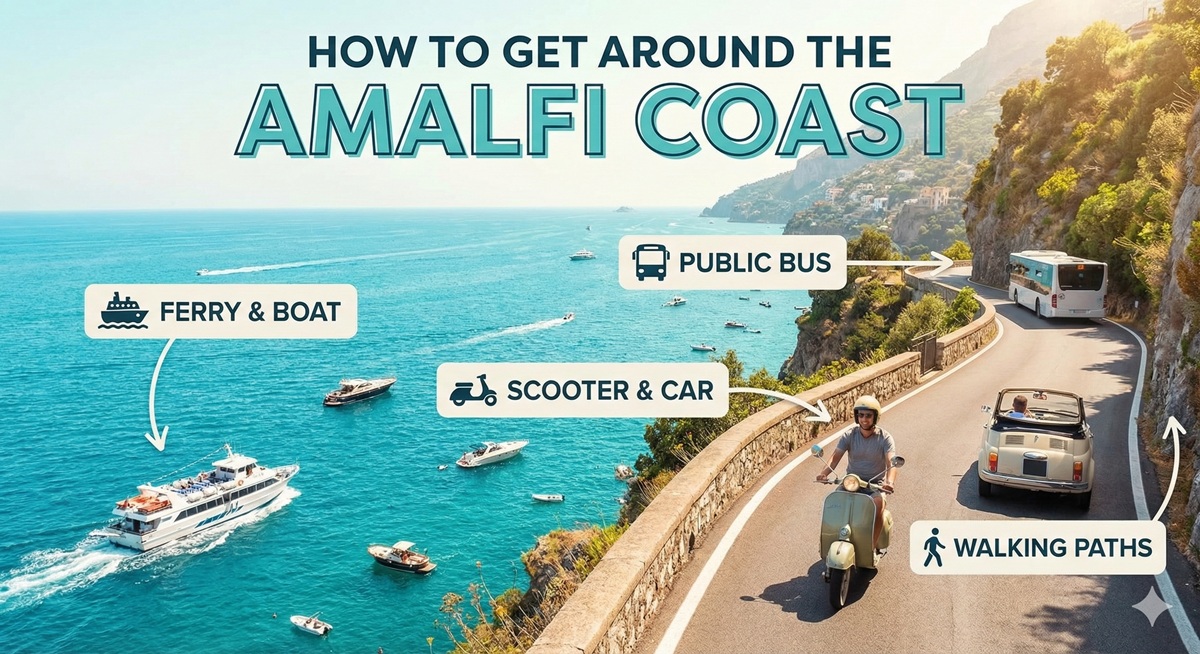
The Amalfi Coast is one of the most beautiful places in Italy. It is also one of the most logistically awkward. One narrow cliff road, millions of tourists, and transport options that work brilliantly in theory and erratically in practice.
Here is what actually works, what doesn’t, and how to plan transport so it doesn’t eat your holiday.
The core problem
Everything on the Amalfi Coast is connected by the SS163 — a two-lane coastal road that is spectacular to look at and genuinely stressful to drive in summer. It was built for mules and fishing carts. It now handles coaches, lorries, tourist cars, scooters, delivery vans, and the occasional ambulance simultaneously. In July and August, a five-kilometre journey can take 45 minutes.
This is not a problem with a perfect solution. The goal is to minimise the time you spend stuck on it.
Option 1: Ferry — the best option nobody uses enough
Cost: €8–€18 per single journey depending on route
Season: April–October only
Routes: Positano ↔ Praiano ↔ Amalfi ↔ Cetara ↔ Salerno (and seasonal services to Naples, Capri, Ischia)
Operators: Travelmar, Alilauro, NLG
The ferry is, without question, the best way to move between towns. It avoids the road entirely. The views from the water are extraordinary — you see the coast in the way it was designed to be seen. It’s usually punctual. The tickets are cheap.
Why doesn’t everyone use it? Partly because ferries don’t run in winter or bad weather. Partly because they’re not always well-publicised. And partly because people arrive by car and then feel committed to using it.
Practical details:
- Buy tickets at the harbour kiosk on the day — advance booking for regular services is rarely necessary (unlike Capri day trips, which should be booked ahead in peak season)
- Ferry frequency varies by route and season. The Positano–Amalfi run operates roughly every 1–2 hours in high season
- Ferries to Capri book out quickly in summer — buy at least a day ahead
- Last ferries in the evening are typically mid-to-late afternoon; check return times before you go
Best used for: Inter-town travel, day trips to Capri, arriving from Salerno or Naples, anything where the journey is as much of the experience as the destination
Option 2: SITA Bus — cheap, reliable, uncomfortable
Cost: €1.30–€2.50 per journey
Season: Year-round
Routes: Runs the entire SS163 from Sorrento to Salerno via all coastal towns
Frequency: Every 40–90 minutes depending on route and time of year
The SITA bus is the local workhorse of the Amalfi Coast. It goes everywhere, it’s cheap, and it operates year-round — including in winter when ferries have stopped.
It is also, in high season, crowded to the point of discomfort, slow due to the road, and occasionally arrives to find three buses’ worth of passengers already waiting at the stop. This is part of the experience, not a malfunction. One practical note: the hairpin bends on the SS163 are genuine — if you’re prone to motion sickness, pack these before you travel:
Practical details:
- Buy tickets before boarding at tabacchi shops, newsstands, or from machines at larger stops. The driver sometimes sells tickets but this is technically not guaranteed
- Validate your ticket when you board (stamp machine near the door)
- Keep exact change — they do not give change reliably
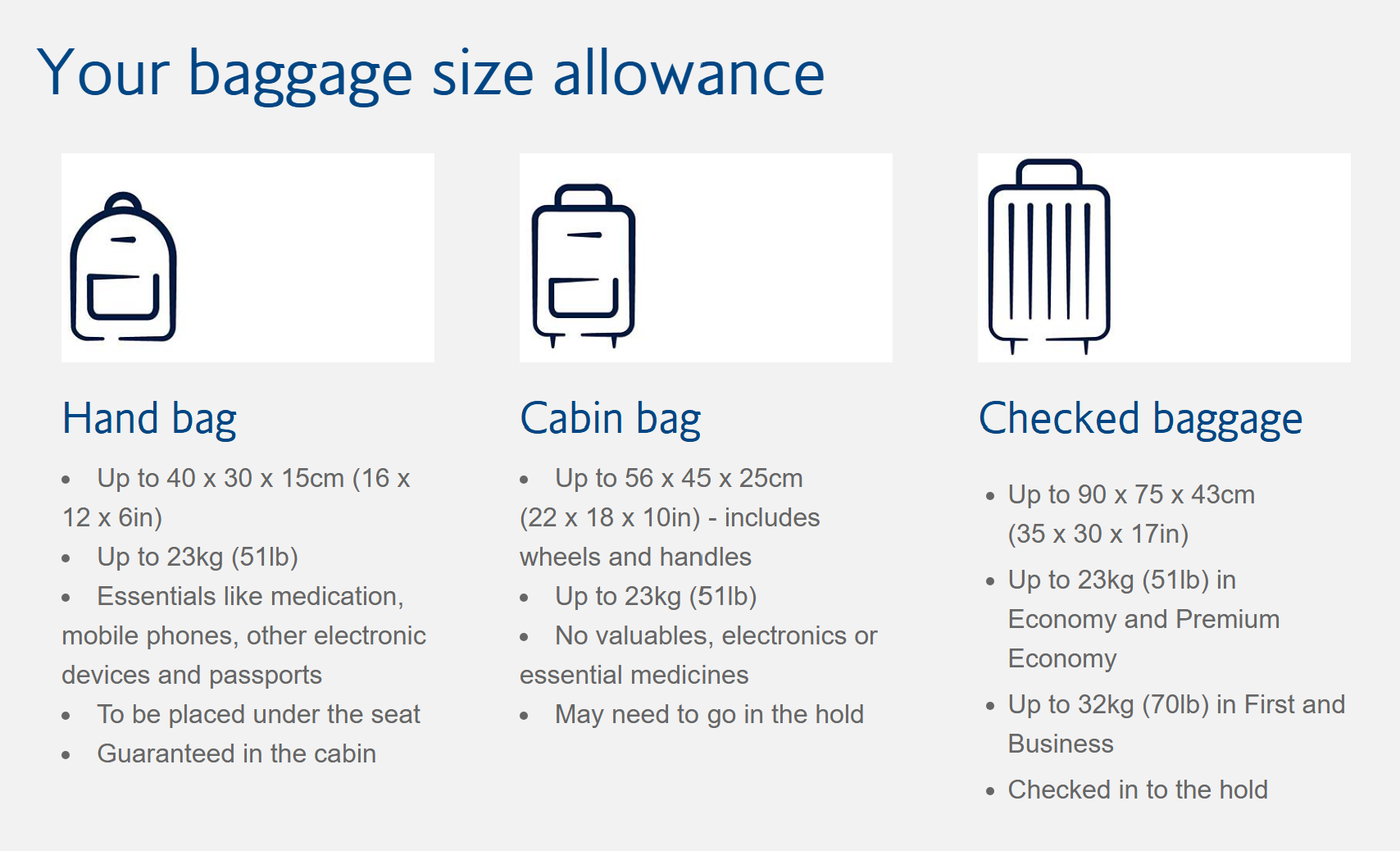
- Large luggage can be a problem in peak season. Ask the driver to put bags in the luggage bay under the bus
- Download the SITA Sud app or check current timetables at sitasudtrasporti.it before you travel
Best used for: Short hops between nearby towns, getting to Ravello (bus from Amalfi), budget travel, off-season movement
Option 3: Driving — possible, but know what you’re getting into
Cost: Car hire from ~€35/day; fuel; parking €5–€25/day depending on location
Season: Year-round
Let’s be direct: driving the Amalfi Coast SS163 in July or August is a test of patience and spatial awareness that not everyone will pass. The road is narrow, the corners are blind, the oncoming coaches are full-size, and everyone behind you on a scooter wants to go faster.
That said, it’s also genuinely manageable with the right approach. Millions of drivers do it safely every year. And outside peak season, it’s an extraordinary drive.
Who should drive: Anyone who has driven mountain or coastal roads before. Anyone travelling with a lot of luggage. Anyone visiting in shoulder season (May, early June, September, October). Anyone who wants to explore inland villages not served by bus or ferry.
Who should not drive: First-time mountain road drivers. Anyone travelling in July/August who has an alternative. Anyone staying in Positano (parking there is a nightmare — see below).
Practical tips:
- Get the smallest car possible. A full-size SUV on the SS163 is not the move. A small hatchback (Fiat 500, Peugeot 208, Toyota Yaris) is the correct vehicle.
- Drive early morning. Before 9am, the road is quiet. By 10am, it isn’t.
- Never try to time-turn in a passing place. Pull in, wait, breathe.
- Parking in Positano requires using one of the official car parks (Parcheggio Spiaggia Grande or Parcheggio Multipiano). Both are expensive. Both fill early. This is the main argument against driving to Positano — take the ferry instead.
- Parking in Amalfi is similarly difficult in high season. The Via delle Cartiere car park is the main option.
- Don’t drive after dark the first time. The first drive is enough to focus on without adding reduced visibility.
Car hire: Compare rates here— small cars book out quickly in summer so reserve at least 2–3 weeks ahead.
Option 4: Water taxi — expensive but brilliant for specific trips
Cost: €80–€200+ depending on journey and operator
Water taxis are private boats you can hire for point-to-point transfers or beach access. They’re too expensive for daily transport but genuinely useful for two specific situations:
- Getting to beaches not accessible from the road (there are several along the coast that can only be reached by boat or very long hikes)
- Transfers with a lot of luggage — particularly arriving at a hotel that’s only accessible by boat
Ask your hotel for a recommended operator.
Option 5: Organised day tour — the stress-free option
For first-time visitors, or anyone doing a single day trip from Naples or Sorrento, a guided day tour handles all the transport logistics for you. Worth it purely for the peace of mind on the first visit.
Look for small-group tours (max 8–10 people) rather than coach tours.
The optimal strategy by trip type
3–4 nights based in Praiano or Amalfi: Ferry + bus. No car needed.
5–7 nights exploring the whole coast: Ferry for longer hops + bus for short hops + consider a 1-day car hire for an inland village day (Ravello, Scala, Tramonti).
Arriving with lots of luggage: Car or water taxi to your hotel, then park the car and switch to ferries and buses.
Off-season visit (October–March): Bus is your primary tool; ferries are reduced or stopped.
Frequently Asked Questions
What is the best way to travel between Amalfi Coast towns?
The ferry, and it is the option most visitors underuse. It skips the coast road entirely, so it avoids the traffic that makes every other method slow, and the views from the water are better than anything you get from a bus window.
How often do the ferries run?
It varies by route and by season. The Positano to Amalfi run goes roughly every one to two hours in high season. Services thin out considerably outside the main months, so check timetables rather than turning up.
Should I hire a car on the Amalfi Coast?
Only if you know what you are taking on. Driving is possible, but the coast road is narrow and busy, and parking is both scarce and expensive. For most trips the ferry and bus combination is less stressful.
Is the SITA bus worth using?
It is cheap and it is reliable, and those two things count for a lot. It is also uncomfortable and often crowded. I use it when the ferry is not running and I am not in a hurry.
What about water taxis?
Expensive, but genuinely brilliant for specific trips where timing matters and you do not want to be tied to a timetable. Not something to rely on for everyday movement.