Where to Stay on the Amalfi Coast: An Honest Town-by-Town Breakdown
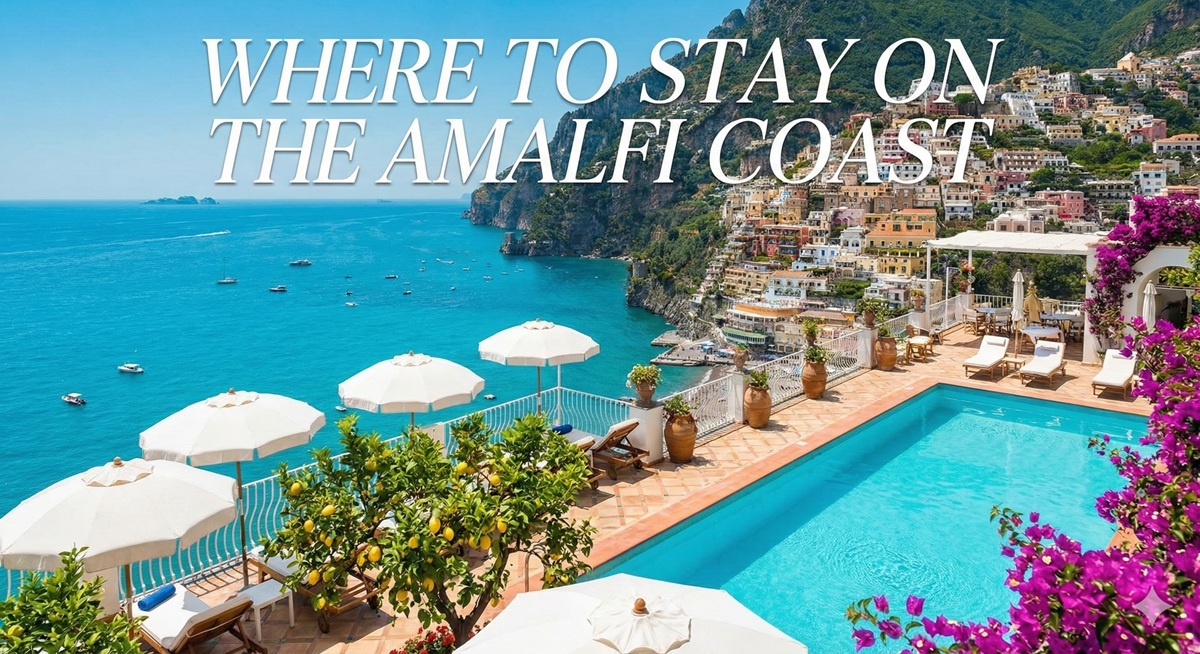
You’ve decided you’re going to the Amalfi Coast. Now you’re staring at a map trying to work out where to actually stay — and every article you’ve found either recommends Positano (expensive, beautiful, exhausting) or gives you a vague list of “options.”
This guide cuts through that. Each town has a real profile: who it suits, what it costs, what the downsides are. By the end, you’ll know exactly where to base yourself.
The fundamental rule: your base shapes your whole trip
On a coastline this narrow, with one congested road connecting everything, where you sleep determines how much of your time you spend getting to places versus being there.
The coast splits roughly in two: the western half (Positano, Praiano, Conca dei Marini) and the eastern half (Amalfi, Atrani, Ravello, Minori, Cetara). If you only have 3–4 days, base yourself in one half and day-trip into the other. If you have a week or more, consider splitting your stay.
Positano — the famous one
Best for: Couples on a splurge, photographers, first-timers who want the full iconic experience
Budget range: €250–€600+/night
Crowding: Very high June–September
Positano is what most people picture when they imagine the Amalfi Coast — and it delivers. The cascading pink and white houses, the Marina Grande beach, the boutiques on Via dei Mulini. It’s genuinely extraordinary.
But it comes with significant caveats.
First, the steps. Positano is almost entirely vertical. Getting from your hotel to the beach and back involves hundreds of steps, potentially multiple times a day. If you have any mobility limitations, or children in a pushchair, this needs to factor into your decision heavily. For everyone else: packing cubes make a real difference when you’re living out of a bag across multiple towns — grab what you need without unpacking everything on a narrow hotel bed:
Second, the price. Positano charges a premium for the famous view. Budget accommodation doesn’t really exist here. Mid-range in Positano is what qualifies as luxury elsewhere on the coast.
Third, the crowds. In July and August the beach is packed from morning, the streets are gridlocked with day-trippers, and getting a table at a decent restaurant without a reservation is difficult.
The verdict: Worth visiting for at least a half-day from wherever you’re based. Worth staying in if budget is not a concern and you’re visiting in May, June, or September.
Praiano — the smart choice
Best for: Independent travellers, couples who want beauty without the circus, people visiting in peak season
Budget range: €100–€250/night
Crowding: Low to moderate
Praiano is the answer to the question: “What if I want the Amalfi Coast experience without paying Positano prices or fighting Positano crowds?”
It sits about 8km east of Positano. The views are comparable. The town is quieter, more genuinely Italian in feel, and spread across two levels — an upper village and a lower cove (Marina di Praia) with a small pebble beach.
Getting to Positano is a 20-minute ferry ride or a bus journey. Amalfi is similarly close. You are not sacrificing access by basing yourself here.
The one genuine downside: fewer restaurants and amenities than Positano or Amalfi. If you want a wide choice of places to eat within walking distance every night, Amalfi town serves you better.
The verdict: The strongest all-round base on the coast for most independent travellers. Beautiful, well-connected, significantly cheaper than Positano.
Amalfi town — the practical hub
Best for: First-timers, travellers who want flexibility, anyone arriving by bus or ferry
Budget range: €120–€300/night
Crowding: Moderate to high
Amalfi is the largest town on the coast and its main transport hub. Ferries from Naples, Salerno, and Positano all dock here. Buses run regularly along the SS163 from here in both directions.
As a base, it’s convenient rather than romantic. The town itself is worth exploring — the Duomo di Sant’Andrea is genuinely impressive, the paper museum (Museo della Carta) is surprisingly interesting, and there are good restaurants that don’t charge solely for the postcode.
The downside is that Amalfi town attracts large numbers of day-trippers, which means the waterfront and main piazza get crowded and loud during the day. The crowds largely dissipate by evening, at which point it’s genuinely pleasant.
The verdict: The best practical base if you want maximum flexibility to explore both directions along the coast. Not the most atmospheric sleeping option but hard to beat for access.
Atrani — the best secret on the coast
Best for: Travellers who’ve done their research, couples, anyone who values atmosphere over convenience
Budget range: €90–€200/night
Crowding: Low
Atrani is a five-minute walk from Amalfi town and might as well be a different planet. It’s the smallest municipality in Italy — a genuinely small village with a tiny piazza, a handful of restaurants, a small beach, and almost no tourists.
Why? Because it’s not on the main road. You have to walk through a short tunnel from Amalfi to reach it, which apparently is enough to deter most visitors.
Accommodation is limited and books out quickly, but what’s there is good value. Staying in Atrani and walking into Amalfi for transport gives you the best of both: the peace of a genuine village and the connectivity of the main hub.
The verdict: Book early and stay here if you can. The hidden gem of Amalfi Coast accommodation.
Ravello — the elevated alternative
Best for: Couples, music lovers, anyone who wants peace and extraordinary views without beach focus
Budget range: €150–€400/night
Crowding: Low
Ravello sits in the hills above Amalfi, about 350 metres above sea level. There is no beach. There are, however, some of the most beautiful gardens in Italy (Villa Cimbrone, Villa Rufolo), a world-class music festival in summer, and views down the coast that are among the best you’ll find anywhere.
The atmosphere is hushed, almost otherworldly — particularly early morning or in the evening when day-trippers have gone.
Getting to the water requires a 25-minute bus journey to Amalfi. For some guests this is a dealbreaker; for others it’s exactly the trade-off they want.
The verdict: Perfect for a 2-night stay for couples who value tranquillity and culture over beach access.
Minori and Maiori — for budget travellers who want genuine Italy
Best for: Budget-conscious travellers, families, people who want a more local experience
Budget range: €70–€160/night
Crowding: Low
Minori and Maiori are the coast’s most “normal” towns. Actual supermarkets. Locals who aren’t in the tourism industry. Restaurants priced for residents. Maiori has the longest beach on the coast.
They’re not pretty in the way Positano is pretty, but they’re charming in an unperformed way that many travellers find refreshing after a day or two of picture-postcard overload.
Good bus connections to Amalfi mean they work well as a base.
The verdict: Best value on the coast. Worth considering seriously if budget is a priority.
Search hotels in Minori and Maiori →
Salerno — the budget base off the coast
Best for: Budget travellers, city lovers, anyone who wants a proper Italian city experience
Budget range: €60–€130/night
Crowding: Low (it’s a real city)
Salerno is not on the Amalfi Coast — it’s a city 40 minutes east by ferry. It has nothing of the dramatic cliff scenery. It does have good restaurants at local prices, comfortable hotels at half the cost, and direct ferry services to Amalfi.
The pitch: stay in Salerno, day-trip the coast. You’ll save 40–50% on accommodation, eat better for less, and get more sleep.
The catch: you lose spontaneous evening access to the coast’s atmosphere, since ferries stop running in the evening and the bus journey back from Amalfi after dinner is a commitment.
The verdict: Excellent for budget-first travellers or anyone adding the Amalfi Coast to a wider Italy trip. Less good if the coast’s atmosphere is what you came for.
Sorrento — gateway town, not coast town
Best for: First-timers, travellers combining with Pompeii, families
Budget range: €100–€220/night
Sorrento is technically not on the Amalfi Coast — it’s on the other side of the peninsula, about 40km from Positano by road (though connected by ferry in season). It has good train connections to Naples and Pompeii, a pleasant old town, and a wide range of accommodation.
It works as a base if you’re combining a trip — Amalfi Coast plus Pompeii plus Naples — and want a central point. It doesn’t work if the Amalfi Coast itself is your main focus, because you’ll spend a disproportionate amount of time getting to and from it.
Every base compared at a glance
| Town | Nightly range (double, high season) | Beach | Crowds | Best for |
|---|---|---|---|---|
| Positano | €250–€600+ | Small, pebbly, packed | Very high | The iconic splurge, photographers |
| Praiano | €100–€250 | Small cove (Marina di Praia) | Low–moderate | Best all-round base, peak-season value |
| Amalfi town | €120–€300 | Central, busy | Moderate–high | Transport flexibility, first-timers |
| Atrani | €90–€200 | Tiny, quiet | Low | Atmosphere, book early |
| Ravello | €150–€400 | None (350m up) | Low | Couples, gardens, peace |
| Minori / Maiori | €70–€160 | Maiori has the longest | Low | Budget + genuine local Italy |
| Salerno | €60–€130 | City, not scenic | Low | Cheapest base, wider-Italy trips |
| Sorrento | €100–€220 | Limited | Moderate | Combining with Pompeii / Naples |
Ranges are typical July–August rates for a mid-range double; shoulder season (May, late September) routinely runs 30–40% cheaper.
How many nights — and should you split your stay?
The coast is smaller than it looks on a map, but the single congested road (the SS163) makes every journey slower than the distance suggests. That changes the maths:
- 3–4 nights: Pick one base and day-trip. Don’t split — you’ll lose half a precious day to checking in and out. Praiano or Amalfi town give you the best reach in both directions.
- 5–7 nights: A two-base split works well — three nights on the western half (Positano or Praiano) and three on the eastern half (Amalfi, Atrani or Ravello). You halve the day-trip distances and see two very different sides of the coast.
- A week+ as part of a wider Italy trip: Base in Salerno or Sorrento for the transport links, day-trip the pretty towns, and keep your accommodation costs sane for the longer stay.
So where should you actually stay?
If you want one recommendation rather than eight, here’s how it usually shakes out:
- Most first-time couples: Praiano. You get the postcard views and quiet evenings without Positano’s price tag or its staircases.
- Anyone who values easy logistics: Amalfi town. Ferries and buses in every direction leave from your doorstep.
- Budget-first travellers: Minori/Maiori on the coast, or Salerno off it. Both cut your accommodation bill roughly in half.
- A milestone trip where money isn’t the constraint: Positano in May, June or September — never July or August, when the crowds undo the magic.
When to book (and why it matters more here)
Amalfi accommodation is unusually supply-constrained: the towns are tiny, there’s no room to build, and demand is global. Practical timing:
- July–August stays: book five to six months ahead. The good-value places in Praiano, Atrani and Minori go first.
- May, June, September: six to eight weeks is usually enough, though Positano still books early.
- Atrani and Ravello have very few rooms full stop — if you want either, treat them as book-first, plan-around-them decisions.
Frequently Asked Questions
Which town is the best place to stay on the Amalfi Coast?
For most people it’s Praiano — it has views comparable to Positano, a quieter and more genuinely Italian feel, good ferry and bus links, and nightly rates roughly half those of Positano. Positano is only the “best” base if budget is no concern and you’re visiting outside July and August.
Is it better to stay in Positano or Sorrento?
Stay in Positano if the Amalfi Coast itself is your main focus and you want to wake up on the coast. Choose Sorrento if you’re combining the trip with Pompeii and Naples and want stronger train connections — but expect to lose time travelling to and from the coast each day, since Sorrento sits on the other side of the peninsula.
Where do most tourists stay on the Amalfi Coast?
Positano and Amalfi town draw the largest numbers because they’re the most famous and the best-connected. That also makes them the busiest and priciest in peak season — which is exactly why Praiano, Atrani and Minori are the smarter picks for travellers who’ve done their research.
What’s the cheapest place to stay on the Amalfi Coast?
On the coast itself, Minori and Maiori are the best value (€70–€160 a night in high season). For the lowest prices overall, base in Salerno — a real city 40 minutes east by ferry — where doubles start around €60 and you day-trip the coast.
Do I need a car to stay on the Amalfi Coast?
No, and a car is more hindrance than help — parking is scarce and costly, and the SS163 is congested all summer. Ferries and SITA buses connect every town, so base yourself somewhere with good transport links (Amalfi town, Praiano or Salerno) and skip the car entirely.
Is it worth splitting your stay between two towns?
For trips of five nights or more, yes. A split between the western half (Positano/Praiano) and the eastern half (Amalfi/Atrani/Ravello) cuts your day-trip distances and shows you two distinct sides of the coast. For three or four nights, stick to one base so you don’t waste a day changing hotels.