South Africa Plug Type and Travel Adapter: What UK Travellers Need
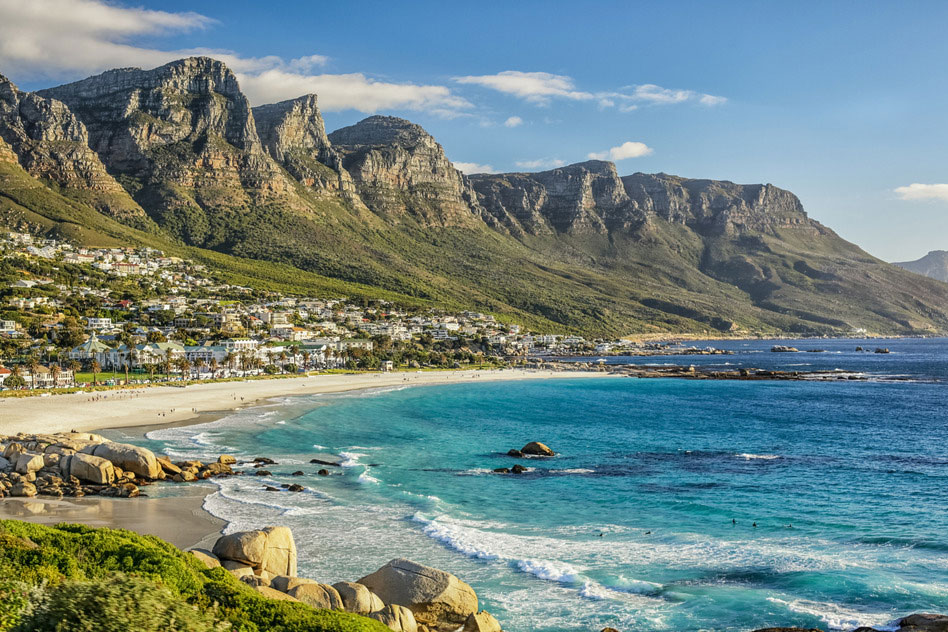
South Africa is the one trip where the universal travel adapter in your drawer is most likely to let you down. It is not that the country is unusual about voltage. It runs at 230V, the same as home. The problem is the plug. South Africa’s main socket takes three big round pins set in a triangle, and most “worldwide” adapters sold in the UK simply do not include that shape.
This guide covers which plug types South Africa uses, why that trips people up, and which travel adapter for South Africa actually works, including on a safari that crosses into Botswana, Namibia or Zimbabwe.
For the basics of what an adapter does and does not do, see the travel adapter guide.
What plug type does South Africa use?
South Africa uses Type M as its main plug and socket, alongside Type N in newer buildings and Type C (the two-pin Europlug) for small devices. Some older properties still have Type D sockets. Mains power is 230V at 50Hz.
Quick reference:
| South Africa | |
|---|---|
| Main plug type | Type M (three large round pins) |
| Also found | Type N (newer buildings), Type C (two-pin), Type D (older buildings) |
| Voltage | 230V |
| Frequency | 50Hz |
| UK plug fits? | No |
| Voltage converter needed? | No, for UK devices |
| Adapter needed? | Yes, UK to Type M |
Is the South Africa plug the same as the UK?
No, although the question is a fair one. Type M is descended from an old British standard, the 15-amp round-pin plug, and South Africa rates it at 16A. So it looks vaguely familiar, three pins in a triangle, but the pins are round and considerably larger than the flat rectangular pins on a modern UK Type G plug. A UK plug will not go into a South African socket, and nothing about the design lets you force it.
The voltage is the part that does match. At 230V and 50Hz, anything you run at home runs the same way in South Africa. Your phone charger, laptop, camera and hair dryer need an adapter only, never a converter.
The three socket types you will actually meet
Type M is the one to plan around. It is still the most common socket in South Africa, found in homes, older hotels, guesthouses and most safari lodges. The pins are large, the socket is heavy-duty, and it is the reason a standard adapter drawer comes up short.
Type N is the newer national standard, SANS 164-2. South Africa designated it the preferred standard in 2013 and has been gradually moving over ever since, so you are most likely to see it in new builds, renovated hotels and recently fitted city apartments in Cape Town and Johannesburg. It takes three round pins in a compact hexagonal shape, and helpfully, Type N sockets also accept a two-pin European plug.
Type C is the two-pin Europlug. It will fit Type N sockets and dedicated two-pin outlets, which you often find beside the bathroom mirror or on a hotel desk. It will not fit a Type M socket.
The practical upshot: a building can have all three, and you will not know which until you walk in. Plan for Type M and anything else is a bonus.
Why most universal travel adapters fail in South Africa
This is the bit the adapter boxes do not tell you. The typical UK-bought universal adapter covers four shapes: UK, EU, US and Australia. Type M is not among them. Take one of those to Cape Town and it will work at the desk socket in a modern hotel, and fail at the bedside socket in a game lodge.
A few universal adapters do include a Type M option, usually as a separate clip-on plug because the pins are too large to fold into the main body. Check the product listing names “Type M” or “South Africa” explicitly. “Works in 150 countries” does not count.
There is a second, quieter problem. Adapters with sliding or interchangeable pins can sit loosely in South Africa’s heavy sockets, and a loose contact runs warm. For chargers that is a nuisance. For anything with a heating element it is a reason not to use one.
Which travel adapter for South Africa should you buy?
For a trip to South Africa alone, a dedicated UK to South Africa (Type M) adapter is the right choice. It is small, it is cheap, it has solid fixed pins that grip the socket properly, and it works in every Type M outlet in the country. If you are travelling with a phone, camera and laptop, take two, or one with USB ports built in.
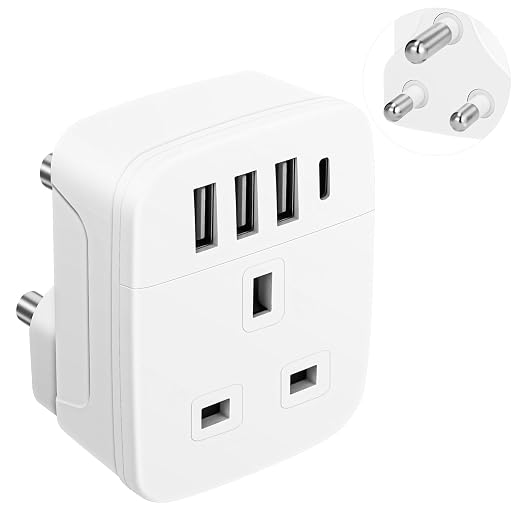
This is the one I would pack for a safari. The pins are fixed, the adapter is earthed, and the four USB ports mean one lodge socket charges a phone, a camera battery and a power bank at the same time. It is also among the best-reviewed Type M adapters on Amazon UK.
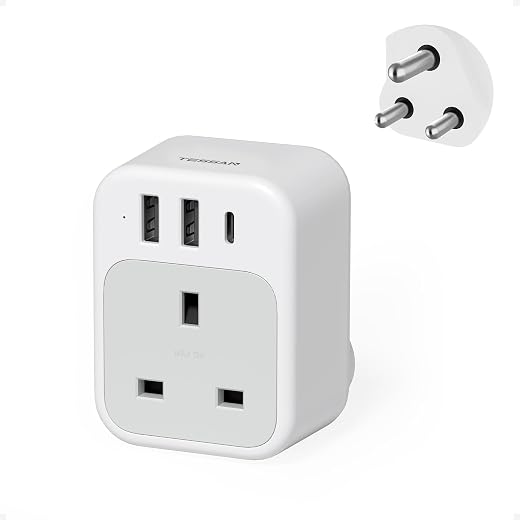
If you would rather stick with a brand you know, TESSAN makes a Type M version with USB built in. It is smaller, and fine for a city trip to Cape Town or Johannesburg.
For more choice, including multi-packs for families, see UK to South Africa Type M adapters on Amazon.
If you want to cover the newer sockets too, pack a cheap two-pin EU adapter alongside it. Between the Type M adapter and the EU one, you are covered in every South African room you will stay in. You probably already own the EU one from a trip to Spain or France. The EU plug adapter guide covers the options.
If you forget, it is not a disaster. Type M adapters are widely sold in South Africa itself, at airport shops and in pharmacies and supermarkets, usually for less than you would pay at home. That said, sorting it before you fly means your phone is charged in the taxi from the airport.
Heading on safari? Neighbouring countries use different plugs
A lot of South Africa trips spill over the border, and the plug situation changes when they do.
| Country | Main plug types |
|---|---|
| South Africa | M, N, C (D in older buildings) |
| Namibia | M, D |
| Lesotho | M |
| Eswatini | M |
| Botswana | D, G, M |
| Zimbabwe (Victoria Falls) | G, D |
| Zambia (Livingstone) | G, C, D |
Two things stand out. Namibia, Lesotho and Eswatini are Type M countries, so the South Africa adapter carries straight over. Zimbabwe and Zambia are the opposite case: they use the UK-style Type G, so at Victoria Falls your UK plug will usually fit with no adapter at all. Botswana mixes both, which makes it the one country where you want a Type M adapter and your UK plugs ready at the same time.
For the full list of countries by plug type, see the worldwide plug adaptor types guide, and for everywhere the UK plug works as-is, the Type G plug guide.
Charging at safari lodges
Remote lodges are where power planning actually matters. Many run on solar or generators, and it is common for charging to be limited to the main lodge building or to set hours, with tents or chalets that have one socket or none. The socket, when there is one, is almost always Type M.
What helps: a Type M adapter with two or three USB ports, so one socket charges your phone, camera battery and power bank at once; a power bank for game drives, because a camera and a phone will not both last a full day on standby; and charging everything whenever the lodge generator is running, not when you happen to remember.
Hair dryers are the item to leave at home for a lodge stay. Generator and solar setups often cannot run high-wattage appliances at all, and lodges that allow them usually provide their own.
Is load shedding still a problem in South Africa?
Much less than it was. South Africa’s national rolling blackouts, known as load shedding, have been suspended since around May 2025, and in March 2026 the government marked 300 consecutive days without it. Eskom has continued to report no load shedding through 2026.
That does not mean the power never goes off. Some overloaded suburbs have seen scheduled local “load reduction” at peak times, and like anywhere, individual areas have faults. Most hotels and lodges in tourist areas have backup power. It is still worth arriving with a charged power bank, but blackouts are no longer something you need to plan the trip around.
Frequently Asked Questions
What travel adapter do I need for South Africa?
A UK to South Africa Type M adapter. Type M, with three large round pins, is still the most common socket in South Africa. A standard universal adapter usually does not include it. Adding a two-pin EU adapter covers the newer Type N and Type C sockets too.
What plug type is used in South Africa?
South Africa mainly uses Type M, plus Type N in newer buildings and Type C two-pin sockets. Some older properties also have Type D. The supply is 230V at 50Hz.
Is the South Africa plug the same as the UK plug?
No. South Africa’s Type M plug has three large round pins, while the UK Type G has three flat rectangular pins. A UK plug will not fit. The voltage is the same, 230V, so UK devices only need a plug adapter.
Will a universal travel adapter work in South Africa?
Often not. Most universal adapters sold in the UK cover UK, EU, US and Australian plugs but not Type M. Check the listing names Type M or South Africa specifically before relying on one.
Will my EU adapter work in South Africa?
Sometimes. A two-pin EU adapter fits Type N sockets and dedicated two-pin outlets, which are common in newer hotels. It will not fit the older Type M sockets, which are still the majority, so do not rely on it alone.
Do I need a voltage converter for South Africa?
No. South Africa runs at 230V and 50Hz, the same as the UK, so UK chargers and appliances work normally with just a plug adapter.
Can I buy a plug adapter in South Africa?
Yes. Type M adapters are widely sold in South Africa, including at airports, pharmacies and supermarkets, and are usually inexpensive. Buying one before you fly means your devices are charged from the moment you land.
What plugs do they use at Victoria Falls?
Zimbabwe and Zambia mainly use UK-style Type G sockets, so a UK plug usually fits without an adapter. This is different from South Africa, Namibia, Lesotho and Eswatini, which use Type M.