Travel Pillow Size Guide
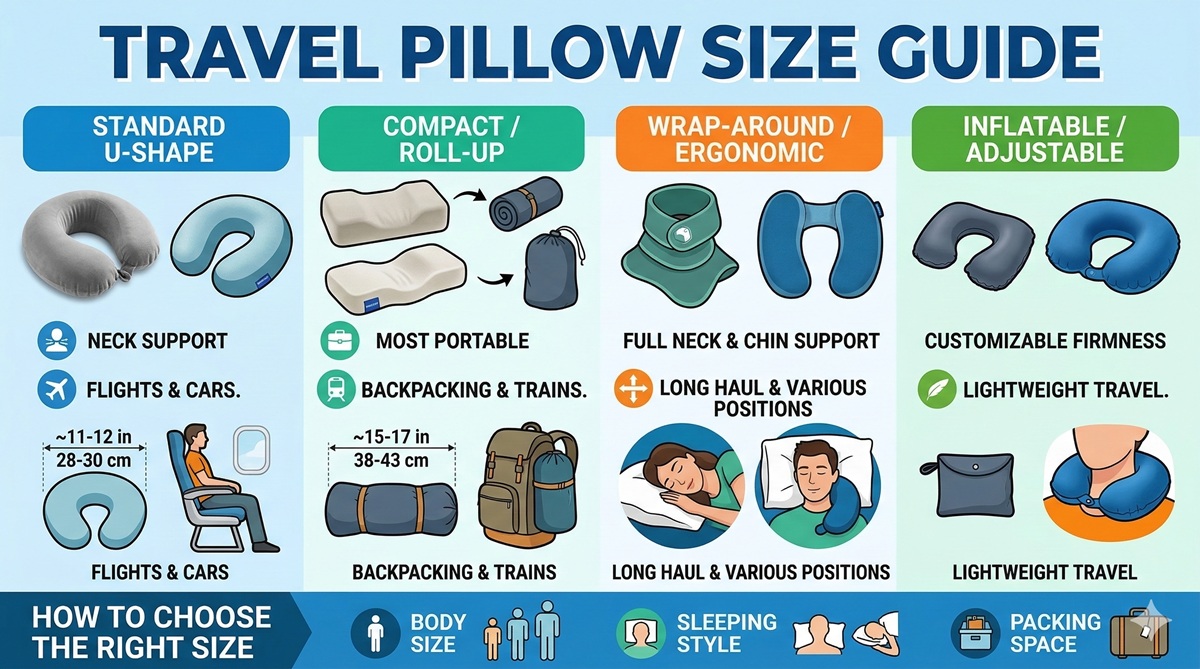
Travel pillow size matters in two distinct ways: how well the pillow fits your neck, and how much space it takes up in your bag. Both are worth getting right — a pillow that fits your neck poorly provides no support, and a pillow that does not fit in your bag gets left at home.
This guide covers the dimensions you need to know for the main pillow types, how to measure your neck for a correct fit, and practical carry-on compatibility advice.
Part 1: Neck Fit
How to Measure Your Neck for a Travel Pillow
Measure your neck circumference at the base, where your neck meets your shoulders. Use a soft tape measure (or a piece of string measured against a ruler). This is the measurement that determines whether a U-shaped or wraparound pillow will fit correctly.
Typical adult neck circumferences:
- Small frame adult: 30–35cm
- Average adult: 35–40cm
- Larger frame adult: 40–45cm+
Children:
- Ages 3–7: 20–27cm
- Ages 7–12: 25–32cm
- Ages 12+: 30–35cm
Most adult travel pillows are designed for neck circumferences of 35–42cm. If you have a notably slim neck (under 33cm), standard adult pillows sit loosely and shift during sleep — consider a more fitted design with an adjustable strap (the SNUGL has an adjustable toggle) or a scarf-style design that wraps and adjusts to neck width.
Inner vs Outer Dimensions
For U-shaped pillows, the measurement that matters is the inner circumference of the U — the gap between the two arms. Too small and the pillow squeezes your neck; too large and it provides no lateral support and slides around freely.
When comparing products, look for “inner opening” or “inner circumference” in the specifications. If not listed, the inflated/uncompressed inner diameter of a standard adult U-pillow is typically 15–18cm.
Pillow Height
Pillow height (the distance from the base to the top of the U-shape arms) determines whether the pillow sits at the right height on your neck. Too low, and it rests on your shoulders rather than providing neck support. Too high, and it pushes up against your jaw uncomfortably.
Average pillow height for an adult neck: 12–15cm. Taller individuals (over 185cm) may benefit from a pillow at the higher end of this range.
The Trtl Pillow Plus addresses this directly with adjustable height settings — a useful feature if you find standard-height pillows sit too low.
Part 2: Packed Dimensions
Comparison by Type
Inflatable pillows (deflated):
The smallest packed size of any pillow type. Standard inflatable U-pillows deflate to approximately:
- Folded flat: 18cm x 12cm x 2cm
- Rolled: 12cm x 6cm diameter
The Purefly and similar models with built-in pumps are slightly larger than basic valve inflatables due to the pump mechanism, but remain very compact.
The Travelrest, as a body pillow rather than a neck pillow, deflates to approximately 15cm x 8cm rolled — still remarkably small for the surface area it provides when inflated.
Scarf-style pillows (folded):
The Trtl Pillow folds flat, packing to approximately:
- Folded: 32cm x 18cm x 4cm
This is larger than deflated inflatables but much smaller than compressed memory foam. It fits flat in a laptop sleeve, the lid pocket of most carry-on bags, or clipped to the outside.
Memory foam U-pillows (with compression bag):
Without compression, most memory foam travel pillows occupy approximately 25cm x 20cm x 14cm — too large to fit in most compact carry-ons without eating significant bag space.
With a compression bag (included with most mid-range and premium foam pillows), this reduces to approximately:
- SNUGL compressed: ~18cm x 18cm x 10cm
- Portable memory foam compressed: ~15cm x 15cm x 12cm
- Aidapt: no compression bag included, approximately 22cm x 20cm x 12cm uncompressed
Wraparound/chin-support designs:
The J-Pillow and BCOZZY are among the least packable options due to their asymmetric shapes. They compress with their included bags to roughly half their full size, but the irregular shape makes them difficult to fit neatly into bag spaces.
- J-Pillow compressed: approximately 22cm x 18cm x 12cm
- BCOZZY compressed: approximately 25cm x 20cm x 10cm
Both are practically best clipped to the outside of a carry-on bag rather than packed inside.
Part 3: Carry-On Compatibility
Airline Carry-On Size Limits
Carry-on size limits vary by airline and are relevant to whether a travel pillow takes up part of your allowance.
A travel pillow is generally treated as a personal item (handbag, laptop bag, small backpack) rather than a hand luggage bag. This means it typically does not count against your cabin bag allowance on most airlines. However:
- On budget airlines (Ryanair, easyJet), where only one bag is allowed unless you pay for priority or extra baggage, a pillow counts as part of or in addition to that single bag
- Clipping a pillow to the outside of a bag may attract attention at strict bag-sizers — deflate inflatables and clip or compress foam pillows to minimise their visual footprint at the gate
For detailed airline baggage rules, see the baggage guides in our related section.
By Bag Type
Full-sized carry-on (56cm x 45cm x 25cm, the standard limit on most full-service airlines):
All pillow types fit — memory foam in the compression bag takes up roughly 10–15% of the bag volume. Not a significant concern.
Compact carry-on (40cm x 30cm x 15cm, common Ryanair “small bag” limit):
Memory foam pillows are difficult to fit inside this bag size without sacrificing significant space for other items. Inflatable or scarf-style are far more practical. The Trtl at folded dimensions of 32cm x 18cm x 4cm fits across the lid pocket of most small bags.
Personal item / underseat bag (typically 40cm x 20cm x 25cm):
Inflatables fit easily. Scarf-style fits. Memory foam is tight and will likely need to be clipped externally.
Backpack-only travel:
For one-bag travellers using a 20–30 litre daypack, the choice of pillow type is almost entirely dictated by packed size. Inflatable or Trtl are the only practical options. A memory foam pillow would occupy a disproportionate amount of the bag’s volume.
Part 4: Children’s Pillow Sizing
Children’s travel pillows are sized differently — see the dedicated guide to travel pillows for kids for age-appropriate sizing and product recommendations. The key difference: inner circumference of children’s U-pillows (25–30cm) versus adult versions (35–40cm). Using an adult-sized pillow on a child means it sits on their shoulders rather than their neck.
Quick Reference Table
| Pillow | Packed Size | Fit Range (Neck) | Carry-On Friendly |
|---|---|---|---|
| Trtl Pillow | 32 x 18 x 4cm (folded) | Most adult necks | Yes |
| SNUGL | ~18 x 18 x 10cm (compressed) | 35–42cm necks | With compression bag |
| J-Pillow | ~22 x 18 x 12cm (compressed) | Most adult necks | Better clipped externally |
| Travelrest | 15 x 8cm rolled | Adjustable (body pillow) | Yes (deflated) |
| BCOZZY | ~25 x 20 x 10cm | 35–45cm necks | Better clipped externally |
| Purefly | ~18 x 12 x 2cm (deflated) | Most adult necks | Yes |
| Aidapt | ~22 x 20 x 12cm | 35–42cm necks | Clip externally |
Frequently Asked Questions
Does a travel pillow count as part of my hand luggage allowance?
On most full-service airlines, a travel pillow clipped to or packed inside your carry-on bag is part of that bag’s allowance and does not count as an extra item. On strict budget airlines, anything additional (including a pillow worn around your neck at the gate) may be counted. Wear it or keep it inside your bag at bag-size checks.
What is the most compact travel pillow?
Deflated inflatable pillows are the smallest — some compress to the size of a large lemon. Of the non-inflatable options, the Trtl folds the flattest. See our memory foam vs inflatable guide for a full comparison.
Can I fit a travel pillow in a 40L backpack?
Yes, all pillow types fit comfortably in a 40L pack. Memory foam takes up more space than inflatable or scarf-style, but a 40L bag has room for all of them without significant sacrifice.