Vietnam Holidays: Best Places to Visit
Vietnam holidays are chaos, and I mean that as a compliment. The motorbikes alone – millions of them, flowing around pedestrians and cars like water around stones – take some getting used to. But once you find the rhythm, this long, skinny country reveals itself as one of the most rewarding destinations in Southeast Asia. The food alone is worth the trip.
I spent three weeks travelling from Hanoi to Ho Chi Minh City, with stops at Halong Bay, Hue, Hoi An, and the Mekong Delta. The country is manageable in that time, though you could easily spend longer. The further you get from the tourist trail, the more interesting it becomes.
Hanoi: The Chaotic Capital
Hanoi is old Vietnam. The French colonial architecture, the ancient temples, the Old Quarter with its guild streets named after the trades that once occupied them – it all feels layered with history in a way that Ho Chi Minh City does not.
The Old Quarter
This is where most travellers base themselves, and for good reason. The 36 streets are named after what was sold there historically – Hang Gai (silk), Hang Bac (silver), Hang Tre (bamboo). These days the goods have evolved, but the narrow streets, crumbling shophouses, and constant motion remain.
Walking the Old Quarter takes practice. Motorbikes use the pavements as roads. Street vendors carry their goods on shoulder poles. The key is to move steadily and predictably – the traffic flows around you if you do not make sudden movements.
What to See
Ho Chi Minh Mausoleum – The embalmed body of Vietnam’s revolutionary leader lies in a Soviet-style mausoleum in Ba Dinh Square. Free entry but strict rules: dress modestly, no talking, no photos, and join the queue early (it closes at 10:30am and lines get long). Whether you find it moving or morbid depends on your perspective, but it is genuinely interesting as a glimpse into Vietnamese political culture.
Temple of Literature – Vietnam’s first national university, founded in 1070. Peaceful gardens, courtyards, and pavilions offer a break from the chaos outside. The turtle steles bearing the names of doctoral graduates are the highlight.
Hoan Kiem Lake – The lake at the heart of Hanoi, surrounded by the Old Quarter. The Ngoc Son Temple on an island in the lake is connected by a red wooden bridge. Come at dawn to see locals doing tai chi, or in the evening when the area closes to traffic and fills with families.
Train Street – A narrow alley in the Old Quarter where the train passes twice daily, inches from the houses. Tourists sit at cafes waiting for the train; locals have been here forever. The government periodically closes it for safety, then it reopens. Check before visiting.
Hanoi Food
This is the real reason to spend time in Hanoi. The food scene here is extraordinary.
Pho – The famous noodle soup originated in Hanoi. Beef (pho bo) or chicken (pho ga), eaten for breakfast ideally. Pho Gia Truyen on Bat Dan Street is legendary – queue for plastic stools and slurp with the locals.
Bun cha – Grilled pork patties with rice noodles, herbs, and dipping sauce. Obama ate this at Bun Cha Huong Lien with Anthony Bourdain; the restaurant now has “Obama set” on the menu. Better versions exist elsewhere, but the hype is understandable.
Banh mi – Vietnamese baguette sandwiches. The Hanoi style tends to be simpler than southern versions, with pâté, cold cuts, and pickled vegetables.
Egg coffee – A Hanoi speciality: espresso topped with whipped egg yolk and condensed milk. Sounds strange, tastes like tiramisu. Giang Café claims to have invented it.
Budget: Street food meals cost 30,000-50,000 VND (£1-2). Restaurant meals 100,000-200,000 VND (£3-7). You can eat extremely well for very little.
Halong Bay
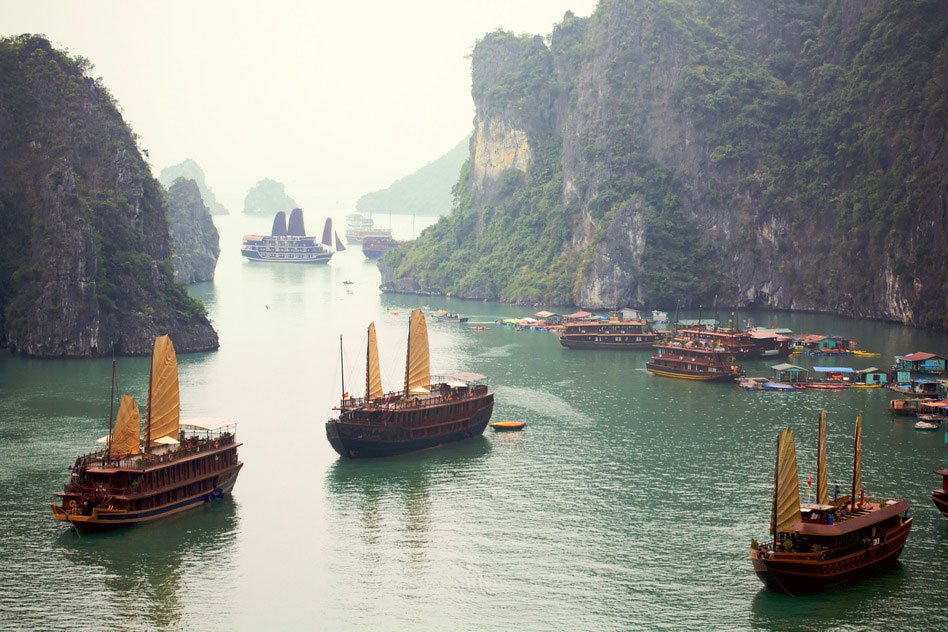
About three hours east of Hanoi, Halong Bay is the iconic Vietnam image: thousands of limestone karsts rising from emerald water, traditional junks sailing between them. It is touristy, commercialised, and still genuinely spectacular.
Choosing a Cruise
Almost everyone experiences Halong Bay on an overnight cruise. Options range from budget boats (£40-60 per person for one night) to luxury cruises (£200-400+). The difference is in the boat quality, food, and itinerary – cheaper cruises visit busier areas, while premium boats go further into less-crowded sections of the bay.
Two nights is better than one if you can afford it. The first day involves getting there and a brief afternoon cruise; a second night lets you actually explore.
Lan Ha Bay is the less-visited section to the south, often accessed via Cat Ba Island. The scenery is similar but with fewer boats. Some operators combine Halong and Lan Ha for the best of both.
What You Will Do
Cruises follow similar patterns: kayaking among the karsts, visiting caves (Sung Sot Cave is the most popular), swimming from the boat, and watching sunset from the deck. The cooking classes and tai chi sessions on better boats are usually worthwhile.
Avoid: The cheapest day trips from Hanoi. Four hours each way in a bus, a few hours on a crowded boat, then back to Hanoi exhausted. Overnight is the minimum.
Central Vietnam: Hue and Hoi An
The middle section of Vietnam contains two essential stops: the imperial city of Hue and the lantern-lit streets of Hoi An.
Hue
The former imperial capital, Hue is quieter and more refined than Vietnam’s bigger cities. The Citadel – a walled fortress containing the Imperial City – was largely destroyed during the Vietnam War but has been gradually restored. Walking through the palatial grounds, with their lotus ponds and ceremonial halls, gives a sense of Vietnam’s Nguyen Dynasty past.
The Perfume River runs through Hue, and a boat trip to the Thien Mu Pagoda is a peaceful afternoon. The pagoda itself is less impressive than the journey.
Hue’s speciality dishes include bun bo Hue (spicy beef noodle soup, more complex than pho) and banh khoai (crispy pancakes). The food here is considered Vietnam’s most refined cuisine.
Hoi An
If Hue is imperial Vietnam, Hoi An is trading Vietnam. This small port town was a major centre for Chinese, Japanese, and European merchants from the 15th to 19th centuries. The old town is remarkably preserved – yellow-painted shophouses, covered bridges, and Chinese temples line pedestrianised streets.
Hoi An is famous for tailoring. Dozens of shops offer custom-made suits, dresses, and shirts at a fraction of Western prices. Quality varies wildly. Yaly Couture and Bebe are reputable; allow time for fittings and avoid same-day rush jobs.
The town is also famous for its food. White rose dumplings (banh bao vac), cao lau (thick noodles with pork), and banh mi (arguably Vietnam’s best – try Banh Mi Phuong) are local specialities.
The lanterns – Hoi An is known for colourful silk lanterns that light up the old town at night. On the 14th of each lunar month (full moon), the town switches off electric lights and illuminates with candles and lanterns. Worth timing your visit if possible.
An Bang Beach is a few kilometres east of town. Decent sand, restaurants on the beach, and a welcome break from temple-hopping.
Ho Chi Minh City
Formerly Saigon (and still called that by most locals), Vietnam’s largest city is the economic powerhouse of the south. It is louder, busier, and more modern than Hanoi – less charm, more energy.
War History
The Vietnam War (the American War, as it is called here) dominates the city’s historical attractions.
War Remnants Museum – Graphic photographs and American military equipment documenting the war from the Vietnamese perspective. Not balanced journalism, but powerful and affecting. The Agent Orange exhibits are difficult to see.
Cu Chi Tunnels – About an hour northwest of the city, this network of underground tunnels was used by Viet Cong fighters. Tours let you crawl through widened sections (the originals were too narrow for most Westerners), see booby traps, and if you choose, fire an AK-47 at the on-site shooting range. The whole thing feels slightly theme-parked, but the tunnels themselves are genuinely impressive engineering.
Independence Palace – The former South Vietnamese presidential palace, preserved as it was when tanks crashed through the gates in April 1975. The war rooms, communications centre, and 1960s décor are fascinating time capsules.
The City Itself
Beyond war history, HCMC is a modern Asian metropolis. The Ben Thanh Market is the tourist shopping hub – expect to haggle hard. The Jade Emperor Pagoda is the most atmospheric of the city’s temples. District 2 (Thao Dien) has the expat cafes and brunch spots.
The street food scene rivals Hanoi’s, though the style differs. Banh mi here are more elaborate, com tam (broken rice with grilled pork) is a local staple, and the coffee is served over ice with condensed milk.
The Mekong Delta
South of Ho Chi Minh City, the Mekong River splits into nine tributaries (hence the Vietnamese name, Cuu Long – Nine Dragons) before emptying into the South China Sea. The delta is Vietnam’s rice bowl and a completely different world from the cities.
Floating Markets
The main attraction. Cai Rang near Can Tho is the largest – hundreds of boats loaded with produce, wholesalers trading from dawn until mid-morning. Tours leave early (5am pickup) to catch the best activity. Cai Be is closer to HCMC and slightly more tourist-oriented.
The reality is that floating markets are declining as roads improve and wholesale moves to land. They are still worth seeing but manage expectations – this is not a pristine traditional scene, it is a working market adapting to modern times.
Beyond the Markets
Day trips from HCMC scratch the surface. Staying overnight in Can Tho or Ben Tre lets you cycle through rice paddies, visit fruit orchards, and see rural Vietnamese life at a slower pace. Homestays in the delta are simple but memorable.
Practical Information
Getting around: Vietnam is long (1,650km north to south) and transport options reflect this. Domestic flights are cheap and fast – Vietnam Airlines, VietJet, and Bamboo Airways connect all major cities, with Hanoi to HCMC costing around £30-60. Overnight trains run the length of the country – the Hanoi to HCMC route takes 30+ hours but breaks naturally at Hue and Da Nang. The Reunification Express is more romantic than comfortable. Buses are cheap but exhausting for longer routes. For the Open Tour Bus (tourist bus hopping between main destinations), quality varies enormously.
Money: Vietnamese Dong (VND). Roughly 31,000 VND to £1. The numbers are confusing at first – a meal costing 50,000 VND sounds expensive until you realise it is £1.60. ATMs are everywhere; cards work in hotels and proper restaurants but street food and small shops are cash only.
Language: Vietnamese. English is widely spoken in tourist areas but limited elsewhere. Learn basic phrases – “xin chào” (hello), “cảm ơn” (thank you), “bao nhiêu” (how much).
Visas: UK citizens can visit visa-free for up to 45 days. For longer stays, e-visas are available for up to 90 days, costing $25 (single entry) or $50 (multiple entry) – apply online at least three days before arrival.
Best time: Vietnam’s climate varies north to south. The north (Hanoi) is coolest November to February but often grey and drizzly. The south (HCMC) is hot year-round with a distinct wet season (May to November). Central Vietnam is best February to August. There is no perfect time for the whole country.
Budget: Vietnam is excellent value. Budget travellers can manage on £20-30 per day with hostels, street food, and local transport. Mid-range comfort (private rooms, restaurant meals, organised tours) runs £40-70 per day.
Safety: Generally very safe. The main issues are traffic (crossing roads requires faith), petty theft (especially bag snatching from motorbikes in HCMC), and scams targeting tourists. Common sense applies.
Frequently Asked Questions
Do I need a visa to visit Vietnam?
UK citizens can visit Vietnam visa-free for up to 45 days. For longer stays, e-visas are available for up to 90 days, costing $25 (single entry) or $50 (multiple entry) – apply online at least three days before arrival.
What is the best time to visit Vietnam?
Vietnam’s climate varies north to south. The north (Hanoi) is coolest November to February but often grey. The south (HCMC) is hot year-round with a wet season May to November. Central Vietnam is best February to August. There is no perfect time for the whole country.
What currency does Vietnam use?
Vietnam uses the Vietnamese Dong (VND). Roughly 31,000 VND to £1. ATMs are everywhere and cards work in hotels and proper restaurants, but street food and small shops are cash only.
What type of power plugs does Vietnam use?
Vietnam uses Type A, C, and G plugs. Voltage is 220V. A universal adapter is recommended as plug types vary by building.
How expensive is Vietnam?
Vietnam offers excellent value. Budget travellers can manage on £20-30 per day with hostels, street food, and local transport. Mid-range comfort runs £40-70 per day. Street food meals cost £1-2, while restaurant meals range from £3-7.
Is Vietnam safe for tourists?
Vietnam is generally very safe. The main issues are traffic (crossing roads requires faith), petty theft (especially bag snatching from motorbikes in HCMC), and scams targeting tourists. Exercise normal caution and common sense.
What to Pack for Vietnam
The tropical climate and varied terrain require versatile packing.
Travel Essentials
Universal Travel Adapter: Vietnam uses Types A, C, and G plugs, and outlets vary by building. A universal adapter is essential.

Neck Pillow: Long-haul flights (11+ hours) and overnight trains on the Reunification Express demand proper sleep support.
Backpack: A versatile backpack is ideal for Vietnam’s varied terrain – from Hanoi’s old quarter to Halong Bay boats to Hoi An’s streets.

Packing Tips
- Light, breathable clothing – Humidity is high in the south
- Rain jacket – Showers can happen any time of year
- Comfortable walking shoes – Hanoi and Hoi An are best explored on foot
- Mosquito repellent – Essential in the Mekong Delta
- Waterproof bag – For Halong Bay kayaking and boat trips
- Modest clothing – For temple visits (cover shoulders and knees)