Places to Visit in China: Travel Guide
China is a huge country, and a first trip usually covers a small part of it. The classic first route links Beijing, the Great Wall, Xi’an and Shanghai, all connected by high-speed rail, and those are the places to visit in China this guide covers.
Much of the appeal is the contrast between old and new. You can walk a section of the Great Wall in the morning and be back by fast train in a city of skyscrapers by evening.
Independent travel in China takes more planning than most of Asia. The language barrier is real, many Western websites and apps are blocked, and payments work differently. It is entirely possible, though. Hong Kong is part of China but has its own entry rules and is covered in a separate guide.
Beijing: Imperial Capital
Beijing was the seat of the Ming and Qing emperors and is the centre of government today. Give it at least four days.
The Forbidden City
The palace covers 72 hectares (about 180 acres) and has 980 surviving buildings. It was home to 24 emperors of the Ming and Qing dynasties. You walk through a long run of courtyards and halls, each grander than the last. The crowds are heavy and the distances are long, so wear comfortable shoes.
Practical tips: the Palace Museum is closed on Mondays (except national holidays) and does not sell tickets on the day, so book online in advance. Foreign visitors need their passport number to book, and daily visitor numbers are capped. You enter from the south through Tiananmen Gate and leave from the north. An audio guide is worth having. Early morning is the quietest time.
Jingshan Park, directly north of the Forbidden City, gives the best view of the whole complex. Climb the hill for sunset.
Tiananmen Square
The square was laid out to be one of the largest in the world, big enough to hold more than 500,000 people. It is the political heart of the country and the site of the 1989 protests. Mao’s portrait hangs on the Gate of Heavenly Peace, and the Monument to the People’s Heroes and the Great Hall of the People face the square. Expect security checkpoints at the entrances.
There isn’t much to do beyond walking across it, so combine it with the Forbidden City directly to the north.
Temple of Heaven
Ming and Qing emperors came here to pray for good harvests. The circular, triple-roofed Hall of Prayer for Good Harvests, with its blue tiles, is one of China’s best-known buildings. Come early in the morning, when the surrounding park fills with locals doing tai chi, playing traditional instruments and exercising in groups. Tickets for the park alone cost less than a combined ticket that includes the main buildings.
The Summer Palace
The imperial summer retreat is northwest of the centre. Kunming Lake makes up about three-quarters of the grounds; you can walk the painted Long Corridor along the shore, climb Longevity Hill, and take a boat across the water. It is calmer than the Forbidden City and fills a pleasant half-day.
Hutongs
Hutongs are the old neighbourhoods of narrow alleys and courtyard houses, many of which have been demolished as the city has grown. The streets around Nanluoguxiang and Yandaixie Street have been restored and are full of shops and cafés, and very busy. For quieter alleys, walk around the Drum Tower (Gulou) or take a pedicab tour through the residential hutongs.
Beijing Food
Beijing cooking is hearty northern Chinese food.
Peking duck is the city’s signature dish: crispy-skinned duck wrapped in thin pancakes with spring onion and sweet bean sauce. Quanjude and Da Dong are two of the best-known restaurants for it.
Jiaozi (dumplings) are cheap, filling and come with endless fillings.
Zhajiangmian is thick noodles with minced pork and fermented bean sauce.
Lamb skewers come from the Muslim northwest and are sold on streets all over the city.
The Great Wall
The Great Wall is not one wall but thousands of kilometres of fortifications built over centuries, and the sections near Beijing are very different from one another.
Badaling
Badaling, about 80 km northwest of Beijing, is the easiest section to reach and the most crowded. It is fully restored, with cable cars. It’s fine if you are short of time, but the crowds take a lot away from it.
Mutianyu
Mutianyu, about 70 km northeast of the city, is restored and has a cable car and a toboggan ride down, but it is less crowded than Badaling. The wall here follows forested ridges.
Jinshanling
Jinshanling, about 125 km northeast of Beijing in Hebei, suits visitors who want something wilder. The first stretch is restored, and the wall becomes more ruined towards neighbouring Simatai, with steep climbs and crumbling watchtowers. The Jinshanling section is about 10.5 km long. Walking from Jinshanling through to Simatai used to be a classic hike, but Simatai was closed in 2010 and reopened in 2014 with its own access, so check locally whether the link between the two sections is open. Jinshanling is harder to reach on public transport than Mutianyu or Badaling.
Jiankou to Mutianyu
The unrestored wall at Jiankou is steep and badly crumbled. The hike from Jiankou to Mutianyu is hard and not officially sanctioned, and is only for experienced, well-prepared hikers.
Getting there: most visitors book a day tour from Beijing that includes transport and entry. Public buses run to Badaling and Mutianyu; other sections need private transport.
Xi’an: Ancient Capital
Xi’an was the capital of several Chinese dynasties long before Beijing. The Terracotta Army is the reason most people come, but the city has more to see.
The Terracotta Warriors
Farmers digging a well outside Xi’an in 1974 found fragments of clay figures. Excavation revealed an army of more than 8,000 life-size terracotta soldiers, along with chariots and horses, buried to guard Emperor Qin Shi Huang in the afterlife. Most of them have still not been dug out.
Pit 1, the largest, holds the main army, with more than 3,000 figures excavated so far, standing in battle formation and each with individual features. Pits 2 and 3 are smaller and hold cavalry and command figures. The site museum displays bronze chariots and explains how the figures were made.
The site is outside the city in Lintong District. Tours are easy to arrange, and public buses run from Xi’an railway station; check the current route and buy tickets in advance. Allow half a day.
Xi’an City Wall
The Ming-era wall runs 13.7 km around the old city and is 12 metres high, with a top wide enough to cycle on. Hiring a bike and riding the full circuit is the best way to see it, and it is at its most atmospheric at dusk when the gate towers are lit.
Muslim Quarter
Xi’an sits on the old Silk Road, and its Muslim Quarter has long been home to the Hui community. The lanes around the Great Mosque are packed with food stalls, spice shops and halal restaurants. Try yangrou paomo (lamb soup with torn bread), roujiamo (stewed meat in a flatbread, often called a Chinese hamburger) and biangbiang noodles (wide belt noodles).
The Great Mosque mixes Chinese and Islamic architecture and looks more like a Chinese temple than a Middle Eastern mosque.
Shanghai: The Future
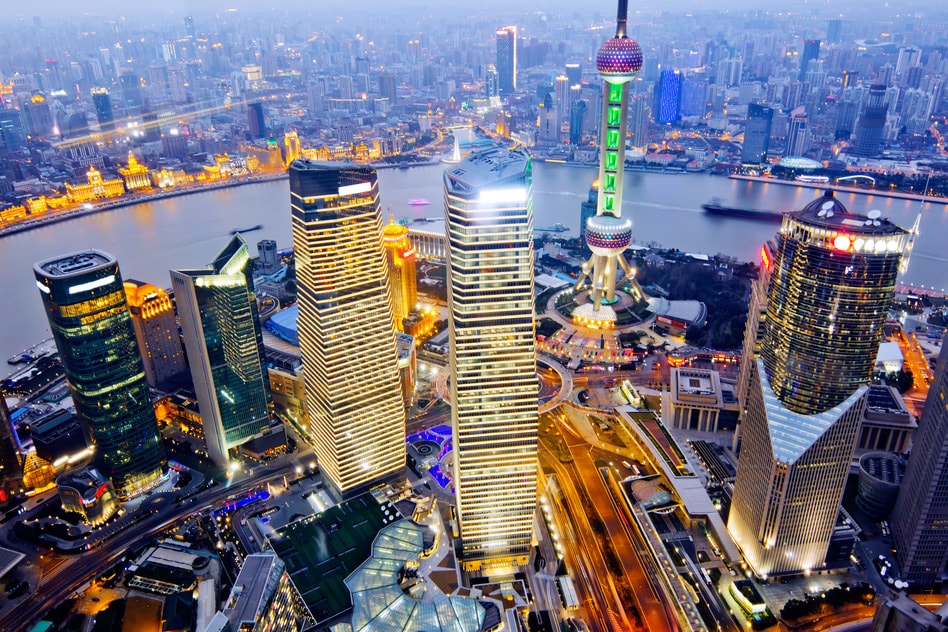
Shanghai is where China’s economic growth is easiest to see. Most of the Pudong skyline across the Huangpu River has gone up within living memory.
The Bund
The Bund is the riverside promenade lined with banks, trading houses and hotels from Shanghai’s early 20th-century heyday. Walk it at night, when Pudong’s towers are lit up across the river.
Pudong
Cross the river by metro, ferry or the tunnel to walk among the towers. The Shanghai Tower is 632 metres tall, the world’s third-tallest building. Its observation decks are at 546 and 552 metres, and the “Top of Shanghai” deck on the 121st floor at 562 metres. The Oriental Pearl Tower is the older and more distinctive landmark.
French Concession
The former French Concession is now the most pleasant part of Shanghai to walk around, with tree-lined streets, art deco buildings, boutiques and restaurants. Stay here if you want cafés and street life rather than skyscrapers.
Yu Garden and Old Town
Yu Garden is a classical Jiangnan garden of pavilions, ponds, rockeries and dragon walls. The Old Town bazaar around it is touristy but fun, with traditional buildings and a lot of shops and snack stalls.
Shanghai Food
Shanghainese cooking is built on fresh ingredients and subtle flavours.
Xiaolongbao are soup dumplings, thin dough filled with pork and hot broth. Din Tai Fung is a reliable chain; Jia Jia Tang Bao is a popular local name.
Shengjianbao are pan-fried buns, crisp on the bottom and juicy inside.
Hongshao rou is red-braised pork belly.
Hairy crab is a seasonal autumn delicacy from the lakes near Shanghai.
Practical Information
Visas
Until 31 December 2026, British citizens can enter China without a visa for up to 30 days for tourism, business, family visits or transit, according to UK government travel advice. You need a visa for longer stays or for work, study or journalism. Your passport must be valid for at least six months after you arrive and have two blank pages. Some nationalities can also use China’s 240-hour visa-free transit through designated ports if they are travelling on to a third country; check eligibility with the Chinese embassy before relying on it.
When you arrive you must register your address with the police within 24 hours. Hotels do this for you at check-in.
Internet
Google, Facebook, Instagram, WhatsApp and most Western social media are blocked in China. Many visitors use a VPN, but UK government advice notes that Chinese law requires VPNs to be licensed by the government, so read that advice before you go. Download any apps you need before you arrive.
Money
The currency is the Chinese yuan (CNY, also called renminbi or RMB), written ¥. Payment by smartphone through WeChat Pay or Alipay is almost universal, so set one of them up before you travel and check the app’s current rules for linking a foreign card. Carry some cash as a backup: outside the major cities, credit cards are not always accepted and ATMs are limited.
Transport
China’s high-speed rail network is fast, punctual and comfortable. The fastest Beijing to Shanghai trains take about four and a half hours. Book through Trip.com or at stations, and book early around public holidays, when popular routes sell out.
Domestic flights are frequent, but for shorter distances the train is often the easier option.
Beijing, Shanghai and other big cities have cheap, efficient metro systems. Didi, the main ride-hailing app, is useful, but set it up before you travel.
Language
Mandarin Chinese. English is not widely spoken outside tourist areas and international hotels. A translation app with a camera function and the Pleco dictionary app help a lot, and a few phrases of Mandarin go a long way, however rough the pronunciation.
Best Time to Visit
Spring (April-May) and autumn (September-October) bring comfortable temperatures. Summer is hot and humid, and winter is cold in the north. Avoid the first week of October (the National Day holiday) and Chinese New Year (late January or February), when huge numbers of people travel and transport is packed.
Costs
Costs depend mostly on where you stay and how you travel. Street food, local transport and hostels keep costs low, while international hotels in the big cities cost far more. Check current ticket prices on official attraction websites before you go.
Safety
UK government advice says serious crime against foreign nationals is relatively rare, but you should watch your belongings at busy tourist sites. The scam to know about is the “tea tasting” or “massage” invitation: a friendly stranger takes you to a bar or tea house, and the establishment then demands a large fee. City traffic is the other everyday hazard.
Frequently Asked Questions
Do UK citizens need a visa for China?
Not for short trips at the moment. Until 31 December 2026, British citizens can enter China visa-free for up to 30 days for tourism, business, family visits or transit. Longer stays and work, study or journalism need a visa. Your passport must be valid for six months after arrival with two blank pages.
What is the best time to visit China?
Spring (April-May) and autumn (September-October) have the most comfortable weather. Avoid the first week of October (National Day holiday) and Chinese New Year (late January or February), when domestic travel peaks and transport is packed.
What currency does China use?
The Chinese yuan (CNY/RMB), written ¥. Mobile payment through WeChat Pay or Alipay is almost universal, so set one up before you go. Carry some cash too, as cards are not always accepted and ATMs are limited outside the big cities.
Can I use Google and social media in China?
No. Google, Facebook, Instagram, WhatsApp and most Western social media are blocked. Many visitors use a VPN, but Chinese law requires VPNs to be government-licensed, so check UK travel advice before you travel and download what you need beforehand.
How much does it cost to travel in China?
It depends on your travel style. Street food, local transport and hostels keep costs low, while international hotels in the big cities cost far more. Check attraction prices on official websites before you go.
Is China safe for tourists?
UK government advice says serious crime against foreign nationals is relatively rare. Keep an eye on your belongings at busy sites, watch out for the “tea tasting” scam, where a stranger invites you somewhere that then demands a large bill, and take care in city traffic.