Places to Visit in Russia: Travel Guide
Important Note: Travel to Russia from the UK, EU, and many Western countries is currently complicated due to sanctions, flight restrictions, and visa difficulties following geopolitical events since 2022. Check current Foreign Office advice before planning any trip. The information below reflects the travel experience in more normal times.
Russia operates on a different scale. I spent two weeks visiting the main places to visit in Russia – Moscow and St Petersburg – and came away with a sense of a country that does nothing by halves – the palaces are vast, the history is dramatic, the winters are brutal, and the bureaucracy is legendary. It is not an easy country to visit, but it rewards those who make the effort.
The two main cities, Moscow and St Petersburg, contain most of what visitors come for. Both are huge, both are filled with world-class museums and historic sites, and both feel distinctly different from each other – Moscow is the power centre, Soviet-influenced and sprawling; St Petersburg is the cultural capital, European-facing and elegant.
Moscow
The capital is a city of contrasts – medieval churches next to Soviet tower blocks next to glass skyscrapers. The scale is immense; the metro stations are underground palaces; Red Square lives up to every expectation. Moscow can feel overwhelming, but two or three days covers the essential sights.
Red Square
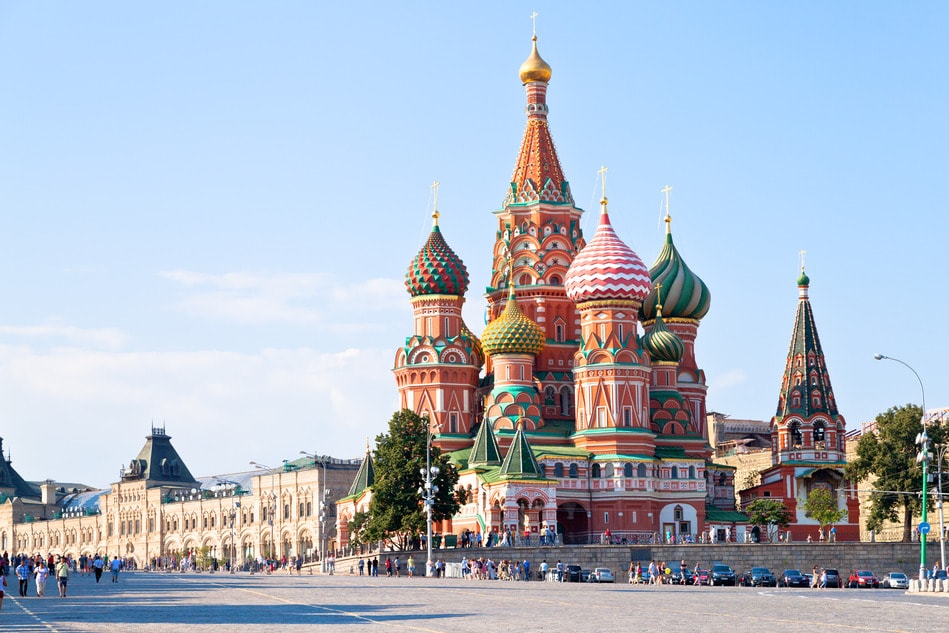
The heart of Russia, both geographically and symbolically. The square is larger than photographs suggest, bounded by the Kremlin walls, the GUM department store, the State Historical Museum, and St Basil’s Cathedral.
St Basil’s Cathedral – The iconic onion domes are even more colourful in person. The interior is a warren of small chapels, each decorated differently. RUB 700 (£6).
Lenin’s Mausoleum – The embalmed body of Vladimir Lenin lies in a granite tomb on the square. Viewing is free but hours are limited (Tuesday-Thursday and Saturday, 10am-1pm); no photography, no talking, keep moving. Queues can be long.
GUM – The state department store, a stunning 19th-century glass-roofed arcade now filled with luxury brands. Worth visiting for the architecture even if you are not shopping.
The Kremlin
The fortified complex at Moscow’s centre has been the seat of Russian power for centuries. The current walls date to the 15th century; behind them are cathedrals, palaces, and government buildings.
What to see: The Armoury (royal treasures, Faberge eggs, coronation regalia), the Diamond Fund (imperial jewels), and the cathedral square with its cluster of golden-domed churches.
Entry requires separate tickets for different sections. The Armoury and Diamond Fund need advance booking. Budget half a day minimum. Armoury RUB 1,000 (£8.50); Cathedral Square RUB 700 (£6).
Other Moscow Highlights
Tretyakov Gallery – Russian art from medieval icons to the 20th century. The collection is exceptional – this is where you see the great Russian painters. RUB 500 (£4.25).
Bolshoi Theatre – The legendary opera and ballet venue. Performances sell out months ahead; book well in advance. Theatre tours available for those who cannot get tickets.
Moscow Metro – The metro stations are an attraction in themselves. Komsomolskaya, Mayakovskaya, and Novoslobodskaya are among the most impressive – chandeliers, mosaics, marble columns. A single journey costs RUB 46 (£0.40).
Gorky Park – The central park along the Moscow River, transformed from Soviet-era amusement park into modern urban space. Good for walking, cycling, and people-watching.
St Petersburg
Peter the Great’s European capital feels distinctly different from Moscow – canals, baroque palaces, and a more elegant atmosphere. The city was built on swampland at enormous human cost to give Russia a window to the West, and the ambition shows.
The Hermitage
One of the world’s great museums, housed in the Winter Palace and several adjoining buildings. The collection spans prehistoric artifacts to Impressionist masterpieces; the palace interiors are as impressive as the art. You could spend days here and not see everything.
The main collection takes at least half a day to skim. RUB 800 (£6.80); free first Thursday of each month.
Nevsky Prospekt
The main avenue running through the city centre, lined with shops, cafes, churches, and historic buildings. Walking the full length takes a couple of hours and passes most of the central sights.
Kazan Cathedral – A massive colonnade modelled on St Peter’s in Rome.
Church of the Saviour on Spilled Blood – The multi-coloured, elaborately decorated church built where Alexander II was assassinated. The interior mosaics are extraordinary. RUB 350 (£3).
Singer Building – The former sewing machine company headquarters, now a bookshop and cafe with views over the street.
Palace Suburbs
Peterhof – Peter the Great’s summer palace, famous for its elaborate fountain system. The gardens cascade down to the Gulf of Finland in a display of engineered excess. The palace interiors are gilded and excessive. Worth a half-day trip. Hydrofoil from central St Petersburg takes 30 minutes.
Catherine Palace (Tsarskoe Selo) – The summer residence of the tsars, with the reconstructed Amber Room – an entire chamber decorated in amber panels. The palace exterior is longer than the Winter Palace. About 25km south of the city.
Pavlovsk – Smaller and less crowded than the other palace complexes, with beautiful grounds. Can be combined with Catherine Palace.
White Nights
From late May to mid-July, the sun barely sets in St Petersburg. The city comes alive with festivals, events, and crowds enjoying the strange twilight. The Mariinsky Theatre holds special performances; bridges open at night to let ships through; locals and tourists wander the streets until dawn.
Beyond the Two Capitals
Trans-Siberian Railway
The legendary train journey across Russia – Moscow to Vladivostok takes six days and crosses seven time zones. Few travellers do the entire route without stopping; most break the journey at Lake Baikal, Irkutsk, or other points along the way.
The journey is about the experience rather than the destinations – endless birch forests, tiny stations, conversations with fellow passengers, and the rhythm of train life. Second-class four-berth compartments (kupe) offer the classic experience.
Golden Ring
A circuit of ancient towns northeast of Moscow – Vladimir, Suzdal, Yaroslavl, Sergiev Posad – with medieval churches, monasteries, and a slower pace than the cities. Good for a few days’ exploration by car or organised tour.
Lake Baikal
The world’s oldest and deepest lake, holding 20% of the world’s unfrozen fresh water. The scenery is dramatic; the water is remarkably clear. The town of Listvyanka is the most accessible point; Olkhon Island offers a more remote experience.
Russian Food and Drink
Food
Borscht – Beetroot soup, served hot or cold with sour cream. The quintessential Russian dish.
Pelmeni – Siberian dumplings filled with meat, served in broth or with sour cream.
Blini – Thin pancakes served with caviar, smoked salmon, or sweet toppings.
Beef Stroganoff – Strips of beef in sour cream sauce. Better in Russia than abroad.
Zakuski – Russian appetizers: pickled vegetables, herring, salads, cold meats. The start of any proper Russian meal.
Drink
Vodka – Drinking vodka properly is a ritual: chilled, in small glasses, downed in one, followed by food (typically pickles or bread). Standard brands include Stolichnaya and Russian Standard.
Kvass – A mildly fermented drink made from bread, slightly sweet and refreshing. Sold from street tanks in summer.
Tea – Russians drink tea constantly, traditionally from a samovar with jam stirred in.
Practical Information
Current Situation
Travel to Russia from the UK, EU, US, and many other countries is currently restricted or discouraged. Direct flights are suspended; visas are difficult to obtain; payment systems are disrupted. Check Foreign Office advice and the current situation before planning any trip.
The information below reflects travel conditions in more normal circumstances.
Getting There
Flights – In normal times, major airlines fly to Moscow (SVO, DME) and St Petersburg (LED) from European hubs. Aeroflot operates the most routes.
Train – International trains connect Moscow with Helsinki, Beijing, and other cities.
Getting Around
Between cities – High-speed trains connect Moscow and St Petersburg (4 hours). The Sapsan service is modern and comfortable. Domestic flights serve the vast distances.
Within cities – Metro systems in Moscow and St Petersburg are extensive and cheap. Taxis via apps (Yandex) are safer than hailing on the street.
Visas
Russia requires visas for most nationalities – historically a bureaucratic process requiring invitation letters, registration, and patience. Electronic visas were introduced for some nationalities before recent restrictions. Check current requirements carefully.
When to Visit
May to September – Warmest weather, White Nights in St Petersburg, outdoor life. Peak tourist season.
December to February – Cold (potentially -20°C or below), but winter has its own appeal: snow-covered cities, frozen rivers, and fewer tourists.
November and March – Shoulder season. Variable weather.
Costs
Russia was moderately priced before recent currency fluctuations.
- Hostel dorm: RUB 800-1,500 (£7-13) per night
- Budget hotel: RUB 3,000-5,000 (£25-42) per night
- Mid-range hotel: RUB 6,000-12,000 (£50-100) per night
- Restaurant meal: RUB 600-1,200 (£5-10)
- Metro single: RUB 46 (£0.40)
- Hermitage entry: RUB 800 (£6.80)
Language
Russian, written in Cyrillic script. English is limited outside tourist areas in major cities. Learning the Cyrillic alphabet helps with signs and menus.
Power
Russia uses Type C and F plugs (two round pins). Voltage is 220V. UK visitors need a travel adapter.
Frequently Asked Questions
Do I need a visa to visit Russia?
Yes, most nationalities require a visa to visit Russia. The process historically required an invitation letter, hotel confirmation, and significant paperwork. However, travel from the UK, EU, US, and many Western countries is currently severely restricted due to geopolitical events since 2022. Check your Foreign Office advice and current Russian visa requirements before attempting to plan any trip.
What is the best time to visit Russia?
May to September offers the warmest weather and the White Nights phenomenon in St Petersburg (late May to mid-July when the sun barely sets). Winter (December-February) is extremely cold (-20°C or below) but has its own appeal with snow-covered cities and fewer tourists. Shoulder months (March-April, October-November) have variable weather and smaller crowds.
What currency does Russia use and what are typical costs?
Russia uses the Russian Rouble (RUB). Before recent currency fluctuations, costs were moderate: hostel dorms RUB 800-1,500 (£7-13), mid-range hotels RUB 6,000-12,000 (£50-100), restaurant meals RUB 600-1,200 (£5-10). The metro is excellent value at RUB 46 (£0.40) per journey. Note that Western payment systems may not work due to sanctions.
Is Russia safe for tourists?
In normal times, Moscow and St Petersburg are reasonably safe for tourists with standard precautions. However, current geopolitical tensions make travel from Western countries inadvisable. Most governments currently warn against all or all but essential travel to Russia. If circumstances change, the main tourist areas have lower crime rates than many assume, but always check current travel advisories.
How many days do you need in Russia?
For just Moscow and St Petersburg, allow 5-7 days (2-3 days per city). Add time for the Trans-Siberian Railway (6 days Moscow to Vladivostok, plus stops), the Golden Ring towns (2-3 days), or Lake Baikal (3-5 days). Russia’s vast size means distances are considerable – plan accordingly and allow buffer time for connections.
Can you visit Russia without speaking Russian?
English is limited outside tourist areas in major cities. Learning the Cyrillic alphabet helps significantly with signs, menus, and metro navigation. Basic Russian phrases are useful. In tourist hotels, museums, and organized tours, you’ll usually find English speakers, but independent travel requires more preparation and patience with the language barrier.
Related
- China
- Mongolia
- Finland
- Baltic States
- Search flights & hotels on lastminute.com