Places to Visit in France: Travel Guide

France rewards visitors in ways that other countries simply cannot match. The places to visit in France are endless – I have returned repeatedly over the years – to Paris for museums and food, to Provence for lavender and villages, to the Alps for skiing, to Normandy for history – and each trip reveals something new. This is a country where every region has its own character, cuisine, and wine; where a two-hour train ride takes you from the streets of Paris to medieval villages that feel completely unchanged.
The French approach to living well is embedded in everyday life: long lunches, excellent bread, farmers’ markets in every town, cheese so varied you could eat a different one every day for a year. It can feel formal and difficult at first – the language barrier is real, and Parisians do not suffer fools gladly – but persist and France opens up into one of the most rewarding travel destinations in the world.
Paris
The capital needs little introduction. It is one of those cities that lives up to its reputation – genuinely beautiful, culturally overwhelming, and endlessly interesting. A week barely scratches the surface; a lifetime might not be enough.
The Eiffel Tower
The iron tower is as impressive in person as photographs suggest. The views from the top are spectacular; the queues can be brutal. Book tickets online in advance (EUR 29 / £25 for the summit by lift) to save time. The Trocadero gardens across the river offer the classic view.
At night, the tower sparkles for five minutes on the hour from sunset until 1am – watch from the Champ de Mars below with a bottle of wine.
The Louvre
The world’s largest museum could occupy days. The glass pyramid entrance, the Mona Lisa (smaller and more crowded than expected), the Winged Victory, the Venus de Milo – these are just the famous pieces. The Egyptian antiquities, the French paintings, the decorative arts collections – all are exceptional.
Entry EUR 17 (£14.60); free first Sunday of each month. Book timed slots online to avoid the worst queues. Allow at least half a day; serious visitors return multiple times.
Musée d’Orsay
Housed in a converted railway station, the Orsay holds the great Impressionist collections – Monet, Renoir, Degas, Van Gogh, Cézanne. The building itself is beautiful, with its huge clock face overlooking the Seine. Entry EUR 16 (£13.80).
Notre-Dame Cathedral
The cathedral suffered devastating fire damage in 2019 and is undergoing restoration, with reopening planned for late 2024. The exterior remains impressive; the surrounding Île de la Cité is worth exploring regardless.
Montmartre
The hilltop neighbourhood retains a village atmosphere despite the tourists. The Sacré-Cœur basilica offers panoramic views over Paris; the winding streets below have artists, cafes, and the remnants of the bohemian quarter where Picasso and Toulouse-Lautrec once worked. The Place du Tertre is touristy; the backstreets are more rewarding.
The Marais
The historic Jewish quarter turned fashionable neighbourhood has boutiques, galleries, and some of the city’s best falafel (L’As du Fallafel, EUR 8-12 / £6.90-10). The Picasso Museum is here; so are some of Paris’s most elegant townhouses.
Versailles
The palace of Louis XIV lies 40 minutes by train from central Paris. The Hall of Mirrors, the Royal Apartments, and the vast formal gardens represent the height of French baroque excess. The crowds in the palace can be overwhelming; the gardens offer space to breathe.
Entry EUR 21 (£18) for the palace; gardens free except on fountain show days. Book timed slots in advance.
French Riviera
The Mediterranean coast from Nice to Monaco has drawn visitors for over a century – artists, aristocrats, celebrities, and ordinary holidaymakers seeking sun and glamour.
Nice
The largest city on the Côte d’Azur has the pebble beach, the Promenade des Anglais, and an atmospheric old town with narrow streets and markets. The Cours Saleya flower and food market is excellent; the Matisse and Chagall museums showcase artists who worked here.
Nice is expensive but manageable, a good base for exploring the coast. The beach is public and free; a sunbed and umbrella from a beach club costs EUR 20-30 (£17-26) per day.
Monaco
The tiny principality is an exercise in concentrated wealth – superyachts, casinos, and sports cars. The Monte Carlo Casino requires proper dress (jacket for men) and a passport; the minimum bets are high. The palace changing of the guard happens daily at 11:55am; the oceanographic museum is excellent.
The Grand Prix transforms the streets each May, but accommodation prices become astronomical.
Cannes
Known for the film festival in May, Cannes has elegant hotels, beaches (mostly private), and the old town of Le Suquet with harbour views. Outside festival season, it is quieter but still chic.
Antibes and Cap d’Antibes
A walled old town, a covered market, the Picasso Museum in the Château Grimaldi, and the millionaires’ peninsula of Cap d’Antibes with its grand villas. More relaxed than Nice or Cannes.
Saint-Tropez
The fishing village turned celebrity haunt is accessible only by winding coastal road or boat. The port is lined with expensive yachts and expensive cafes; the beaches at Pampelonne are famous. Beautiful but overpriced.
Provence
The interior of southern France moves at a different pace – lavender fields, hilltop villages, olive groves, and some of the country’s best food and wine.
Avignon
The medieval city was once home to the papacy. The Palais des Papes (EUR 14.50 / £12.50) is enormous, austere, and impressive; the famous broken bridge (Pont Saint-Bénézet) is smaller than the song suggests. The old town is walkable and pleasant; the July theatre festival brings crowds and performances.
Aix-en-Provence
A university town with tree-lined boulevards, fountains, and excellent markets. Cézanne’s studio is preserved on the outskirts; the town itself is simply a pleasant place to eat, drink, and wander. The Saturday market fills the old town.
Luberon Villages
The hilltop villages of the Luberon – Gordes, Roussillon, Ménerbes, Bonnieux – are impossibly photogenic. Perched on ridges, built of golden stone, surrounded by lavender and vineyards, they represent the Provençal ideal. Visit early morning or late afternoon when day-trippers have gone.
Lavender
The lavender fields bloom from mid-June to mid-August, reaching their peak around mid-July. The Valensole plateau has the largest expanses; the Sénanque Abbey surrounded by lavender is the classic photograph.
Loire Valley
The château country of central France, where Renaissance kings built extravagant castles along the river. A car makes exploration easier, though guided tours from Tours or Amboise cover the highlights.
Chambord
The largest and most theatrical of the châteaux, with its 440 rooms, 365 fireplaces, and extraordinary roofline of towers and chimneys. The double helix staircase (attributed to Leonardo da Vinci) is a masterpiece of engineering. Entry EUR 16 (£13.80).
Chenonceau
The “ladies’ château” bridges the River Cher with extraordinary elegance. The history involves Diane de Poitiers, Catherine de Medici, and centuries of powerful women. The gardens are formal and beautiful. Entry EUR 16 (£13.80).
Amboise
A smaller town with a château overlooking the Loire and the Clos Lucé, where Leonardo da Vinci spent his final years. The inventor’s workshop has been recreated with models built from his drawings.
Normandy
The northern coast has beaches, seafood, and some of France’s most moving historical sites.
D-Day Beaches
The landing beaches of June 6, 1944 – Omaha, Utah, Juno, Gold, Sword – stretch along the coast near Caen and Bayeux. The American Cemetery at Colleville-sur-Mer, overlooking Omaha Beach, is beautifully maintained and deeply affecting. The Caen Memorial Museum provides comprehensive context.
Give this at least a full day. Guided tours help make sense of the scale and significance.
Mont Saint-Michel
The medieval abbey on its tidal island is one of France’s most recognisable sights. The climb through the village to the abbey is atmospheric; the bay at low tide stretches to the horizon. Visit early morning or late afternoon to avoid the worst crowds. Entry to abbey EUR 13 (£11).
Bayeux
A small town with an enormous tapestry – the 70-metre Bayeux Tapestry depicting the Norman conquest of England, nearly a thousand years old and remarkably preserved.
French Alps
The mountains bordering Switzerland and Italy offer world-class skiing in winter and excellent hiking in summer.
Chamonix
The town beneath Mont Blanc is the most famous Alpine resort. The Aiguille du Midi cable car (EUR 71 / £61 return) takes you to 3,842 metres with views of Mont Blanc and the surrounding peaks. In winter, the skiing includes the Vallée Blanche off-piste descent.
Annecy
A lakeside town with a picturesque old town, canals, and crystal-clear water. Good for summer swimming, hiking, and cycling around the lake. Less frantic than the major ski resorts.
French Food and Wine
Regional Cuisines
Every region has its specialities:
Paris and the North – Onion soup, steak frites, boeuf bourguignon, croissants and pastries.
Provence – Ratatouille, bouillabaisse, aioli, herbes de Provence, rosé wine.
The Southwest – Duck and goose in every form: confit, foie gras, cassoulet. Armagnac.
Normandy – Camembert, cider, calvados, seafood, cream sauces.
Burgundy – Coq au vin, escargots, Dijon mustard, some of the world’s finest wines.
Alsace – Choucroute (sauerkraut with sausages), tarte flambée, Riesling.
Wine Regions
France produces arguably the world’s finest wines, and visiting the vineyards is a pleasure:
Burgundy – Pinot Noir and Chardonnay at their most refined. The Côte d’Or villages produce wines that sell for hundreds per bottle, but village wines at EUR 20-40 (£17-34) are excellent.
Bordeaux – Grand châteaux, blended reds, sweet Sauternes. Tours and tastings widely available.
Champagne – The sparkling wine region around Reims and Épernay, with cellar tours in vast underground caves.
Loire – Lighter wines: Sancerre, Vouvray, Muscadet. Good value and less crowded than the famous regions.
Provence – Rosé dominates, best drunk cold in summer.
Practical Information
Getting There
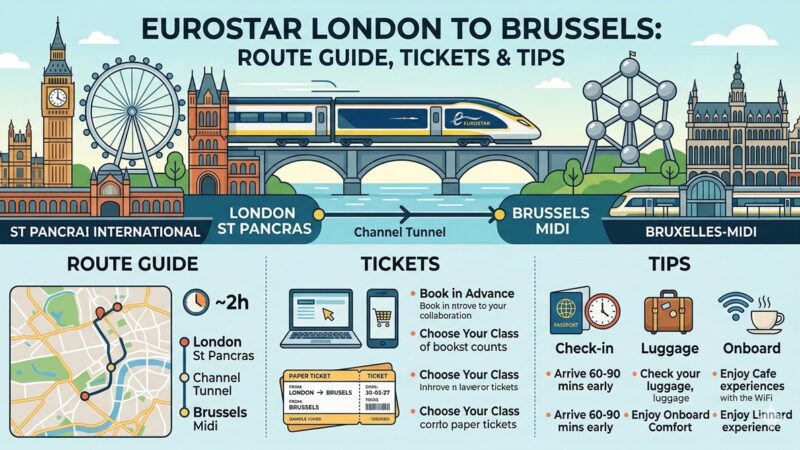
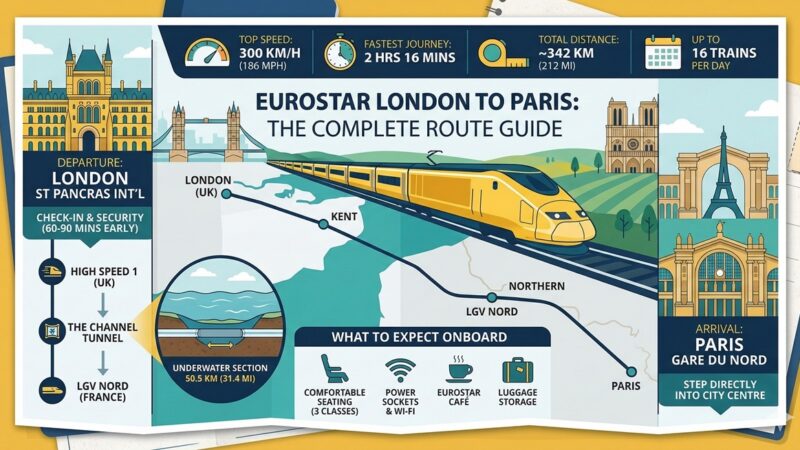
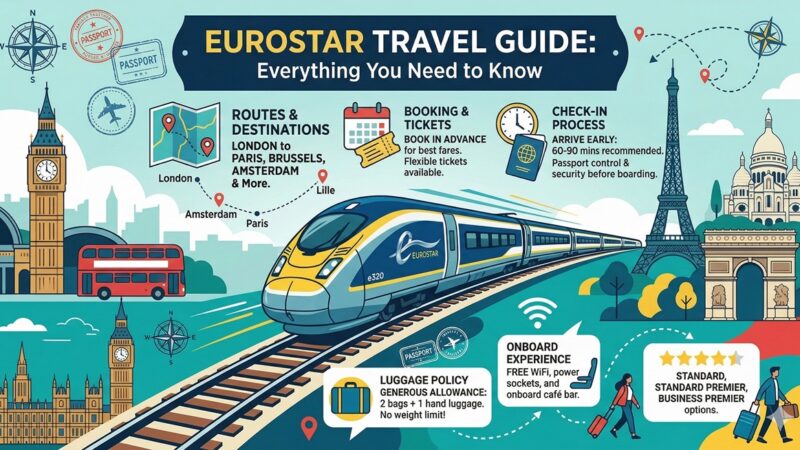
Eurostar runs from London St Pancras to Paris Gare du Nord (2.5 hours). Flights from multiple UK airports serve Paris, Nice, Lyon, and regional cities. Ferries cross from Dover to Calais (1.5 hours) and other Channel ports.
Getting Around
Trains – The TGV high-speed network connects Paris with major cities rapidly: Lyon (2 hours), Marseille (3 hours), Bordeaux (2 hours). Book through SNCF or Trainline; early booking yields significantly cheaper fares.
Regional trains and buses – Slower services connect smaller towns. Essential for areas like Provence without TGV service.
Driving – A car is useful for wine regions, Provence villages, and the countryside. Autoroutes are efficient but have tolls. French drivers can be aggressive.
When to Visit
April to June – Spring. Pleasant weather, fewer crowds than summer, good for cities and countryside.
July and August – Peak summer. Hot in the south, crowded everywhere, expensive. Parisians take August off; some restaurants close.
September and October – Autumn. Wine harvest, good weather, reasonable prices.
December – Christmas markets, particularly in Alsace.
Costs
France is moderately expensive.
- Hostel dorm: EUR 30-50 (£26-43) per night
- Budget hotel: EUR 70-100 (£60-86) per night
- Mid-range hotel: EUR 120-200 (£103-172) per night
- Restaurant lunch: EUR 15-25 (£13-22)
- Restaurant dinner: EUR 30-60 (£26-52)
- Coffee: EUR 2-4 (£1.70-3.45)
- Glass of wine: EUR 4-8 (£3.45-6.90)
- Museum entry: EUR 10-17 (£8.60-14.60)
Visas
France is in the Schengen Area. UK visitors can stay up to 90 days in any 180-day period. Passport must be valid for at least three months beyond planned departure.
Language
French. English is spoken in tourist areas, major cities, and hotels, but far less than in Northern Europe. Basic French phrases are appreciated and sometimes necessary outside tourist zones.
Power
France uses Type C and E plugs (two round pins). Voltage is 230V. UK visitors need a travel adapter.
Frequently Asked Questions
Do I need a visa to visit France from the UK?
No, UK visitors can stay in France for up to 90 days within any 180-day period without a visa as part of the Schengen Area agreement. Your passport must be valid for at least three months beyond your planned departure date.
When is the best time to visit France?
April to June and September to October offer the best balance of pleasant weather, fewer crowds, and reasonable prices. July and August are peak season with hot weather and high prices, especially in the south. December is excellent for Christmas markets, particularly in Alsace.
What currency does France use and should I exchange money?
France uses the Euro (EUR). Credit and debit cards are widely accepted in cities and tourist areas. ATMs are common and usually offer the best exchange rates. It’s worth carrying some cash for smaller establishments, markets, and rural areas.
How much does a trip to France cost?
Budget travellers can expect to spend EUR 80-120 (£69-103) per day on hostels, local food, and public transport. Mid-range travellers should budget EUR 200-300 (£172-258) per day for hotels, restaurant meals, and attractions. Paris is more expensive than other regions.
Is France safe for tourists?
France is generally safe for tourists, though pickpocketing is common in Paris (especially on the Metro, around the Eiffel Tower, and in Montmartre). Stay aware in crowded areas, keep valuables secure, and avoid isolated areas at night. Political demonstrations occasionally occur but are usually peaceful.
Do I need to speak French to travel in France?
While English is spoken in major tourist areas, hotels, and cities, basic French phrases are appreciated and sometimes necessary outside tourist zones. Learning simple greetings and phrases like “Bonjour,” “Merci,” and “Parlez-vous anglais?” significantly improves interactions with locals.