10 Bridges of London

I have walked across most of London’s bridges at one point or another, often without thinking much about them. But one evening, crossing the Millennium Bridge at sunset with St Paul’s Cathedral glowing golden ahead and the Tate Modern industrial and imposing behind, I understood why people photograph these crossings obsessively. Each bridge offers different views, different history, and a different experience of the river that has shaped this city for two thousand years. Here are ten worth knowing.
London is a city of many bridges. In fact, there are over 200 bridges that span the River Thames. While some of these bridges are rather unassuming, others have become iconic landmarks in their own right. Here are ten of the most famous bridges of London.
Tower Bridge
Tower Bridge is the one with the two towers and the lifting roadway – often confused with London Bridge (the boring concrete one next to it). Built 1886-1894, it’s London’s most iconic bridge.
Glass Floor Walkway
The high-level walkways between the towers were built for pedestrians to cross when the bridge was raised for ships. They closed in 1910 because people preferred to wait at street level. Now they’re the main visitor attraction.
The glass floor panels were added in 2014. Standing 42 metres above the Thames while traffic passes below is genuinely unnerving. When the bridge lifts while you’re up there, you can watch the road split apart beneath your feet.
Victorian Engine Rooms
The original steam engines that powered the bridge until 1976 are preserved on the south side. Massive Victorian engineering – impressive even if you’re not into machinery.
Watching the Bridge Lift
The bridge still lifts around 800 times a year for tall ships. Check the published timetable on the Tower Bridge website and time your visit right.
Practical info:
- Hours: 10am-6pm (last entry 5pm)
- Tickets: £12.30 adults, £5.30 children (book online for 10% off)
- Time needed: 1-1.5 hours
- Nearest tube: Tower Hill
Walking across at street level is free – you only pay for the Exhibition.
Westminster Bridge
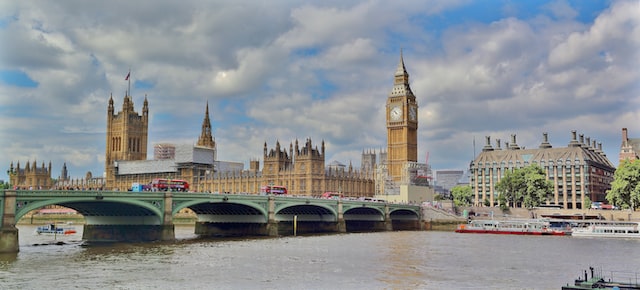
Westminster Bridge spans the River Thames between Big Ben and the Houses of Parliament. It is one of only two bridges in London painted green (the other being Putney Bridge) and offers some of the most recognisable views in the city.
History
Westminster Bridge was designed by Charles Labelye and opened in 1750, the first stone bridge to span the Thames in London. It was replaced in 1862 by a wider iron bridge, then again in 1868 by the current structure, designed by Sir Joseph Bazalgette.
Views
One side faces Big Ben, the Houses of Parliament, and St Margaret’s Church. The other looks toward the London Eye and County Hall. Walking across at dusk, when the Parliament buildings are lit up, is one of the better free experiences in London.
3. Millennium Footbridge

The Millennium Footbridge — the Wobbly Bridge — connects the South Bank with the City of London.
It opened on 10 June 2000, wobbled alarmingly under foot traffic, and closed two days later. It reopened in February 2002 after £5 million of damping work.
The view looking north frames St Paul’s Cathedral perfectly, which is why it appears in so many London photographs.
Crossing is free.
4. Lambeth Bridge
Lambeth Bridge opened in 1932, designed by Sir George Humphreys. It is one of only two bridges in London painted red (the other is Tower Bridge, which is actually red and blue). At 1,220 feet (372 metres) it spans from the north end of Albert Embankment to Lambeth Palace Road.
Looking north from the bridge you see the Houses of Parliament and Big Ben. Looking south, the Tate Britain stands on the north bank with Lambeth Palace on the south.
5. Vauxhall Bridge
Vauxhall Bridge was designed by Sir Alexander Binnie and opened in 1906. The original iron bridge was replaced with a steel structure in 1939. Over 50,000 vehicles use it daily, and there are pedestrian walkways and cycle lanes on both sides.
6. Chelsea Bridge
Chelsea Bridge has stood on this site since 1858. The current bridge, opened in 1937, is the third to occupy the spot — the first was a suspension bridge by James Walker, too weak for the traffic; the second was a wrought-iron structure by Sir Joseph Bazalgette. The current steel bridge cost £1.2 million and was opened by King George VI.
7. Putney Bridge
Putney Bridge is one of two Thames bridges painted green (Westminster is the other). The current stone bridge, designed by Sir Joseph Bazalgette and built of Cornish granite, opened in May 1886 and replaced a wooden toll bridge that had stood since 1729.
At 709 feet long with eight lanes, it carries over 140,000 vehicles daily. It is also the start point for the Oxford-Cambridge Boat Race each spring.
8. Waterloo Bridge
Waterloo Bridge is a Grade II listed structure, widely regarded as one of the finest bridges in London. Construction began in 1811 to a design by John Rennie and was completed in 1817 — it was briefly the longest-span bridge in the world.
The name followed an unusual path: opened as Waterloo Bridge to commemorate the 1815 battle, renamed Wellington Bridge after Wellington’s death in 1852, then switched back in 1939. The current bridge dates from 1942, rebuilt during the war largely by women workers while men were away fighting.
On a clear day the views stretch from St Paul’s Cathedral east to the City skyline and west toward Westminster.
9. London Bridge
For centuries, London Bridge was the only Thames crossing in the city. The first was a Roman wooden bridge from around 50 AD; the medieval stone bridge, begun in 1209, lasted 600 years and was covered with houses and shops. The current bridge, designed by Harold Knox King and Harold Ingress Bell, opened in 1973. Plain, functional, and often confused with Tower Bridge by visitors.
The area around it has more going on: Borough Market is just south, the Shard looms overhead, and HMS Belfast is moored to the east.
10. Southwark Bridge
Southwark Bridge is quieter and less photographed than its neighbours, which makes it more pleasant to walk across. It connects Southwark on the south bank to the City of London on the north.
History
The first Southwark Bridge was designed by John Rennie and opened in 1819 — the first iron bridge over the Thames. The original was painted green, later repainted red (earning it the nickname “London’s Red Bridge”), then returned to green in 1921. The current paint dates from 1984.
Views
The south end faces Shakespeare’s Globe Theatre. Looking north, St Paul’s Cathedral dominates the skyline. A plaque on the north side lists construction dates and architects for all the central London bridges.
Frequently Asked Questions
How many bridges cross the River Thames in London?
There are over 200 bridges that span the River Thames in London, ranging from iconic landmarks like Tower Bridge and Westminster Bridge to smaller, less famous crossings.
Which is the most famous bridge in London?
Tower Bridge is considered the most famous bridge in London. Built between 1886-1894, it’s an iconic symbol of the city with its distinctive Gothic towers and bascule design that still lifts to allow tall ships to pass.
Can you walk across all of London’s bridges?
Yes, pedestrians can walk across most of London’s bridges including Tower Bridge, Westminster Bridge, London Bridge, Millennium Footbridge, Waterloo Bridge, and Southwark Bridge. Many offer excellent views of the Thames and city landmarks.
What is the oldest bridge still standing in London?
While London Bridge has existed in various forms since Roman times, the current London Bridge dates from 1973. Richmond Bridge, built in 1777, is the oldest Thames bridge still in use in Greater London.
Which London bridge is best for photography?
Tower Bridge offers the most iconic photo opportunities with its Gothic towers and Victorian architecture. Westminster Bridge provides excellent views of Big Ben and the Houses of Parliament, while the Millennium Footbridge frames St Paul’s Cathedral perfectly.
Are London’s bridges free to cross?
Yes, all bridges across the Thames in London are free to cross for pedestrians and most vehicle traffic. There are no tolls on central London bridges.