Eurostar London to Brussels: Route Guide, Tickets & Tips
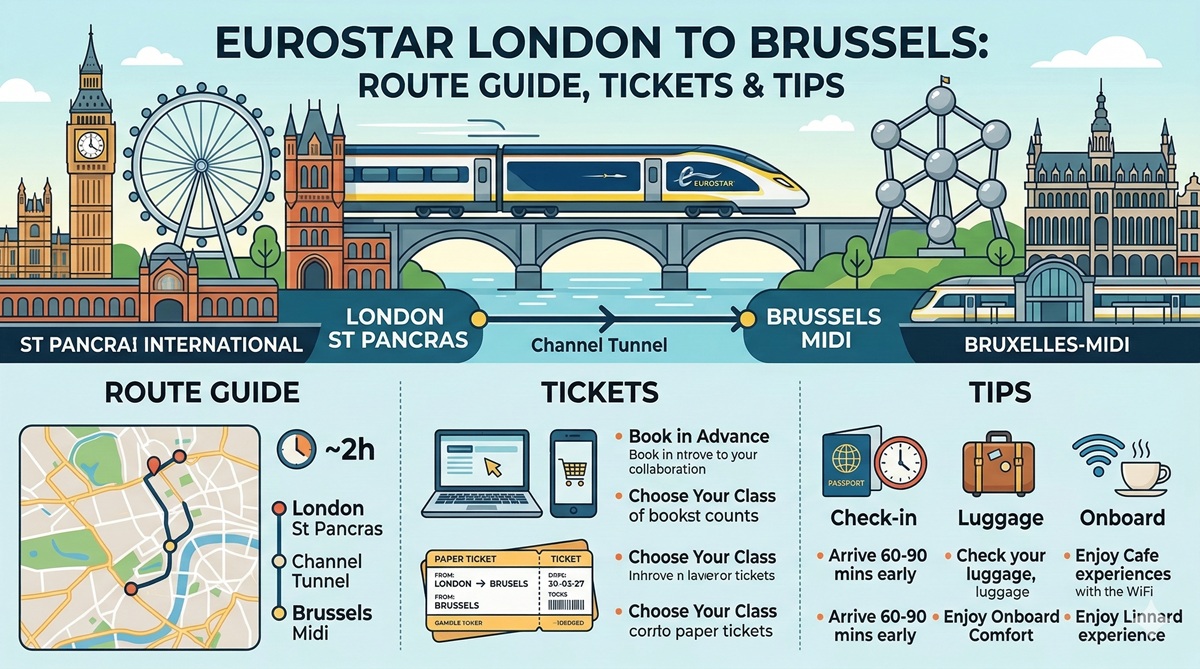
Brussels gets fewer column inches than Paris, and I think that’s partly because it’s harder to pitch. It’s not a postcard city — there’s no single iconic image that sells it the way the Eiffel Tower sells Paris. But it’s one of the best cities in Europe to eat and drink in, it has a genuinely interesting medieval centre, and the journey from London is the shortest of Eurostar’s three main routes: 1 hour 51 minutes, with no changes.
I’ve taken this route a handful of times, mostly for long weekends. It’s fast enough that it barely feels like a trip — you leave London on a Friday morning and you’re sitting in a café in the Grand Place by lunchtime.
Quick facts:
| Departure station | London St Pancras International |
| Arrival station | Brussels-Midi (Bruxelles-Midi / Brussel-Zuid) |
| Journey time | 1 hour 51 minutes |
| Frequency | Up to 10 trains daily |
| Cheapest advance fare | From ~£44 one way |
| Typical advance return | £80–140 |
The Journey
London St Pancras to Brussels-Midi in under 2 hours. The routing is the same as the Paris service through Kent and the Channel Tunnel, but on the Belgian side the train angles northeast after Calais rather than continuing south. You pass through Lille (where a handful of passengers join or disembark) and then run east across the flat Belgian countryside into Brussels.
The tunnel crossing — about 20 minutes — comes roughly in the middle of the journey. Mobile signal cuts out briefly; it returns once you’re in France.
From boarding to pulling into Brussels-Midi, the journey is short enough that you’re unlikely to need much entertainment. A coffee from the bar car, a read, and a glance out the window as the Brussels suburbs appear is about the measure of it.
Brussels-Midi: Arriving and Getting Around
Brussels-Midi (also called Bruxelles-Midi in French and Brussel-Zuid in Dutch) is the main arrival point for international rail in Brussels. It’s the busiest station in Belgium.
A word of warning: Brussels-Midi’s immediate surroundings are grim. The area around the station is not the Brussels you came for. Do not linger here or attempt to judge Brussels by what you see in the first five minutes outside.
Getting from Brussels-Midi to the centre:
- Metro/Premetro: Direct services from Brussels-Midi into the city centre. Line 2 and 6 run from Brussels-Midi. Line 3 (premetro) also serves the station. Journey time to the city centre is about 5–8 minutes. A single ticket costs €2.10; a 10-journey card is €14.
- Train: Brussels has a dense urban rail network. A local train from Brussels-Midi to Brussels-Central (the most central station) takes 3 minutes. Useful if your hotel is in that direction.
- Taxi/Uber: From Brussels-Midi to the Grand Place or Ixelles is typically €12–18. Ubers are available and slightly cheaper. The taxi rank is outside the station — as with most major stations, some touts operate in the arrivals area; use the official rank.
- Walking: The Brussels city centre is about 25 minutes on foot from Brussels-Midi via the Rue du Midi. Perfectly walkable if you’re travelling light.
What to Do in Brussels
Brussels is often used as a gateway to other Belgian cities — Bruges (50 minutes by train) and Ghent (30 minutes) are both easy day trips. But Brussels itself rewards at least a couple of days.
The Grand Place is the centrepiece — one of the finest town squares in Europe, surrounded by ornate guild houses and the Gothic town hall. Visit early morning when it’s quieter, or in the evening when the buildings are lit.
Belgian food is the main event. Mussels and frites at a proper brasserie (the real version, not a tourist-trap imitation), waffles from a street vendor, chocolate from any of the dozens of artisan shops in the centre, and beer — Belgium produces over 1,500 distinct beers, and the specialist beer cafés in Brussels stock a significant proportion of them.
The Comic Strip Museum (Musée Belge de la Bande Dessinée) is genuinely worth a visit, even if you’re not a comics fan. It covers Tintin, the Smurfs, and the Belgian tradition of bande dessinée in a beautifully converted Art Nouveau department store building.
Ixelles and Saint-Gilles are the neighbourhoods worth wandering for restaurants, independent shops, and a feel for where Brussels actually lives. The Art Nouveau architecture in these areas — Brussels had a pivotal role in the Art Nouveau movement — is among the best in the world.
Tickets for London to Brussels
Pricing on the London–Brussels route follows the same dynamic model as all Eurostar fares: cheapest well in advance, progressively more expensive as the departure approaches.
- Standard advance: from ~£44 one way; realistic fares of £55–90 one way when booked 6–10 weeks out
- Standard Premier: from ~£85 one way advance; includes full meal service
- Business Premier: from ~£250 one way; full flexibility, lounge access
The Brussels route tends to be slightly less in demand than Paris, which can mean marginally cheaper fares are available closer to departure compared to equivalent Paris trains. Friday evenings and Sunday afternoons still command a premium.
For the full picture on fares, booking windows, and how to find the best prices, see the Eurostar tickets guide.
Seat Classes
All three Eurostar classes — Standard, Standard Premier, and Business Premier — run on the London–Brussels route. The considerations are the same as on the Paris route. On a 1h 51m journey, Standard is completely adequate; Standard Premier’s meal service is a nice touch but a shorter window to enjoy it.
For a full comparison of what each class includes, see the Eurostar seat classes guide.
Check-In at St Pancras
The check-in process for Brussels is identical to the Paris route. You go through UK exit passport control, security, and then Belgian border control before boarding. Arrive 45–60 minutes before departure.
Belgian border officers are generally efficient. The main queue risk on a busy day is French/Belgian passport control, which fluctuates by period.
Full walkthrough in the Eurostar check-in guide.
Baggage
Standard and Standard Premier tickets include two bags plus hand luggage, no weight limit, no liquids restriction. Business Premier: three bags. Everything in the Eurostar baggage allowance guide.
Brussels as a Rail Hub
One of the practical strengths of Brussels as a destination is Belgium’s rail network. From Brussels-Midi or Brussels-Central:
- Bruges: 50 minutes. The medieval canal city is one of Belgium’s most visited destinations, and easily done as a day trip from Brussels (or as your base if you prefer the atmosphere there).
- Ghent: 30 minutes. A university city with well-preserved medieval architecture, less polished for tourism than Bruges and arguably more interesting for it.
- Antwerp: 40 minutes. Belgium’s second city, with a strong café culture and one of the best historic centres in the country.
- Liège: 1 hour. Less visited, more Belgian, with some impressive Romanesque architecture and a good food scene.
- Onwards to France, Germany, Netherlands: Brussels is on the main Thalys/Eurostar/Intercity Express network. Paris Gare du Nord from Brussels-Midi takes 1h 20m on Thalys. Amsterdam from Brussels takes 1h 50m on IC Direct. This makes Brussels a useful base for a longer European trip with no flights involved.
Practical Tips
Get out of Brussels-Midi as fast as you can. It’s not dangerous, but it’s depressing. Take the Metro one stop into the city.
Book a Bruges day trip while you can still get a cheap train ticket. Belgian domestic trains don’t use dynamic pricing the same way Eurostar does, but they can fill up, particularly on summer weekends. Check the SNCB/NMBS website (Belgium’s national rail operator).
Eat well, not cheaply. Brussels has restaurants at every price point, and the temptation to eat in the Grand Place tourist trap zone is strong. Walk one street back and the quality improves and the prices drop.
Beer cafés are not pubs. The tradition in Brussels beer cafés is to sit, order from the extensive list with guidance from the bar, and drink slowly. A 33cl Belgian strong ale often runs 8–12% ABV. Treat them with respect.
Day trips work both ways. Arriving on a Friday and taking a day trip to Bruges on Saturday before returning Sunday is one of the most efficient long-weekend structures on the Eurostar network.
Frequently Asked Questions
How long is the Eurostar from London to Brussels?
1 hour 51 minutes — the shortest of Eurostar’s three main international routes.
How much is the Eurostar to Brussels?
Standard advance fares start from around £44 one way. A realistic advance return is typically £80–140. Business Premier is from ~£250 one way.
Which station does Eurostar arrive at in Brussels?
Brussels-Midi (Bruxelles-Midi in French, Brussel-Zuid in Dutch). Local train, Metro, and taxis connect from here to the city centre.
Do I need to go through passport control for Brussels on Eurostar?
Yes. You clear both UK exit and Belgian/EU entry passport control at St Pancras before boarding. Belgium is in the Schengen Area; UK passport holders can visit for up to 90 days without a visa.
Is Brussels worth visiting for a weekend?
Yes. The food and beer alone justify it. The Grand Place, the Art Nouveau architecture, and the easy day trips to Bruges and Ghent make it one of the better short-break destinations in Europe.
For the full picture on taking Eurostar — routes, tickets, classes, and baggage — see the Eurostar travel guide.