Best Travel Pillow for Kids (2026)
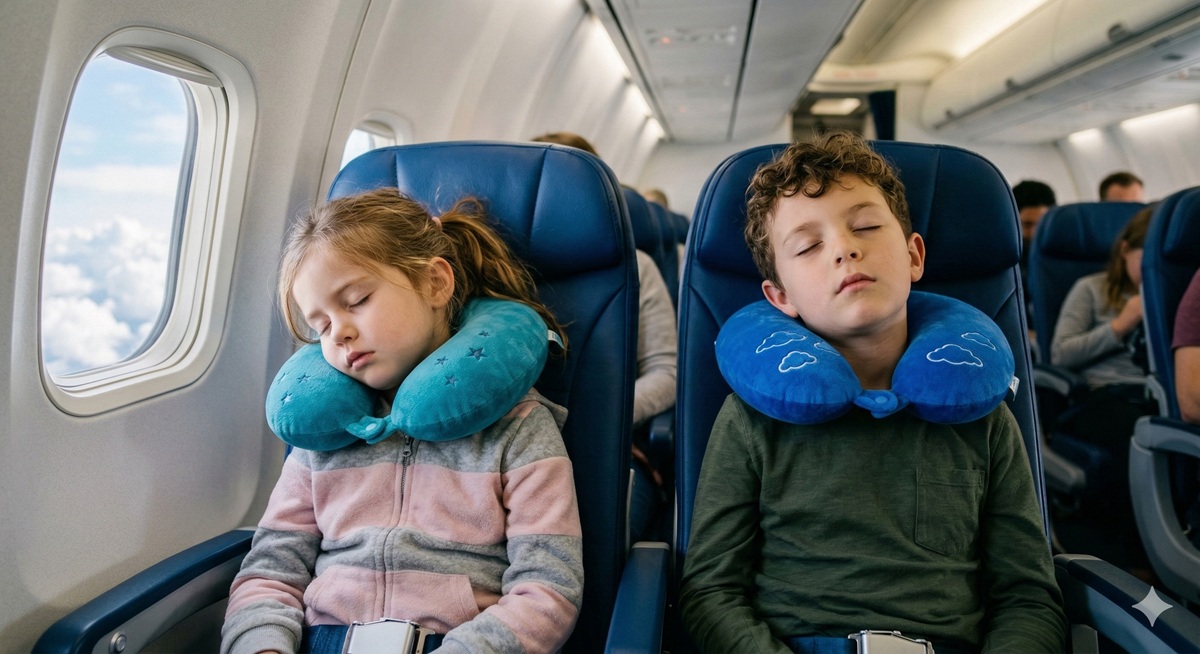
Adult travel pillows do not work on children. A standard U-shaped neck pillow designed for an adult neck is too wide, too heavy, and positions itself at the wrong height on a child’s smaller frame — often sitting around their ears rather than their neck. The result is a child who is more uncomfortable than without a pillow, and a parent who has wasted £25.
Children’s travel pillows are sized for smaller necks, designed for the way children actually sleep on transport (which is rarely upright), and light enough not to be burdensome to carry. Here is what I’ve found works across different age ranges, based on family holidays that have involved some very long-haul routes.
Age Groups: What Each Needs
Children’s travel needs change significantly with age. A pillow that works for a five-year-old is wrong for a twelve-year-old, and vice versa.
Under 3 (Toddlers)
Toddlers on long-haul flights either sleep across a parent’s lap or in a bassinet (for those under 12 months and within weight limits — check with your airline as bassinet availability varies). Standard neck pillows are not appropriate for this age group. A small, soft pillow or rolled blanket to cushion the gap between car seat and window is more useful.
What actually helps for toddlers: a familiar small blanket or comforter from home that provides comfort through smell and texture, not structural neck support.
Ages 3–7
Children in this range are old enough for a small neck pillow but still unlikely to sleep upright in a seat. The most useful products for this age group are hooded travel pillows and lap pillows — soft pillows that create a padded surface for a child to lay their head sideways on a parent’s lap or against the tray table.
Look for machine-washable materials. Children this age are messy travellers. Anything that cannot be thrown in the washing machine after a flight is impractical for regular use.
Ages 7–12
This is where proper kids’ neck pillows become useful. Children in this range can sleep upright or leaning sideways in a seat, and a correctly sized pillow makes a genuine difference on long-haul.
The proportions matter: neck circumference for a 7–10 year old is roughly 25–30cm versus 35–40cm for an adult. Standard adult pillows simply do not fit correctly.
Ages 12+
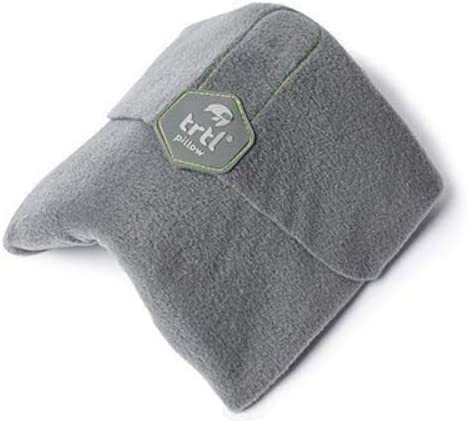
Most children over 12 can use adult pillows, particularly scarf-style options like the Trtl Junior, which is specifically sized for smaller necks and still fits most adults with slimmer builds. Memory foam U-pillows in standard adult sizing may still be too large for younger teenagers — it’s worth measuring neck circumference against product specifications.
Top Picks by Age
Best for Ages 3–7: Kids’ Lap or Hooded Travel Pillow
For young children who will sleep lying down rather than upright, a plush hooded travel pillow creates a comfortable laying surface without requiring a child to hold their head upright. The hood blocks light without a separate sleep mask, which young children often refuse to wear.
Look for: hypoallergenic materials, machine-washable cover, soft fill (not memory foam, which can be too firm for small heads), and a compact carry size. Most good options in this category cost £15–25.
What to avoid: Pillows with hood attached to neck pillow in a fixed position — children this age shift positions constantly and a fixed design restricts movement.
Best for Ages 7–12: Trtl Pillow Junior
The Trtl Junior is the children’s version of the Trtl Pillow — the scarf-style design with internal support frame, sized for children 8+. The proportions are appropriately scaled, the internal frame is lighter than the adult version, and it is machine washable.
The Trtl design works particularly well for children because it prevents forward head drop — the most common way children injure their neck during travel sleep. Children drop off suddenly and heavily when they finally sleep on long flights, and without chin/head support, the forward slump is more severe in a child’s looser-muscled neck than in an adult’s.
Price: Around £30–35 (check current pricing on Amazon and the Trtl website)
Best for: Ages 8–12, upright sleepers, children who sleep suddenly and heavily
Not ideal for: Children under 8 (too large), those who prefer very soft pillows
Best Budget for Children: BUYUE Small Size
The BUYUE travel pillow comes in a Small size (for neck circumferences up to 13 inches / 33cm), which fits many children aged 8 and upwards. At around £20–23, it includes a contoured 3D eye mask and earplugs — a full sleep kit for a child going on their first long-haul.
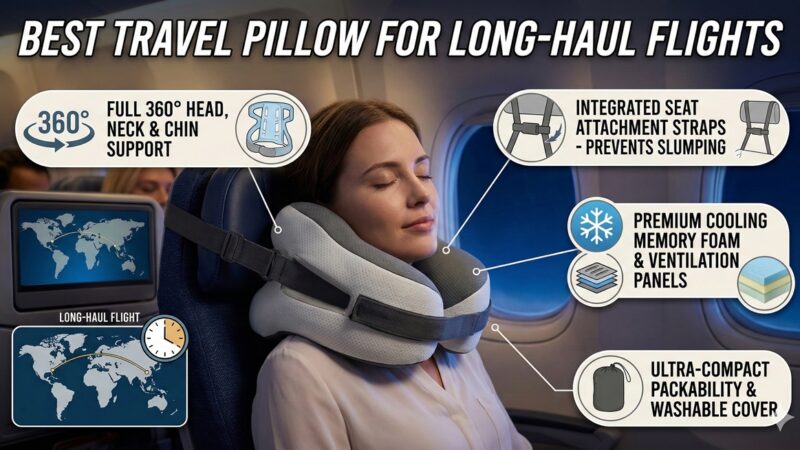
The 360-degree design prevents forward head drop with soft cushioning rather than a rigid frame, which some children find more comfortable than structured options. The micro-velvet cover is soft against skin.
One practical note: the eye mask included is sized for adults. For children under 10, it may sit too large. Worth buying a separate children’s sleep mask if the included one does not fit comfortably.
Price: £20–23 (with accessories)
Best for: Ages 8–12, budget-conscious parents, those wanting a full sleep kit
Not ideal for: Very young children, those who need a firmer support structure
Best Memory Foam for Children: Scaled-Down U-Pillow
For children aged 10+ who prefer soft cushioning over structured support, a small-sized memory foam U-pillow is worth considering. Look for products specifically labelled as children’s or travel-sized rather than standard adult pillows.
Key specifications for children’s memory foam pillows: inner circumference under 30cm (most adult pillows are 35cm+), weight under 250g, removable washable cover. These exist from several brands at £12–20 on Amazon UK.
What to Look for When Buying
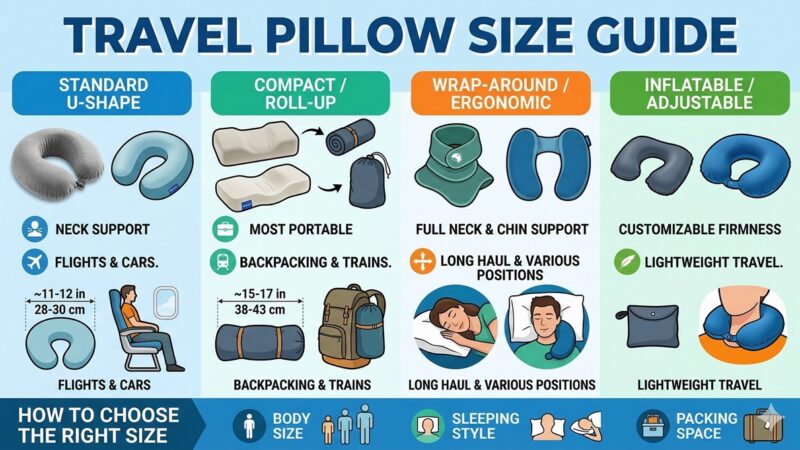
Correct neck sizing. Measure your child’s neck circumference before purchasing. Children’s pillows typically fit necks up to 30–33cm; adult pillows start at 35cm. An oversized pillow sits on the shoulders rather than around the neck and provides no useful support.
Machine washable. Non-negotiable. Children’s travel pillows need to be washed regularly. Any pillow with spot-clean-only instructions is impractical.
Hypoallergenic fill. Children with dust mite allergies or sensitive skin should avoid pillows with natural fills (down, wool). Memory foam, TPU, and synthetic polyester fills are typically hypoallergenic.
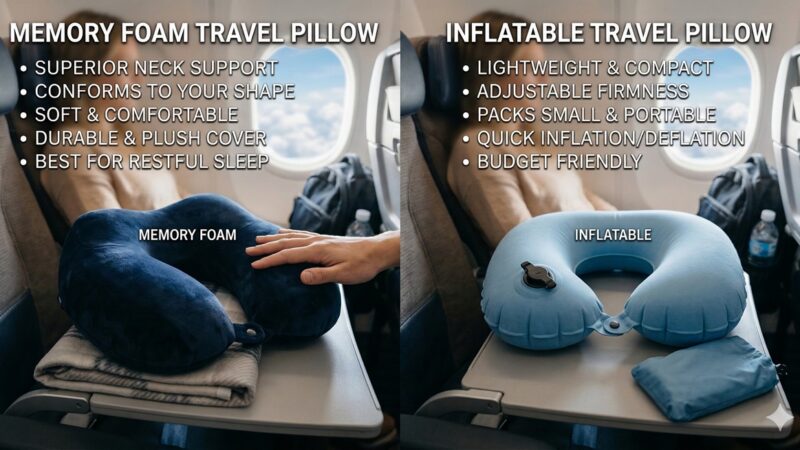
Weight and bulk. Children often insist on carrying their own bag (until they don’t). A bulky pillow clipped to a child’s backpack becomes a source of complaint within minutes. Inflatable or scarf-style are the most packable; foam U-pillows the least.
Safety. Avoid pillows with rigid protruding parts or sharp edges — internal frames should be fully enclosed. Look for CE marking on products sold in the UK.
Seat Setup for Children on Long-Haul
Getting a child’s sleeping position right matters as much as the pillow itself.
Book a window seat for children who will sleep. The same logic applies as for adults: a window gives them a surface to lean against and keeps them from being disturbed by other passengers. On a long-haul overnight, the window seat is significantly better for a sleeping child.
Use a footrest to flatten the seat. Some parents pack a small inflatable footrest that sits under the tray table, raising the floor enough for a child’s legs to extend flat. Combined with a folded blanket on the tray table, this creates a makeshift flat sleeping surface. Airlines have cracked down on full-length inflatable beds that block aisles in recent years, but a small compact footrest is generally acceptable.
Dress for sleep. Comfortable, slightly warm clothing. Layers that can be removed. The aircraft will change temperature multiple times — children feel this more acutely than adults.
Bring their favourite thing. Whether it is a small stuffed animal, a particular blanket, or a familiar toy — comfort objects help children settle into sleep in unfamiliar environments far more effectively than any pillow.
Managing Sleep Timing for Children
Children’s body clocks are more resistant to disruption than adults’, which is both a blessing and a challenge.
On an overnight long-haul, the ideal is to match their sleep timing roughly to the destination. This is easier said than done: children who are excited about a holiday will resist sleep regardless of what time zone they are heading to.
Practical approach:
- Keep them active in the airport and during boarding
- Let them watch their film or use their device for the first hour or two
- Dim their screen and put on their sleep kit (pillow, mask, blanket) approximately when the meal service ends
- Do not force sleep — but create the conditions for it and let tiredness do the rest
For longer routes (Europe to Australia, UK to Southeast Asia), managing a child’s sleep cycle across multiple nights is an entire subject in itself. On a single overnight flight, the above approach works for most children over five.
Long-Haul Routes with Children
The pillow question is just one part of surviving long-haul with children. For the specific destination planning and logistics:
- Thailand holidays — popular UK family long-haul, 11–12 hours
- Bali — 14–16 hours from UK, typically via Singapore or Kuala Lumpur
- Maldives — 10–11 hours
Also see our how to sleep on a plane guide for the full in-flight sleep approach — most of the adult strategies apply to children with minor adjustments.
Frequently Asked Questions
What age is a travel pillow suitable for?
Most travel pillow manufacturers recommend their standard products from age 3 or above. Under age 3, structured neck pillows are not appropriate — children’s necks in this age group need a different kind of support. From 3–7, hooded lap pillows are more useful than neck pillows. From 8 upwards, properly sized neck pillows work well.
Can my child use my travel pillow?
Most adult pillows are too large for children under 12. The inner circumference of adult U-pillows (typically 35–40cm) means they sit on a child’s shoulders rather than around their neck. The Trtl Junior is specifically designed for children 8+ and is one of the few structured options correctly scaled for smaller necks.
Is the Trtl Pillow safe for children?
The Trtl Junior is designed for children 8+. The internal plastic frame is fully enclosed in the fleece wrap. It has been tested and sold as a children’s product with a safety record. Ensure you choose the Junior version rather than the standard adult Trtl, which is too large.
Do children’s travel pillows go in hand luggage?
Yes — children’s travel pillows are hand luggage items on all airlines. They are personal items and are not counted as a separate bag. Scarf-style and inflatable options take up the least space; foam options can clip to the outside of a child’s backpack.