Eurostar Check-In: What to Expect at St Pancras
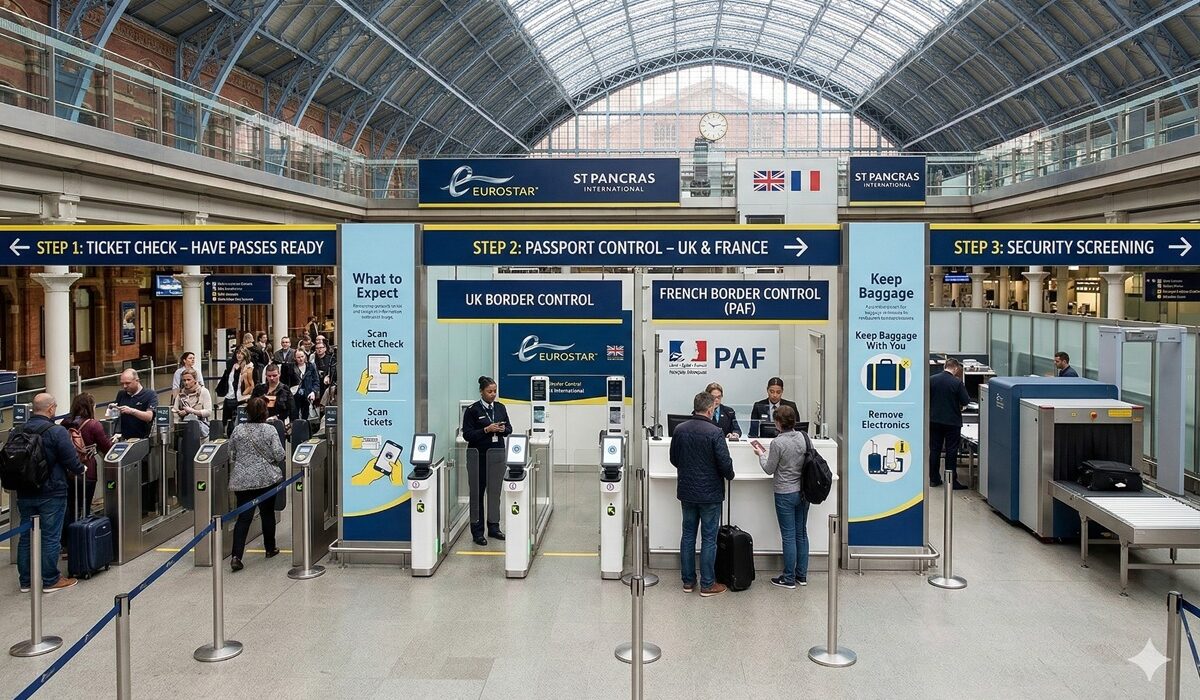
The check-in process for Eurostar is modelled on an airport — there’s a reason they tell you to arrive early. But it’s considerably less chaotic than most airports if you know what to expect. I’ve done it enough times now that it’s routine: arrive 45 minutes before departure, work through the stages in order, and you’ll be sitting in the departure lounge with time to spare.
This guide walks through the whole thing, from arriving at St Pancras to boarding the train.
Where to Go at St Pancras
St Pancras International is the only Eurostar departure point in London. It’s in the same building as King’s Cross St Pancras station — you’ll see both names. The Eurostar international terminal is on the ground floor of the station’s western side.
If you’re arriving by Tube (Northern, Victoria, Piccadilly, Circle, Hammersmith & City, or Metropolitan lines at King’s Cross St Pancras), follow signs to St Pancras International rather than King’s Cross. The Eurostar check-in hall is clearly signposted once you’re inside the station building.
If you’re arriving by taxi or on foot from the Euston Road, the main station entrance on the north side leads you to the Eurostar concourse via escalators or lifts. Allow a few minutes to navigate from the entrance to the check-in desks — it’s not a long walk, but the station is large.
How Early Should You Arrive?
Eurostar’s official recommendation: at least 30 minutes before departure.
My recommendation: 45–60 minutes, without exception.
Here’s why. The check-in process involves two separate passport controls — UK exit and EU entry — plus security. If any one of those queues is long (and French passport control in particular can be slow during school holidays or peak periods), 30 minutes can become uncomfortably tight.
The busiest check-in periods:
- Friday mornings and early afternoons (London outbound)
- Friday evenings (London outbound — very busy)
- Sunday afternoons and evenings (London inbound return — busiest of the week)
- School holiday start and end dates
- Summer peak: July and August throughout
During these periods, 60 minutes is a minimum rather than a comfortable buffer. I’ve seen the French passport control queue alone take 25 minutes on a busy Saturday morning.
Step-by-Step: The Check-In Process
1. Ticket Check-In
Approach the Eurostar check-in hall. Automated gates accept your QR code ticket from the app or a printed ticket — scan it and walk through. If you have any issues (group tickets, name discrepancies), staffed desks are alongside the automated gates.
You don’t need to print tickets. The Eurostar app works reliably — download your ticket offline before you travel so you’re not relying on connectivity at the station.
2. UK Passport Control (Exit)
This is the UK Border Force check. You’re leaving the UK and they’re recording your departure. UK and EU passport holders use automated eGates; most move through quickly. Non-UK, non-EU passport holders go through staffed lanes, which can take longer.
Have your passport open at the photo page. Avoid fumbling with bags — keep it accessible from the moment you enter the check-in hall.
3. Security
Airport-style security: bags go through an X-ray machine, you walk through a metal detector or scanner. Liquids through security are fine — unlike at an airport, there is no 100 ml liquids restriction on Eurostar. You can carry full-size shampoo, wine, or any other liquid through. Bags still go through the X-ray, but liquid volume is not restricted.
What to expect:
- Laptops out of the bag (same as airport security)
- Coats and belts into the tray
- Large bags through the machine — you may be asked to put them on the belt yourself
Prams and pushchairs fold and go through separately. Allow a little extra time if you’re travelling with a buggy.
4. French or Belgian Border Control (EU Entry)
This is the stage that catches most first-time travellers out.
Before you board the train in London, you go through immigration for the country you’re travelling to — France or Belgium (and also the Netherlands, for Amsterdam services). This is an EU external border crossing, and it’s handled on the London side before departure.
French and Belgian border officers check your passport or national identity card. EU and EEA citizens typically move quickly through here. Non-EU passport holders (including UK passport holders since Brexit) go through separate lanes and may be asked about the purpose of their trip, accommodation, and onward plans. Have any relevant documentation accessible: hotel bookings, return ticket confirmation.
Entry requirements for UK passport holders visiting France or Belgium:
- UK passports allow visa-free stays of up to 90 days in the Schengen Area within any 180-day period
- Your passport should have at least 3 months of validity beyond your planned stay
- You may be asked to show proof of accommodation or funds — rare, but possible
Important for the future: The EU’s ETIAS (European Travel Information and Authorisation System) is expected to launch in 2026. Once live, UK passport holders will need to apply (online, similar to the US ESTA) before travelling to Schengen countries. At the time of writing, this is not yet required. Check current requirements at GOV.UK before you travel.
5. The Departure Lounge
After clearing all controls, you’re in the Eurostar departure lounge. This is a secure airside space with seating, shops, food outlets, and toilets. Business Premier passengers have access to the dedicated Eurostar Business Premier Lounge — a quieter, nicer space with complimentary food and drinks.
The departure lounge at St Pancras is reasonably well equipped: a Pret a Manger, a champagne bar (the famous one at the end of the long upper concourse), and several other food and drink options. On busy mornings, it can feel crowded. If you’re in Standard class and you want a peaceful pre-departure coffee, aim to be through security with 30+ minutes to spare so you can find a seat.
6. Boarding
Boarding is announced on screens and by staff in the departure lounge. Eurostar boards by carriage — your carriage number is on your ticket. You’ll queue at the relevant boarding gate and walk down to the train.
Business Premier passengers board first. If you’re in Standard and you have large bags, boarding promptly when your carriage is called is worth doing — the end-of-carriage luggage stacks can fill up quickly on busy trains. See the Eurostar baggage allowance guide for tips on managing luggage at boarding.
Returning to the UK via Eurostar
When you return to London from Paris (Gare du Nord), Brussels (Brussels-Midi), or Amsterdam (Amsterdam Centraal), the check-in process is similar: check-in gates, security, and passport control before boarding.
At Gare du Nord, the UK Border Force runs checks on the French side before you board for London — the same pre-clearance model as St Pancras. You clear UK immigration in Paris, not at London St Pancras, which means you can walk straight out of the train at St Pancras like a domestic arrival.
The queues at Gare du Nord can be longer than St Pancras, particularly on Sunday evenings when everyone is heading back to London. Allow 60 minutes minimum at Gare du Nord on a Sunday. The departure terminal is in the lower level of the station — follow Eurostar signs when you arrive.
At Brussels-Midi, the process is the same: UK Border Force checks before boarding, in the dedicated Eurostar departure area on the lower level of the station.
Tips for a Smooth Check-In
Download your ticket offline before you leave. The Eurostar app stores your ticket for offline access. Don’t rely on loading it on station Wi-Fi at the last minute.
Keep your passport in a jacket pocket. You’ll show it twice in quick succession — once at UK exit, once at EU entry. Having it buried in a bag both times wastes time and frays nerves.
Have your boarding carriage number ready. It’s on your ticket. Knowing it before you reach the boarding gate speeds up the queue.
Go to the toilet before passport control, not after. Once you’re in the airside departure lounge, you’re in a more constrained space. The toilets before security, in the main station concourse, are generally easier to access quickly.
Travelling with children: The process is the same but takes longer. Build in extra time — 75–90 minutes before departure if you have young children and pushchairs. Folded pushchairs go through X-ray, which adds a step to security.
Early morning trains (before 7am): These are quieter through check-in, but getting to St Pancras that early means an even earlier start. If this is your option, consider staying near St Pancras the night before rather than rising at 5am from south London.
What You Cannot Bring Through Security
The same prohibited items as airport security, with the addition of items that are specific to Eurostar’s rules:
- No gas canisters (camping gas, large aerosols)
- No knives with blades over 3 inches
- No e-scooters or hoverboards
- No firearms or replica weapons
Standard prohibited items (anything that would be refused at an airport) apply. The security process is equivalent in thoroughness to an airport X-ray check.
For the full rules on what you can carry — including no-weight-limit baggage, bikes, prams, and customs — see the Eurostar baggage allowance guide.
Frequently Asked Questions
How early should I arrive at St Pancras for Eurostar?
Eurostar recommends 30 minutes. Practically, 45–60 minutes is more comfortable, and 60 minutes is a minimum on busy Friday and Sunday departures or during school holidays.
Do I need to print my Eurostar ticket?
No. The app stores your ticket offline. A QR code on your phone or a printed ticket both work at the automated gates.
Do I need a passport for Eurostar?
Yes. You go through UK and EU passport control before boarding — Eurostar crosses an international border. A passport (or EU national ID card for EU citizens) is required.
What happens at passport control for UK travellers going to France?
UK passport holders are checked at the EU external border by French border officers. You may be asked about your trip — accommodation, return ticket. Stays of up to 90 days in the Schengen Area are permitted without a visa for UK citizens.
Is there a lounge at St Pancras for Eurostar?
Yes — the Eurostar Business Premier Lounge is available to Business Premier ticket holders. It’s a dedicated space with food and drinks, separate from the main departure hall.
Can I take liquids through Eurostar security?
Yes — the 100 ml liquids restriction does not apply on Eurostar. You can carry full-size toiletries, wine, or any other liquid. Bags still go through an X-ray machine.
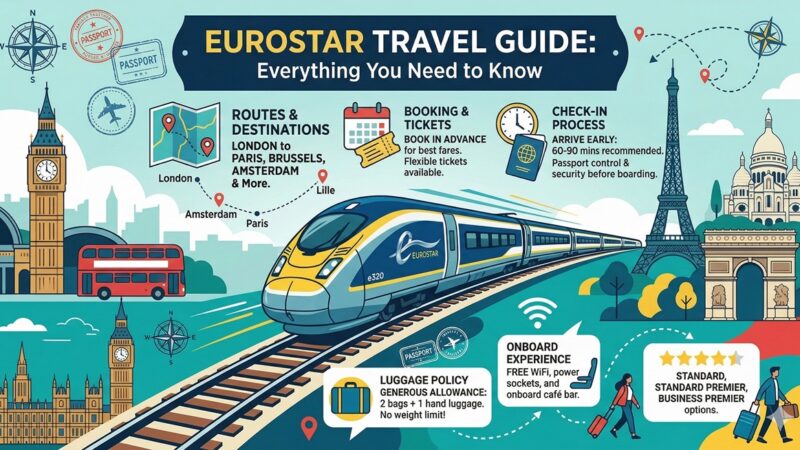
For the complete guide to travelling on Eurostar — routes, tickets, seat classes, and baggage — see the Eurostar travel guide.