Eurostar London to Paris: The Complete Route Guide
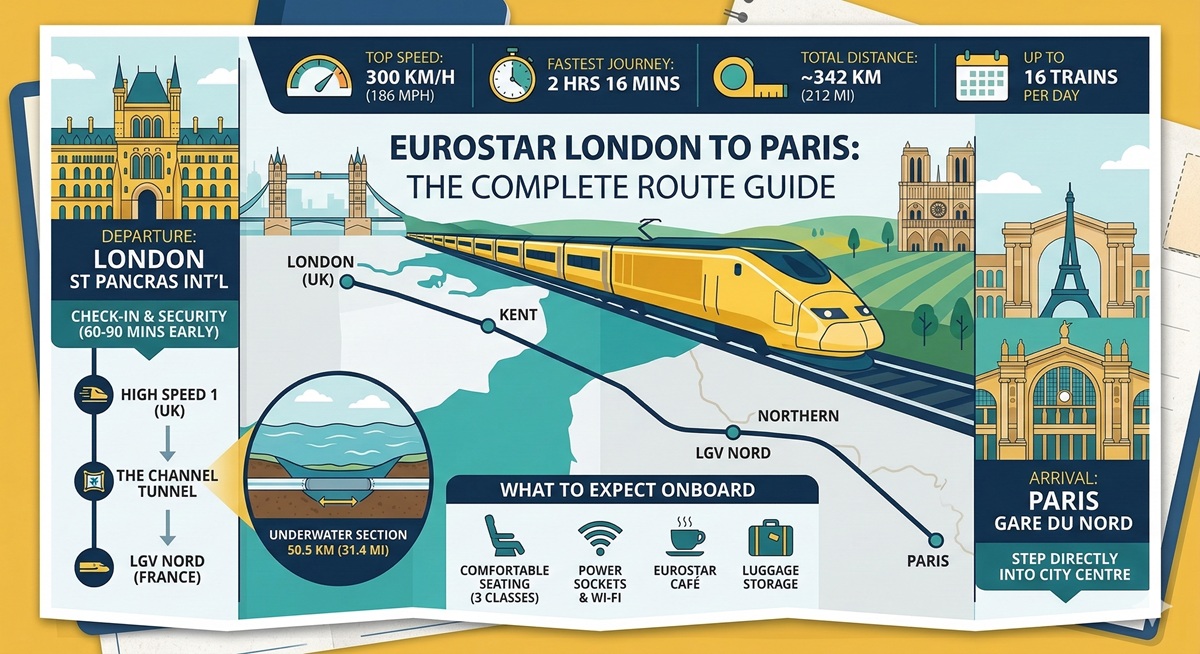
The first time I took Eurostar to Paris, the speed of it surprised me. You leave St Pancras, work your way through south-east London and Kent, drop into the tunnel somewhere after Folkestone, and 20 minutes later you’re in France. Another hour through flat northern farmland, and the train slows into the outer suburbs of Paris. From checking in at St Pancras to standing on the pavement outside Gare du Nord takes about three and a half hours. It’s genuinely quicker than flying once you count the airports.
This guide covers the London to Paris Eurostar in detail — the journey, how to get a decent fare, what the experience is like, and what to expect at both ends.
Quick facts:
| Departure station | London St Pancras International |
| Arrival station | Paris Gare du Nord |
| Journey time | 2 hours 16 minutes |
| Frequency | Up to 18 trains daily |
| Cheapest advance fare | From ~£44 one way |
| Typical advance return | £80–150 |
The Journey
The train leaves from the Eurostar international terminal at St Pancras. After departure, you pass through south-east London before the track opens out through Kent. The landscape is mostly green and rolling — nothing dramatic — before you reach the Channel Tunnel entrance near Folkestone.
The tunnel itself takes about 20 minutes. Lights outside the window drop to black and there’s a pressure change you’ll feel slightly in your ears. Phone signal cuts out. It’s dark and slightly odd the first time, perfectly unremarkable after that.
On the French side, the train emerges near Calais and runs south-east through the Pas-de-Calais. The landscape flattens out into broad agricultural plains. It’s not stunning scenery, but you’re only on this stretch for about 80 minutes, and the time passes quickly. Wi-fi works through here, though it can be patchy.
As you approach Paris, the speed drops and the outskirts appear — low-rise commercial districts, suburban housing. Then Gare du Nord: covered in glass and iron, busy, slightly chaotic. You’re in the 10th arrondissement of Paris, a short walk from the Grands Boulevards and a Metro ride from virtually anywhere.
Gare du Nord: Arriving in Paris
Gare du Nord is one of Europe’s busiest railway stations, and it feels it. When you step off the Eurostar, follow the exit signs. There’s no passport control on arrival into France — you cleared that at St Pancras before boarding.
From Gare du Nord, your options for getting around Paris:
- Metro: Lines 4 and 5 run from Gare du Nord into central Paris. Line 4 stops at Châtelet, Saint-Michel, and Montparnasse. Tickets cost €2.15 each or €16.90 for a carnet of 10. The Navigo Easy card is the simplest way to load and tap as you go.
- RER B: Runs south to central Paris (Châtelet–Les Halles, Saint-Michel–Notre-Dame) and north to CDG airport. Useful if your hotel is along the B line.
- Taxi / Uber: A taxi from Gare du Nord to most central Paris hotels costs €15–25. Uber is slightly cheaper. The rank is outside the main station exit, though the station can be busy with touts — ignore anyone approaching you inside.
- Walking: The area immediately around Gare du Nord includes Canal Saint-Martin and the 10th arrondissement. If your hotel is in this neighbourhood, you may not need transport at all.
For what to do once you’re there, see our Things to do in Paris guide.
Tickets: How to Get the Best Price
The London to Paris route is Eurostar’s most popular and prices reflect that. The cheapest advance fares start from around £44 one way, but realistic prices depend on how far ahead you book and which day you travel.
When to book:
- 3–6 months ahead: best selection of cheap fares, particularly for popular dates
- 6–10 weeks ahead: usually still reasonable fares available
- 2–3 weeks ahead: prices start climbing, especially on Fridays and Sundays
- Last minute: typically £150–250+ one way
Day of week matters. Friday evening and Sunday afternoon/evening trains are the most expensive because demand is highest. Tuesday, Wednesday, and Thursday departures are almost always cheaper. If you can travel on a Wednesday and return on a Thursday, you’ll pay noticeably less.
Outward vs return fares. Eurostar sells one-way tickets rather than traditional return fares. You buy an outward and a return as separate tickets, which means you can mix and match times — use the cheapest outward fare on your preferred date and pick the cheapest return time rather than being locked into a fixed return.
Book at eurostar.com for the best seat choice and the simplest changes process. Third-party booking sites like Trainline and Omio list Eurostar fares and are sometimes useful for comparison, but check whether they add a booking fee.
For the full picture on fares, classes, and booking strategies, see the Eurostar tickets guide.
Seat Classes on the London–Paris Route
All three Eurostar classes run on the London–Paris route.
Standard is comfortable and completely adequate for a 2-hour journey. You get a standard train seat — wider than an economy airline seat — with a fold-down tray, a power socket, and the standard two-bag allowance with no weight limit. The bar buffet car is open for food and drinks.
Standard Premier adds a full meal service at your seat: a proper three-course meal with drinks included in the fare. The seat itself is the same physical dimensions as Standard on most Eurostar rolling stock (specifically on the e320 trains that run most London–Paris services), but the meal and the service make it feel genuinely different. Worth considering for a morning departure or an evening where you’d otherwise be eating station food.
Business Premier is a wider seat, a premium meal, access to the lounges at St Pancras and Gare du Nord, flexible ticketing (change or cancel without penalty), and priority boarding. The lounge at St Pancras is genuinely good — a quiet space with food and drinks before departure, notably calmer than the main departure hall. If you’re travelling for work and need to change plans at short notice, Business Premier pays for itself.
Full details on what each class includes, the rolling stock differences, and which is worth paying for are in the Eurostar seat classes guide.
Checking In at St Pancras
Eurostar recommends arriving 30 minutes before departure at St Pancras. In practice, 45–60 minutes is more comfortable, and I’d say 60 minutes during school holidays or on busy Friday evenings.
The check-in process works like an airport:
- Go to the Eurostar international terminal on the ground floor of St Pancras (signs are clear)
- Check in at automated gates or staffed desks using your ticket or QR code
- UK exit passport control — show your passport
- Security — X-ray and metal detector. No liquids restriction applies (unlike airports)
- French border control — EU immigration pre-clearance before you board in London
- Departure lounge — seating, shops, the Eurostar lounges for Business Premier passengers
- Boarding — announced by carriage number
The dual passport control (UK exit + French entry) is the thing most people underestimate on their first trip. The French border queue can move slowly during busy periods. Build in the time.
The full walkthrough of the check-in process, including tips on queue times and what to expect, is in the Eurostar check-in guide.
Baggage
Standard tickets include two bags plus a small hand luggage item (handbag, laptop bag), with no weight limit and no liquids restriction. Business Premier gets three bags. You must be able to lift and stow your bags yourself.
The no-liquids rule is worth repeating: unlike flying, you can carry full-size shampoo, wine, or anything else liquid through Eurostar security. No 100 ml limit. Your bags still go through an X-ray, but the restrictions are significantly lighter than at an airport.
For bikes, prams, and oversized items, see the full Eurostar baggage allowance guide.
Tips for the London–Paris Route
Take the tunnel section as your chance to disconnect. Signal goes out for roughly 20 minutes. Use it. Read something, eat something, or just stare at the dark.
Book a window seat on the upper deck. The views through northern France aren’t dramatic, but a window seat on the upper deck gives you a sense of the open landscape. On upper deck, seats on the right side of the train (seats with even numbers heading towards Paris) get morning sun on early departures.
The bar buffet car fills up. On busy trains, the queue for the bar buffet can be long. If you want a coffee and a snack, get up early in the journey before the rush, or bring your own food from the station concourse at St Pancras.
Gare du Nord can be overwhelming. It’s a big, busy station with a history of pickpocketing around the exits. Keep bags on you, ignore tout approaches, and follow the Metro signs rather than accepting help from strangers.
Return timing matters. Sunday evening trains back to London are heavily used by weekend visitors and significantly more expensive. If you can travel back on a Monday or return early Sunday afternoon, you’ll pay less and board a quieter train.
Frequently Asked Questions
How long does Eurostar take from London to Paris?
The standard journey time is 2 hours 16 minutes. There is very little variation between services — Eurostar consistently delivers this time.
How often do Eurostar trains run to Paris?
Up to 18 times a day. The first departure from London is around 6am; the last is typically around 8pm. Frequency is higher mid-morning and afternoon.
How much is the Eurostar from London to Paris?
Cheapest advance fares start from around £44 one way. A realistic return in advance typically costs £80–150 for Standard. Standard Premier and Business Premier are considerably more.
Which station does Eurostar go to in Paris?
Gare du Nord, in the 10th arrondissement of central Paris. Metro lines 4 and 5 connect from here to the rest of the city.
Is Eurostar quicker than flying to Paris?
City centre to city centre, yes. Accounting for airport transfers, check-in time, and the actual flight, Eurostar is typically 60–90 minutes faster door-to-door.
Do I need to book in advance for Eurostar to Paris?
You don’t have to, but you’ll pay more if you don’t. The cheapest fares go weeks or months ahead. Booking the day before or on the day typically means paying £150–250+ one way.
For the full picture on Eurostar routes, classes, and booking, see the Eurostar travel guide.