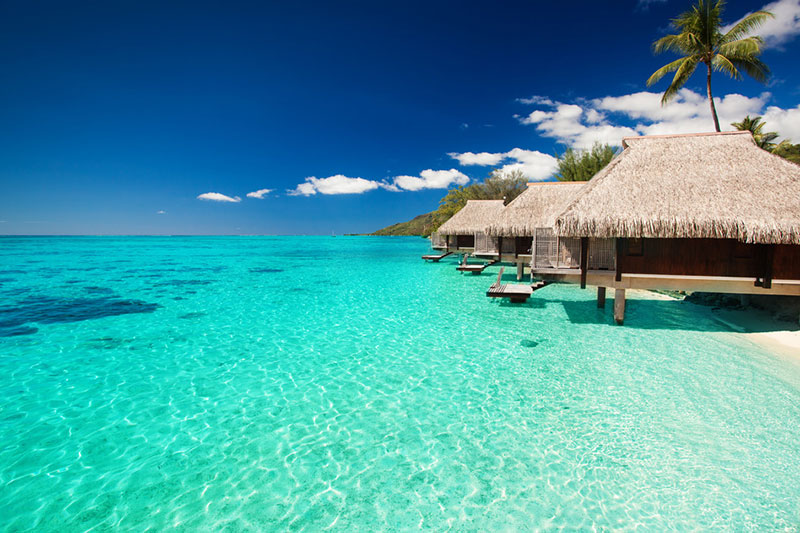
The Maldives ruins you for other beach holidays. Once you have floated in water so clear you can count the scales on passing fish, once you have woken up in an over-water villa with the Indian Ocean lapping beneath your floor, regular beaches just do not cut it anymore. This is not a destination – it is a standard that everything else gets measured against.
Scattered across the Indian Ocean southwest of Sri Lanka, the Maldives comprises nearly 1,200 coral islands grouped into 26 atolls. Only about 200 are inhabited, and roughly 150 host tourist resorts. The geography is unique – these are among the lowest-lying islands on Earth, barely rising above sea level, which makes the whole place feel impossibly flat and endless, nothing but turquoise water meeting blue sky in every direction.
The Resort Experience
Here is how the Maldives works: most resorts occupy their own private island. You fly into Male, transfer by speedboat or seaplane to your resort, and then you are essentially on your own tiny paradise for the duration. No popping out to explore neighbouring towns – there are none. No comparing restaurant prices down the road. Your island is your world.
This sounds limiting, but it is actually liberating. You unplug completely. Days blur into each other in the best way – breakfast, snorkel, lunch, nap, sunset drinks, dinner, stars. The simplicity is the point.
Over-Water Villas
The iconic Maldives experience. These stilted bungalows sit directly over the lagoon, usually with glass floor panels so you can watch fish swimming beneath you, steps leading directly into the water, and private decks for jumping in whenever you fancy. Waking up, opening your doors, and diving straight into the ocean before breakfast never gets old.
Prices vary wildly – budget around $500-800 per night for mid-range options, $1,500+ for luxury brands like Six Senses, Soneva, or One&Only. Most resorts also offer beach villas if you prefer sand between your toes, typically at lower rates.
What All-Inclusive Actually Means
Most Maldives resorts offer various meal plans. Full board covers breakfast, lunch, and dinner but not drinks. All-inclusive usually adds alcohol, soft drinks, and sometimes activities. Premium all-inclusive throws in top-shelf spirits, spa credits, and excursions.
Read the fine print carefully. Some resorts charge extra for the good restaurants even on all-inclusive plans. Others include everything genuinely. Given how captive you are on these islands, understanding what you are paying for matters more here than almost anywhere else.
Choosing Your Atoll
The Maldives stretches over 800 kilometres north to south, and where you stay affects what you experience.
North Male Atoll
Closest to the international airport, so transfers are quick and cheap – often just 20-45 minutes by speedboat. Good house reefs, easy access, and plenty of resort options at various price points. The trade-off is that it is the busiest area, and you might see other boats during excursions.
South Male Atoll
Similar proximity to the airport but slightly quieter. Excellent surf breaks between March and October – Pasta Point, Honkys, and Sultans are legendary among surfers, though most require staying at specific resorts with access rights.
Ari Atoll
About 25-30 minutes by seaplane from Male. This is the place for whale shark encounters – the south of Ari Atoll has year-round sightings, with peak season from November to April. Manta rays are also common. If marine life is your priority, Ari Atoll delivers.
Baa Atoll
A UNESCO Biosphere Reserve with some of the most pristine reefs in the Maldives. Hanifaru Bay here hosts one of the world’s largest gatherings of manta rays during the southwest monsoon (June to November) – hundreds of mantas feeding in a small bay is genuinely one of nature’s great spectacles.
Remote Southern Atolls
Places like Laamu, Gaafu, and Addu are far from Male – requiring domestic flights or long seaplane journeys – but reward you with virtually untouched reefs and near-complete solitude. If your fantasy involves seeing no other tourists, this is where to look.
Diving and Snorkelling
The Maldives consistently ranks among the world’s top diving destinations, and for good reason. Visibility regularly exceeds 30 metres, water temperatures hover around 27-29°C year-round, and the marine life is extraordinary.
What You Will See
Manta rays are probably the main draw – these gentle giants, with wingspans up to four metres, glide through cleaning stations where smaller fish pick parasites from their bodies. Whale sharks cruise through certain channels, especially in Ari Atoll. Reef sharks patrol the drop-offs – whitetip, blacktip, and grey reef sharks are common and completely uninterested in humans.
Beyond the megafauna, the reefs themselves are stunning – hard and soft corals in purples, oranges, and blues, with clouds of anthias, butterflyfish, and angelfish. Night dives reveal hunting octopuses, sleeping parrotfish in their mucus cocoons, and bioluminescent plankton that sparkles when disturbed.
House Reefs
Many resorts have house reefs directly accessible from the beach or jetty. This is genuinely special – no boat required, just grab your mask and fins and go. Some house reefs are better than the excursion sites. When choosing a resort, ask specifically about house reef quality and accessibility.
Diving Costs
Expect to pay $80-120 per dive at most resorts, or $400-600 for a ten-dive package. Full equipment rental adds $30-50 per day. Liveaboards are an alternative – week-long boat trips hitting the best dive sites across multiple atolls, typically $2,000-4,000 depending on the boat and route.
Snorkelling
You do not need to dive to experience Maldives marine life. The shallow lagoons and reef edges are perfect for snorkelling, and many resorts offer guided snorkel trips to channels and outer reefs. If you are not a certified diver, do not let that stop you – snorkelling here is world-class.
Male: Worth a Visit?
The capital packs 150,000 people onto an island of just two square kilometres – one of the most densely populated places on Earth. The contrast with the resort islands is jarring. Narrow streets, motorbikes everywhere, mosques calling prayer five times daily.
Honestly? A few hours is enough. See the Islamic Centre with its golden dome, wander through the fish market where the morning catch gets auctioned, and browse the shops along Majeedhee Magu. It is interesting to see how Maldivians actually live versus the resort fantasy, but do not build your trip around it.
Most visitors pass through Male only for airport transfers. If you have a long layover, it kills time. Otherwise, head straight to your island.
When to Visit
The Maldives has two seasons driven by the monsoons.
Dry Season (December to April)
This is peak season. Northeast monsoon brings calm seas, minimal rain, and the best visibility for diving. Christmas and New Year are especially busy – resorts charge premium rates and book out months ahead. January through April offers similar weather with slightly smaller crowds.
Wet Season (May to November)
Southwest monsoon brings more rain, stronger winds, and occasionally rough seas. But this is also prime manta season in Baa Atoll, best for surfing, and significantly cheaper. Rain typically falls in short bursts rather than all-day downpours, and resorts drop rates by 30-50%. If you are flexible and budget-conscious, wet season is worth considering.
Water temperature stays warm year-round – you will not need a wetsuit, maybe just a rash guard for sun protection.
Getting There and Around
International Flights
Velana International Airport (MLE) in Male is the main gateway. Direct flights operate from Dubai, Singapore, Colombo, and various Asian and Middle Eastern hubs. From Europe, you will typically connect through the Gulf – Emirates, Qatar, and Etihad all serve Male well.
Resort Transfers
This is where costs can surprise you. Transfers are rarely included in room rates and vary dramatically based on distance:
Speedboat – $100-250 return for resorts in North or South Male Atoll. Journey time 20-90 minutes depending on location.
Seaplane – $400-600 return for more distant atolls. These small floatplanes operate only in daylight and cannot fly in bad weather, so late arrivals sometimes mean an overnight in Male. That said, the views are spectacular – flying over the atolls, watching the islands appear as turquoise rings in the deep blue ocean, is properly memorable.
Domestic flight plus speedboat – For the furthest resorts, you fly to a regional airport then transfer by boat. Cheaper than seaplane but more hassle.
Budget your transfer costs separately – they can add $500-1,000 per person to your trip total.
Practical Information
Currency: Maldivian Rufiyaa, but US dollars are accepted everywhere in resorts. You will likely never need local currency unless visiting inhabited islands. Credit cards work at all resorts.
Language: Dhivehi is the local language, but English is spoken fluently throughout the tourism industry. You will have zero communication issues at resorts.
Visas: Free 30-day visa on arrival for most nationalities. Just need a valid passport, proof of accommodation, and return ticket.
Culture: The Maldives is a Muslim country. On resort islands, anything goes – bikinis, alcohol, whatever. But on inhabited local islands, dress modestly (cover shoulders and knees), alcohol is prohibited, and public displays of affection should be avoided. If you visit Male or take excursions to fishing villages, respect local customs.
Tipping: Not traditionally part of Maldivian culture, but resorts often add a 10% service charge. Additional tipping for exceptional service is appreciated but not expected.
Budget Considerations
The Maldives has a reputation for being outrageously expensive, and it can be. But options exist at various price points:
Ultra-luxury ($2,000+ per night): Brands like Cheval Blanc, Soneva, Waldorf Astoria. Private pools, butler service, Michelin-quality dining, the works.
Luxury ($800-1,500 per night): Still exceptional – think Conrad, Anantara, W Maldives. Over-water villas, excellent reefs, multiple restaurants.
Mid-range ($300-600 per night): Increasingly good options. Smaller resorts, potentially beach villas rather than over-water, but still private islands and good diving.
Budget ($100-200 per night): Guesthouses on inhabited islands like Maafushi, Thulusdhoo, or Dhigurah. Local homes converted to simple hotels, local restaurants, excursions to resort-quality dive sites and sandbanks. Not the postcard fantasy, but genuinely good value and more culturally authentic.
Is It Worth It?
That depends entirely on what you value. If your idea of holiday heaven is lying on a pristine beach, swimming with manta rays, and genuinely switching off from the world, the Maldives delivers like nowhere else. The combination of marine life, water clarity, and isolation is unmatched.
If you need cultural stimulation, nightlife, or diverse activities beyond water sports, you will get bored. This is not Bali. There are no temples to explore, no markets to wander, no motorbike rides through rice paddies. It is beautiful emptiness, and you need to be the kind of person who finds that appealing.
For honeymoons, milestone anniversaries, or anyone who just needs to stare at the ocean and decompress completely, the Maldives earns its reputation. It is expensive, yes. But sometimes you get what you pay for.